
What follows is an editorial from Chris Christianson in response to an Op-Ed by Dr. Erin Bendily in Louisiana. Christianson’s words ring as true in Chicago, Nebraska, Florida or California as they do in his home state of Louisiana.
Read Rail safety mandates don’t belong in America’s transportation bill ►
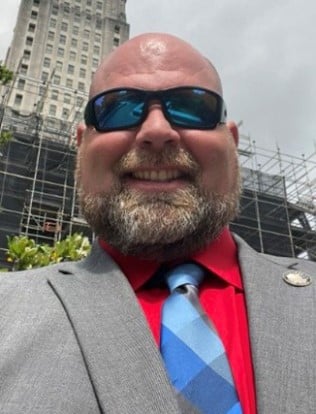
I’m a proud fourth-generation railroader who has spent more than 20 years working the rails for Union Pacific and serve as Louisiana’s Safety and Legislative Director for SMART-TD, the largest railroad union in the country.
Over the years, I’ve watched coworkers lose their limbs. I’ve attended funerals that never should have happened. I’ve seen what happens when safety becomes “at the corporation’s discretion” or “controlled by market factors.” AKA “optional.”
These buzzwords might keep people safe in the simulations run by PhDs in a think tank, but when cost-cutting outruns common sense and when people making safety decisions are far removed from the work, people get hurt or killed.
That’s why I read Erin Bendily’s recent op-ed with more than passing interest. I felt compelled to set the record straight.
In her piece, Dr. Erin Bendily argues that federal rail safety mandates, including provisions of the Railway Safety Act (RSA), are unnecessary, overly burdensome, and potentially harmful to Louisiana’s economy.
She presents her argument as a sober, fact-based analysis, citing regulatory costs, warning against “one-size-fits-all” mandates, and suggesting that market forces, existing rules, and railroad discretion are sufficient to manage safety without additional federal intervention. It is an argument delivered with confidence, credentials, and the language of authority.
The problem? It just isn’t true.
As the Vice President of Policy and Strategy at the Pelican Institute, Dr. Bendily’s analysis rests on spreadsheets, economic models, and regulatory theory.
Mine rests on experience: not anecdotes, not hypotheticals, but decades of watching how railroads behave when safety is left to their discretion.
Here is the truth that never appears in think-tank white papers: rail safety regulations exist because railroads have repeatedly proven that they will not voluntarily choose safety over profit. Every major safety rule on the books today was written in response to blood on the ground, not academic concern.
I have ridden the rear rail car of a two-and-a-half-mile train downhill into a yard at night, in poor lighting, holding my radio as high as I could so the engineer might hear me when I gave instructions or yelled “stop.” I have walked rail beds for miles along adjacent creeks, balancing on uneven rock in the dark, just to reach a mechanical problem. I have worked jobs where a single missed detail could kill someone.
Those realities do not appear in cost-benefit analyses.
Dr. Bendily speaks authoritatively about safety outcomes without ever having to answer a radio call that comes too late. She speaks about efficiency without ever having to explain to a family why someone didn’t come home. She treats safety as a variable to be optimized rather than a baseline requirement for survival.
That is the central flaw in her argument: rail safety is not an abstract policy question. It is a lived condition.
The railroads have enormous financial resources. They employ armies of lawyers, lobbyists, and public relations firms to push back against every safety measure that might cost them money. Groups like the Pelican Institute and “experts” like Dr. Bendily are part of that ecosystem. They make a living providing intellectual cover fire for decisions that look good on earning statements and are catastrophic on the ground.
Let’s be clear: l ‘m not saying Dr. Bendily lacks intelligence or academic credentials. I’m saying she lacks proximity to this topic. When it comes to rail safety, proximity matters.
I’m offering it up that maybe she should not be considered any kind of authority on rail safety legislation in Louisiana. These safety regulations are supported by every craft in the industry, legislators on both sides of the aisle, and Presidents Biden and Trump.
SMART-TD, the union I represent, can (and does) argue publicly and privately about wages, attendance policies, sick time, and quality-of-life issues. Those are legitimate subjects for negotiation and debate. But when the question is whether rail workers survive their shift, the conversation changes.
At that point, it is no longer about ideology or regulatory philosophy, and it sure as hell isn’t time for a PhD at the Pelican Institute to be listened to.
Railroaders are not a line item. We are the people who walk the right-of-way, throw the switches, inspect the equipment, and manage massive, unforgiving machines in conditions most Americans never see.
So when lobbyists, law firms, or think-tank executives insist they know what level of safety is “enough,” they are speaking far outside their depth. They do not bear the consequences of being wrong. We do.
If Dr. Bendily and the Pelican Institute want to debate tax policy or regulatory structure, fine. But when they move into the realm of rail safety and argue against protections designed to keep people alive, they are no longer engaging in neutral analysis. They are choosing how much railroaders’ lives and trackside towns are worth compared to the rate of velocity on the freight we haul.
Rail workers are the experts on rail safety. Full stop. Not because we read about it, but because we live it. No amount of credentialed commentary can outweigh that fact.
This industry has learned repeatedly that safety regulations are written in response to tragedy. Ignoring that history doesn’t make it disappear. It guarantees it will repeat.
That is something we cannot, and will not, accept.
Please look at the RSA and all other rail safety legislation. Take the advice of these “experts” who have never operated a switch and who live in communities far from the tracks with a grain of salt.
As we approach the third anniversary of the Norfolk Southern derailment in Ohio, let’s consider our sources with more scrutiny than we once did. Let’s decide to listen to the guy with actual skin in the game, even if he isn’t wearing a fancy suit. It is time Louisiana and the rest of the country stand up and insist the Rail Safety Act gets the up or down vote on the floor of Congress that it deserves, and that we deserve.
Related News
- Virginia 2-PC Law Could Become a Reality if We Act Now
- WATCH: Members Step Up to Take Care of Their Own
- Fighting for prevailing wage in the shop: Massachusetts union leader explains the offsite fabrication loophole
- Metro Micro Operators Overwhelmingly Ratify First Contract
- General President Coleman’s statement on the shooting of Alex Pretti
- New Documentary Features California Local 1741 Bus Operators
- WATCH: Railroaders Meet Life’s Risks Head-On
- What Does $73.16/Hour Actually Mean?
- “We take care of each other:” SMART Army builds custom wheelchair ramp for TD brother
- Veterans helping veterans: SMART members help build new VA Medical Center in Kentucky