
A Message from Ohio State Safety & Legislative Director Clyde Whitaker
The Night That Changed East Palestine Forever
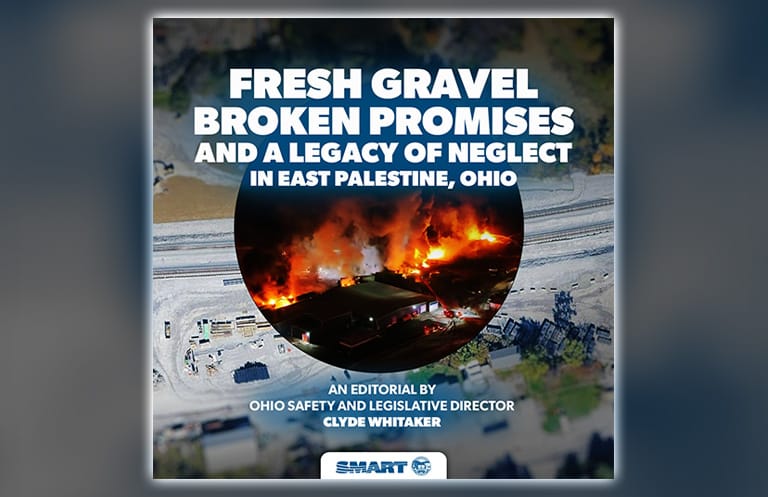
On February 3, 2023, a Norfolk Southern freight train carrying hazardous chemicals derailed in East Palestine, Ohio. Thirty-eight cars jumped the track, fires burned for days, and toxic chemicals filled the air and water around the town. Residents were evacuated, and their lives were changed forever.
Three years later, railroad traffic still rumbles through East Palestine every day, just as it did before. Trains carrying toxic materials go through without pause. People in town still worry about their health and safety. Many haven’t seen the money they were promised from settlement agreements. The pain hasn’t gone away, and it feels like much of America has already forgotten.
Ohio Strengthened Defect Detector Laws
One real safety improvement came from Ohio lawmakers in 2024. After the derailment, the Ohio Legislature passed stronger rail safety requirements, including new rules on railroad wayside defect detectors in the biennial transportation budget signed by Governor Mike DeWine.
The new law requires railroads doing business in Ohio to make sure that wayside detector systems are operational, effective, and adhered to properly.
This change didn’t happen by accident. It was driven by SMART-TD members, our Ohio State Legislative Board, and railroaders across this state who refused to let East Palestine become just another headline that fades away.
Every meeting, every testimony, and every call with lawmakers leaned into a simple message: Ohioans deserve these basic protections. The people of East Palestine deserve them most of all.
Ohio became the first state in the nation to legislate strong defect detector requirements.
That law is real progress. After all, the NTSB traced the cause of the East Palestine crash to a defective wheel bearing that overheated, which is exactly the kind of failure defect detectors are meant to catch.
While the Cloud Was Still in the Air
But here’s the bitter truth: for many railroad crews in Ohio today, that law hasn’t changed how railroads behave.
And I want people to understand how quickly the railroads went right back to business as usual.
Within ten days of the derailment in East Palestine, while the cloud was metaphorically still hanging over Ohio, I received a call from a crew right here in our state.
They told me they had been hit by a hot bearing detector. They were coming close to their 12-hour Hours of Service limit, the federal law that dictates how long a rail crew can continue to move trains or turn a wheel.
Instead of being ordered to stop and inspect, they were told to ignore the detector alarm and keep it moving.
Not long after, they passed another train, and that crew radioed them with the words no railroader ever wants to hear:
A wheel on your train is fully on fire.
Our crew got the train stopped just short of a bridge that runs directly over one of the largest highways in Ohio.
The eyes of the world were still on Ohio’s rails. And even with that level of scrutiny, when the choice had to be made, (stop and inspect, or keep the velocity of that night’s freight moving) the decision was made to roll the dice.
The railroad got lucky that night. The consequences could have been East Palestine-level devastation brought to one of the largest population centers in our state.
They just can’t help themselves.
Even when logic, common sense, and self-preservation all scream that they should be part of the solution, they always go out of their way to chase short-sighted, immediate profits.
New Laws, Same Old Railroads
Over the past three years, SMART-TD members in Ohio have reported that when a wayside defect detector indicates a trending hot wheel or overheated bearing, they are told not to stop the train to inspect it.
Instead, they are ordered to keep going until the next so-called “natural stop,” even when the detector data clearly shows something is wrong.
In some cases, crews have initiated stopping procedures, getting out of throttle and into the brakes, only to be told to keep moving.
This is happening too often.
The safest action, stopping the train to inspect, is denied.
That’s not what we fought for.
That’s not what the people of East Palestine deserve.
One documented case involved a Key Train, which is a hazardous-materials train with federal designation, where two separate defect detectors flagged the same hot wheel location.
Regardless, the crew was told to press on for more than 150 miles to reach their destination without stopping.
One crew member lives in a town that the train passed through. He knew firsthand the danger to his own family and neighbors.
He asked twice to walk his train and inspect the wheel.
Our brother was denied both times.
He did exactly what SMART-TD teaches and what the railroads claim they want us to do: put safety first.
But the railroad put policy and profit ahead of safety.
This isn’t isolated to Ohio or neighboring states like Pennsylvania.
Across the country, conductors and engineers want to stop and check suspected defects. They have scientific evidence from defect detectors that something is wrong.
But they are repeatedly told not to stop, and to keep the train rolling through small towns just like East Palestine.
That’s unacceptable.
And it’s proof that the railroads have short memories.
Three years ago, they promised safety in speeches and press releases.
Their actions say otherwise.
3rd Anniversary Is a Perfect Moment to Take Stock
On this third anniversary of the East Palestine disaster, we must reflect not just on what we’ve learned, but on what’s already been forgotten.
Yes, Ohio passed a law that should make trains safer.
But if the railroads ignore it when it counts, their pledges mean nothing.
SMART-TD is calling on every member in Ohio, Pennsylvania, and across the country to stand firm for safety.
Go on record every time advocating for the safest choice, to stop and inspect. And document it when your request is ignored or denied.
Tell your local union officials. Tell your Safety and Legislative Representatives. Document these incidents.
We need to hold the railroads accountable and prove these aren’t isolated events.
We should also renew our fight for bipartisan federal rail safety legislation, like the Rail Safety Act and other commonsense bills that would protect workers and the public nationwide.
A consistent federal standard would prevent the patchwork of laws that railroads manipulate for gray areas.
Turning Up the Heat
Since 1860, railroads have proven they won’t change because it is the right thing to do.
But some come to the fold because they see the light.
And some because they feel the flame.
On this anniversary of a preventable rail disaster on the Ohio/Pennsylvania border, we must recommit ourselves to turning the heat up on that flame to a point it can never be ignored again.
For ourselves.
For each other.
For the people of East Palestine, whose lives will never be the same.
Clyde Whitaker
Ohio State Safety & Legislative Director, SMART-TD
Related News
- SMART Local 1 signs new contractor to complete specialized workforce request
- RIDER Safety ACT Aims to Curb Transit Assaults Nationwide
- Rail Safety Is Too Important For Corporate Discretion
- Virginia 2-PC Law Could Become a Reality if We Act Now
- WATCH: Members Step Up to Take Care of Their Own
- Fighting for prevailing wage in the shop: Massachusetts union leader explains the offsite fabrication loophole
- Metro Micro Operators Overwhelmingly Ratify First Contract
- General President Coleman’s statement on the shooting of Alex Pretti
- New Documentary Features California Local 1741 Bus Operators
- WATCH: Railroaders Meet Life’s Risks Head-On