
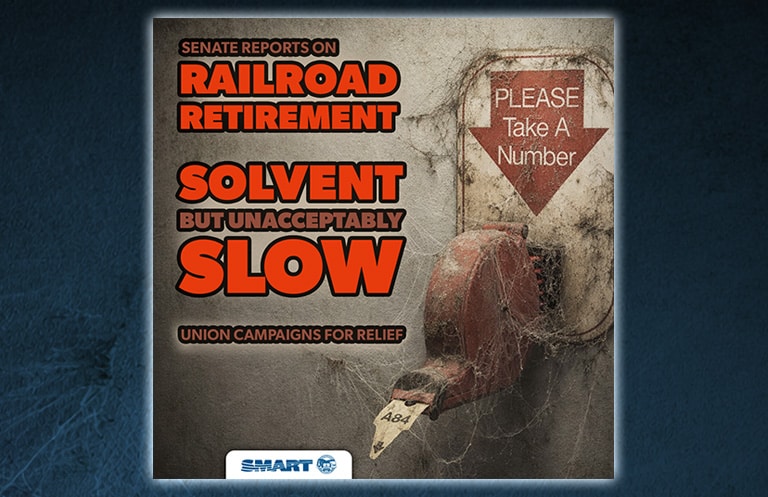
Washington, D.C.— On February 5, 2026, the U.S. Senate Health, Education, Labor, and Pensions (HELP) Committee underscored a critical message for SMART-TD members: Railroad Retirement remains a strong and valuable system, but chronic underfunding of the Railroad Retirement Board (RRB) itself is creating unacceptable service delays that directly harm railroaders and their families.
The Good: RRB Is Much Stronger Than Social Security
Committee Chairman Sen. Bill Cassidy (R-La.) emphasized the system’s long-term financial strength and sustainability, calling it a model for retirement security nationwide.
“The RRB’s trust fund is predicted to continue running smoothly and solvently for 75 years, which is the limit of our projections. It is the gold standard for sustainability.”
Lawmakers from both parties acknowledged that Railroad Retirement provides benefits that far exceed those available under Social Security, particularly for career railroaders.
During the hearing, Sen. Bernie Sanders (I-Vt.), the committee’s Ranking Member, remarked that, “Rail workers who have been on the job for 30 years and retire at the age of 60 receive more than $4,500 a month. That is the good news.”
For working SMART-TD members, this underscores that Railroad Retirement remains one of the strongest retirement systems in the country, rewarding long careers and supporting families in retirement.
The Bad: Chronic Underfunding and Lack of Service
While praising the benefit structure, Sen. Sanders delivered a blunt warning about the consequences of Congress failing to adequately fund the Railroad Retirement Board’s day-to-day office operations.
“The bad news, Mr. Chairman, is that the Railroad Retirement Board budget has been flat for several years. As a result of this insufficient funding, it takes an average of 470 days for the Railroad Retirement Board to determine if a worker is eligible to receive the assistance they need.”
And The Ugly: Real Life Emergencies Met With Long Delays
Those delays have serious consequences for active railroaders, particularly those dealing with injuries, illness, or sudden career interruptions.
Sanders also pointed to the erosion of in-person services, noting that rail workers are sometimes forced to wait up to two and a half hours on the phone to receive assistance. He added that many field offices in rail communities have been forced to shut down or substantially reduce their services.
Even when eligibility is eventually approved, workers are often left waiting far too long for relief.
“And even when it is determined that a worker is eligible to receive disability benefits, it can take 18 months or longer for them to receive those benefits. In my view, that is unacceptable.”
What This Means for SMART-TD Members Still Working
For active railroaders, the hearing confirmed several hard realities. Disability claims can take well over a year, leaving workers and their families in prolonged financial uncertainty. Field office closures and staffing shortages continue to limit access to knowledgeable, in-person assistance when it is needed most. These delays are not caused by the benefit system itself, but by years of flat funding for RRB administration despite growing workloads and increasing demands on the agency.
SMART-TD has consistently warned that underfunding RRB operations harms railroaders at their most vulnerable moments, and this hearing placed those concerns squarely on the congressional record.
What This Means for Retirees and Survivors
For retirees and survivors, the hearing offered both reassurance and caution. The Railroad Retirement system itself remains financially strong, with long-term solvency projections extending 75 years into the future. At the same time, service delays and reduced field office access can complicate survivor claims, benefit adjustments, and major life-event changes. Continued congressional attention is essential to ensure retirees can access the benefits they earned without unnecessary barriers.
Bottom Line for SMART-TD Railroaders
The Senate hearing made one thing unmistakably clear: Railroad Retirement works, and the trust fund is strong. However, the Railroad Retirement Board cannot properly serve railroaders without adequate staffing and funding. We all know that the RRB is self-funded out of our paychecks. The money is there and ready to fix the staffing and technology problems that prevent railroaders from accessing these important services. What the RRB and rail labor are asking is that Congress allow us permission to use these funds to fill the gaps.
SMART-TD will continue pressing Congress to fully fund RRB administrative operations, restore and strengthen field office access, and ensure no railroader or retiree is forced to wait months (or even years) for benefits they have already earned.
Related News
- On-Duty Assault Leaves Amtrak Conductor Facing Financial Hardship
- Transit Equity Day: Remembering Rosa Parks
- Railroads Have Short Memories: East Palestine 3 Years Later
- SMART Local 1 signs new contractor to complete specialized workforce request
- RIDER Safety ACT Aims to Curb Transit Assaults Nationwide
- Rail Safety Is Too Important For Corporate Discretion
- Virginia 2-PC Law Could Become a Reality if We Act Now
- WATCH: Members Step Up to Take Care of Their Own
- Fighting for prevailing wage in the shop: Massachusetts union leader explains the offsite fabrication loophole
- Metro Micro Operators Overwhelmingly Ratify First Contract