
When Brother David Garringer (Local 1393, Buffalo, NY) suffered a devastating, on-the-job injury, his life was turned upside-down.
After five surgeries, doctors told him this past November that his leg would need to be amputated below the knee and prescribed a motorized wheelchair custom-built for his 6’8” frame. There was a major problem: his house wasn’t accessibility-friendly, and his amputation date was getting closer.
“I didn’t see any light at the end of the tunnel,” he reflected.
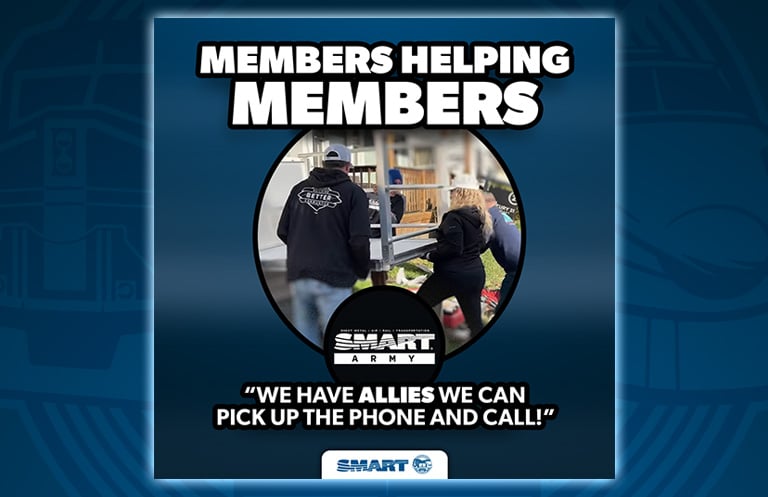
Enter the SMART Army, who built a wheelchair ramp at Brother Garringer’s house to ensure his independence after surgery.
Described as a collective effort from members to give back to one another and their communities by using their skills and abilities, Brother Adam Kerr (Local 71, Buffalo, NY) explains how this effort emphasizes what it means to be a union member.
“The biggest value you can get out of a union is that collective membership that you can lean on. You’re not just co-workers. You are brothers and sisters,” he said.
For Brother Garringer, his experience with the SMART Army was the first time that he felt hopeful in two years.
“We’re not in a tunnel anymore, and we realized we’re not in this alone,” he explained. “I have relatives that are in unions all over…other parts of the country, and…they said ‘Dude, that union you’re a part of is amazing. My union would never do something like that for us.””
Related News
- Members Who Work Federal Holidays Guaranteed Extra Pay Under New Bill
- Safety Starts With Us
- BNSF Seeks Dangerous RCO Waiver
- Mourning the Loss of Brother Benjamin Bicknell
- I’m Not Qualified =’s I’m Not Doing It!
- Train Lengths Would Be Capped Under New Arizona Bill
- Senate Hearing Highlights the Good, the Bad, and The Ugly of RRB
- On-Duty Assault Leaves Amtrak Conductor Facing Financial Hardship
- Transit Equity Day: Remembering Rosa Parks
- Railroads Have Short Memories: East Palestine 3 Years Later