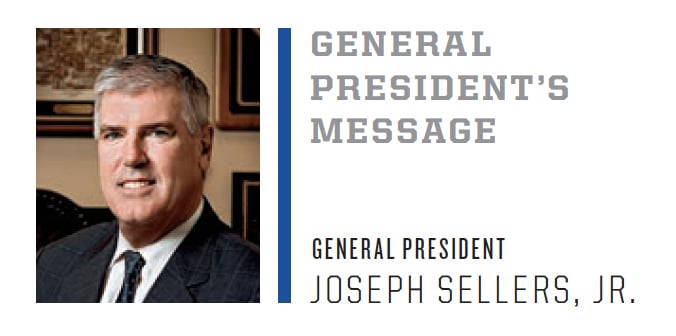
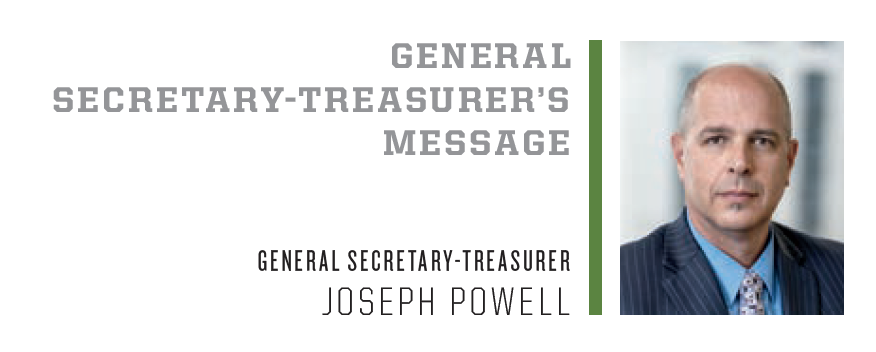
Make no mistake: In the United States, the upcoming midterm election is vitally important to the advancement of the pro-worker agenda. Normally this would sound cliché, but all it takes is a look at current events to understand what our country is facing. Our jobs, our democracy and our families’ futures are on the line, and the decisions that will be made in the coming two years will determine our success moving forward.
The members of our union have made historic progress in the past 21 months. Instead of a cold shoulder for labor and our interests, we now have open door access in the Oval Office and in Congress, giving us a voice on decisions that affect the lives of workers and their families. We now have a seat at the table; we are able to advocate for your livelihood on matters of policy and planning. This new access has paid off. Time after time, our allies in Congress and the current administration did more than elicit words of support; they acted on your priorities as union men and women.
In fact, no administration or Congress since the 1930s has accomplished so much working with labor in so little time. Since January 2021, we have seen the elimination of the Cadillac tax on members’ and retirees’ health care; the strengthening of multiemployer retirement programs and retirement security; the reintroduction of a two-person crew rule that would make the rule of two a federal regulation; and a historic infrastructure package that goes beyond funds for roads and bridges, directing federal resources to critical rail infrastructure improvements — with a real safety review and operator protections — as well as cleaner and safer building indoor air quality (IAQ) work, all of which will deliver thousands of jobs to SMART members. Industry-Recognized Apprenticeship Programs (IRAPs), introduced by the previous administration to undermine our long-standing registered apprenticeship programs, were eliminated. This new administration and Congress prioritized a pro-organizing initiative to ensure that workers looking to form a union and strengthen your collective bargaining power were met with serious support.
The members of our union have made historic progress in the past 21 months.
All of these substantial advances were made because of the work we put in to support pro-labor elected officials from both parties. That includes officials like Don Bacon, a Republican member of Congress from Nebraska who stands with SMART members on the issues that matter to working families, as well as Tim Ryan — a long-time proworker candidate who never forgot his blue-collar values and has spent his career standing up for workers. We don’t look at party label — we look to support those who do more than just promise; who act on our behalf.
Unfortunately, there are special interests who are looking to reverse our gains. A network of anti-worker groups and corporations are quietly funding and assisting those opposed to our values. They want a return to the days when workers had no say in the direction of this nation, and they see themselves as the sole arbiters of what is best for us, our families and our jobs. They care only about their own profit and power. We cannot hand the reins back over to them; we cannot let them rule over our lives and dictate our families’ futures.
We have come far in only 21 months – and we still have ground to cover as we work to make sure working families are prioritized in the halls of power. I urge you to vote on November 8th to secure your future by locking in the gains we have made.
I would like to recognize the hard work from both SMART TD and SMART Rail and Mechanical Department leaders that went into negotiating the new tentative agreements reached with the rail carriers in September. This has been a long and drawn-out process, and at the end of the day, members have something to vote on in the coming weeks.
America invented the semiconductor, but our country produces only 10% of the world’s supply — and none of the most advanced chips. These chips are essential for today’s cars, household appliances and advanced national defense systems and equipment. And yet, for too long the U.S. relied on global production instead of manufacturing chips here at home. But that changed this past August. To address this issue, Congress passed, and the president signed, the CHIPS and Science Act, which will spur billions of dollars in private sector investment.
The law will lead to the construction of semiconductor manufacturing plants across the country, with strong labor standards that require Davis-Bacon prevailing wage rates for facilities built with CHIPS funding. Importantly, these facilities demand the unique expertise and skill set that SMART sheet metal workers are equipped with.
When we elect candidates who ACT on our behalf, rather than just talk, we get laws like the CHIPS and Science Act and the Inflation Reduction Act, and our families and our country benefit.
The private sector has already responded. The week the act passed, companies announced nearly $50 billion in additional investments in U.S. semiconductor manufacturing. Make no mistake, this leads to quantifiable work hours backed by the Davis-Bacon rules and project labor agreements attached to them. SMART workers are already starting to see the reward. Thanks to CHIPS funding, sheet metal workers at SM Local 83 will soon begin working on a new GlobalFoundries chip plant in Malta, New York, and Local 359 members are currently working on an Intel chip plant in Arizona; just two of many megaprojects coming online across the country.
All of this is thanks to the hard work you put in to get our allies in office — elected officials who work with OUR UNION to ensure you benefit from decisions made in Washington, D.C. and the state capitols.
Take the Inflation Reduction Act, for example, which directly benefits seniors and retirees.
Today, the average American pays two to three times what our brothers and sisters in Canada and citizens of other nations pay for prescription drugs. Now, because of the act’s provision allowing Medicare to negotiate prescription drug costs, up to 7 million Medicare beneficiaries could see those costs go down, while 50 million Americans with Medicare Part D will have their costs at the pharmacy capped at $2,000 per year. Additionally, 3.3 million Medicare beneficiaries with diabetes will benefit from a guarantee in the legislation that insulin costs are capped at $35 for a month’s supply.
The act also focuses on building our country’s green energy future. Union members will be tapped to perform new climate infrastructure work through the production of electric vehicle facilities, solar power plants and wind turbines. Many of these facilities have already broken ground across the country, with more projects in the planning phase.
These are investments in America’s future, our families and those who paved the way for current workers. And these life-changing laws result directly from you: your votes for proworker candidates, your solidarity with your union brothers and sisters, and your continued work pressuring elected officials to follow through on their promises.
When we elect candidates who do just that — who ACT on our behalf, rather than just talk — we get laws like the CHIPS and Science Act and the Inflation Reduction Act, and our families and our country benefit.
There will always be issues in any election that may pull you one way or the other. This November, think about what will allow you and your family to live the life that you have earned. The elected officials that voted to bring work back to America and create good-paying union jobs should be given serious consideration.
Please continue to secure your future by voting for SMART allies.
In solidarity,
Joseph Powell SMART General Secretary Treasurer
Dear Brothers and Sisters,
Since my last column, a lot has taken place. Breakthroughs have been made on multiple bus properties and a marathon negotiation session regarding a national freight rail contract has resulted in a Tentative Agreement (TA). The Federal Railroad Administration (FRA) has finally come through for us and issued a Notice of Proposed Rulemaking (NPRM) requiring two-person crews for both freight and passenger rail operations with some exceptions. In-depth details about the National Rail TA are well-documented elsewhere.
Two-person crew NPRM
On July 28th, the Federal Railroad Administration had its NPRM requiring two-person crews on most trains published in the Federal Register, kicking off an initial comment period. Thus far, 10,750+ comments have been received for the rule. This is the most comments FRA has ever received on a proposed rulemaking. I am urging you to submit your comments in support of the two-person crew rule before the deadline, which has been extended to December 2nd, if you have not done so already. Details on how to submit your comments are available on our website at https://www.smart-union.org/2pc.
Now is the time to stand together in support for each other and in solidarity. Let’s keep alert and have situational awareness in all that we do.
There are absolutely ZERO federal regulations preventing one-person crews. This proposed rulemaking puts in place restrictions against one-person crew operations. Though we may not like that the NPRM establishes a waiver process to allow for one-person crews, they are required by law to establish a waiver process for regulations such as this. I know that many are saying on social media and elsewhere that through a waiver process that this NPRM opens the door for one-person crews. I would like you to keep in mind that currently there is NO door.
We are fortunate that FRA has had the foresight to include a provision mandating public input on all waiver requests, while most regulations do not even consider public concern on waiver requests. Even if you don’t like the rule and its provisions, it is important that you comment and tell the FRA how you feel. You don’t even have to submit your name, you can comment anonymously.
Bus industry advances & contracts
While the freight rail contract drew huge headlines and much media attention, our Bus Department is not at rest. Agreements have been reached and voted on and beneficial legislation has also been approved and signed into law.
Members who work for the Los Angeles Metropolitan Transportation Authority (LACMTA) voted at the end of July to ratify a TA negotiated by our Bus Department and GO 875. Members will now enjoy appreciation pay for those who worked through the pandemic along with generous wage increases of 26.6% over the life of the agreement, no changes to employee benefits, updates to sick leave, modifications to work rules and modified disciplinary procedures – the carrier’s board approved it, and the contract is done. Congratulations to the Bus Department, GO 875 General Chairperson John Ellis and his negotiating team on a job well done.
For our members who work for Santa Cruz Metro (SCM), a victory was achieved when California Gov. Gavin Newsom signed S.B. 957 into law, including the property under the umbrella of the state’s Public Employment Relations Board (PERB). The law requires that employers and employees of SCM adjudicate complaints of specified labor violations before PERB as an unfair practice instead of in superior court. By requiring the district to adjudicate claims before PERB, the bill will impose a state-mandated local program that will serve to harmonize relations between SCM management and labor.
Finally, a TA was reached for our membership who work for Charlotte Area Transit System (CATS) and has been voted on. Our membership voted against ratification and the discussions of next steps continue as of this writing. Our Bus Department is committed to gaining an agreement that our members will find acceptable and is scheduled to head back to the bargaining table for further negotiations. We will not give up until we have a TA that addresses the issues our CATS members gave as the reason for voting down the agreement.
Our unfortunate losses
While we celebrate these successes, it is also important to pause and reflect on our challenges as well. Members from both the bus and rail industries have experienced losses since my last column. Our bus members face assaults and harassment from the public on a daily basis, while our rail members are facing unreasonable attendance policies that put our members’ lives at risk and exacerbate fatigue. Tragically, both departments have faced the loss of life of fellow brothers, while on the job, on the way to and from work, and in one case, a member was gunned down just outside his home. These losses are unacceptable to us as a union and to our families who distinctly feel the unimaginable hardship and loss of a husband, wife, father, son or daughter.
Let us take a moment to remember Local Chairperson Kevin Spragg (Local 1420), Ryan Jones (Local 446), Mario Navarro (Local 18), Local Chairperson Richard Keen (Local 1263), Zachery Lara (Local 1846), William “Bill” Laver (Local 556) and Daniel Ruley (Local 61). They will all be missed.
Now is the time to stand together in support for each other and in solidarity. Let’s keep alert and have situational awareness in all that we do. Please stay safe, and God bless.
Fraternally,
Jeremy R. Ferguson President, Transportation Division
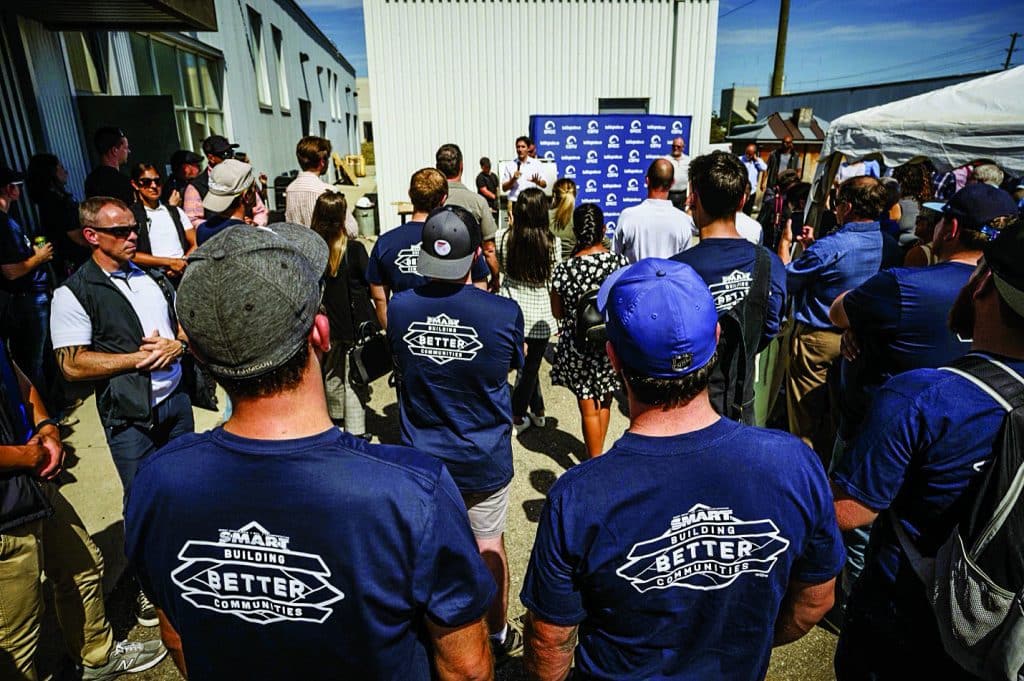
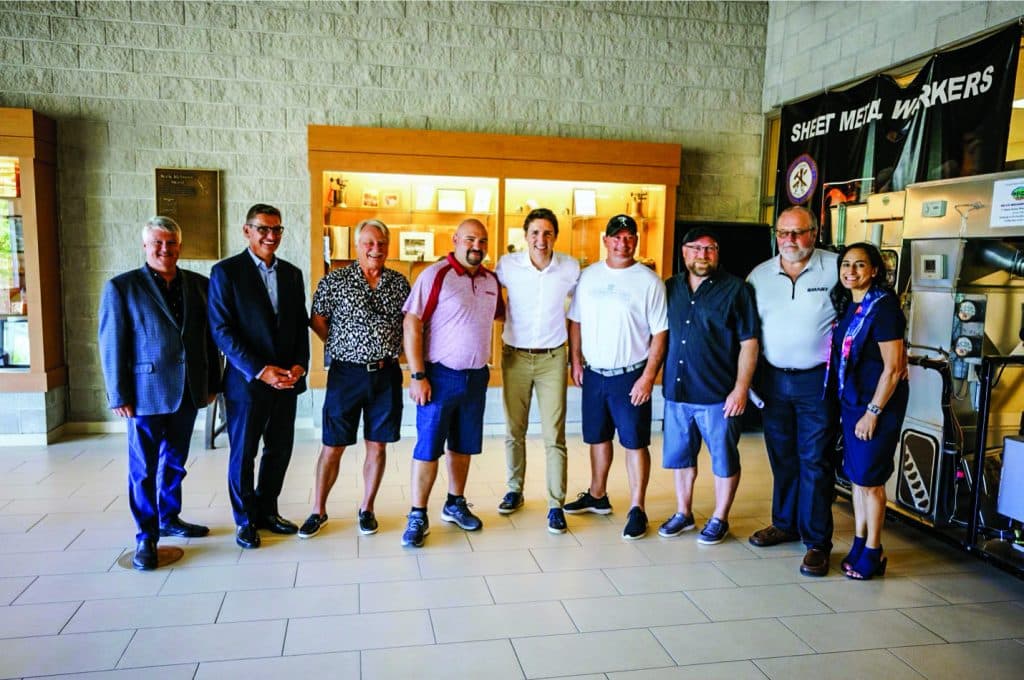
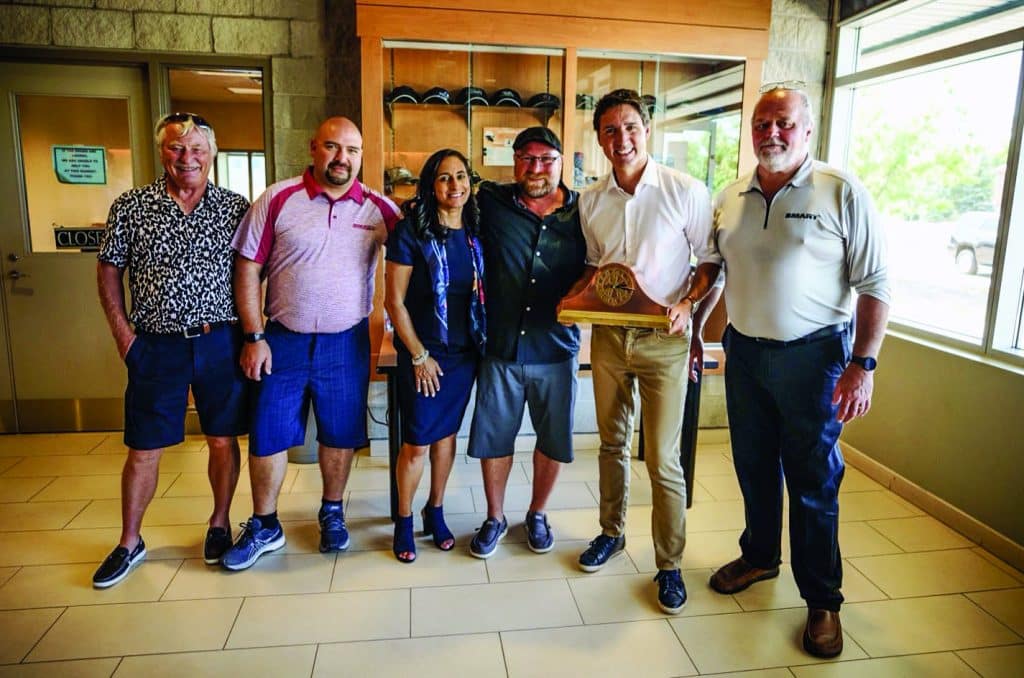
On September 2nd, just ahead of Labour Day 2022, we had the honour of hosting Canada Prime Minister Justin Trudeau, Minister of National Defence and local MP for Oakville Anita Anand, Parliamentary Secretary for Public Safety and local MP for Oakville North-Burlington Pam Damoff, and Parliamentary Secretary for Labour and MP for Sault Ste. Marie Terry Sheehan. They attended a cookout and toured the Provincial Ontario Sheet Metal Workers’ Training Centre (OSMWTC) in Oakville, Ontario.
In his address, Prime Minister Trudeau spoke about the importance of the skilled trades in Canada, thanking trade union members across the country for our work in standing up for a better Canada and recognizing that we are essential partners in how we build a better future for everyone.
During the tour, we emphasized the importance of indoor air quality and verification of proper ventilation. We spoke about the importance of fire dampers and the need for ongoing inspections to ensure that they are properly functioning — and the hazard that could occur when they are not installed correctly. The apprentices attending the centre had the opportunity to give Prime Minister Trudeau a hands-on training experience by taking a flat sheet of metal and producing a length of duct ready for installation. The prime minister was also presented with a copper clock on our behalf.
In his address, Prime Minister Trudeau spoke about the importance of the skilled trades in Canada, thanking trade union members across the country for our work in standing up for a better Canada and recognizing that we are essential partners in how we build a better future for everyone.
In turn, we thanked the government for its recommitment of $84 million to the Union Training and Innovation Program (UTIP). These grants support the Government of Canada’s commitment to strengthen union-based apprenticeship training, innovation and enhanced partnerships.
The UTIP’s objective is to improve the quality of training in the trades to better support a skilled, inclusive, certified and productive trades workforce. It also aims to address barriers that prevent key groups, such as women and Indigenous people, from succeeding in the trades. Our training centres and locals across the country have benefited from the program.
Events like the one at OSMWTC are important for both our union and our country. As Canada sets its target for net zero emissions by 2050 and begins retrofitting all buildings across Canada — and as the COVID-19 pandemic continues to elevate the importance of ventilation, proper fresh air intakes and the increasing of air exchanges — the demand for our highly skilled workers will continue to grow.
At SMART Canada, our members are qualified professionals and certified tradespeople dedicated to all aspects of roofing, architectural cladding, custom sheet metal and complete ventilation systems. Our sheet metal members fabricate and install proper ventilation and air filtering systems to ensure the overall health of our schools, offices, hospitals and homes. Our roofing and architectural members play a vital role in the building envelope by enhancing and protecting the investments of the project.
Pictured Left to Right — Parliamentary Secretary for Labour and MP for Sault Ste. Marie Terry Sheehan, International Union of Painters and Allied Trades General Vice President and Chair of CBTU Robert Kucheran, Management Co-Chair of OSMWTC and Vice President Estimation of Modern Niagara Kim Crossman, Labour Co-Chair of OSMWTC & Business Manager/Financial Secretary-Treasurer of Local 397 Dan Krupa, Prime Minister Justin Trudeau, Provincial Building & Construction Trades of Ontario Business Manager Marc Arsenault, Executive Director of OSMWTC Scott Wood, President of the Ontario Sheet Metal Workers’ & Roofers’ Conference and Business Manager/Financial Secretary-Treasurer of Local 30 Art White and Minister of National Defence and local MP for Oakville Anita Anand.
The building envelope keeps outside elements, such as moisture and humidity, from entering and causing major damage. Envelope components are designed to prevent water leakage or infiltration to the interior by a barrier system that repels and sheds water at the outermost surface. As the building envelope becomes more efficient, the supply of fresh air into buildings is vital.
And most important to the quality of air in buildings is the upgrading and improving of air filtering and HVAC system capacities — another area of expertise for SMART workers. Whether it is cleaning the air within the buildings or cleaning the air before it’s dispersed into the atmosphere, we play an important role to ensure that the air we breathe is fit for human consumption.
Pictured Left to Right — Management Co-Chair of OSMWTC and Vice President Estimation of Modern Niagara Kim Crossman, Labour Co-Chair of OSMWTC & Business Manager/Financial Secretary-Treasurer of Local 397 Dan Krupa, Minister of National Defence and local MP for Oakville Anita Anand, Executive Director of OSMWTC Scott Wood, Prime Minister Justin Trudeau, President of the Ontario Sheet Metal Workers’ & Roofers’ Conference and Business Manager/Financial Secretary-Treasurer of Local 30 Art White.
We must collectively use our expertise and meet with local, provincial and the federal government to be a resource in achieving climate and clean air goals. If we don’t have healthy buildings and healthy homes, we won’t have healthy communities, healthy cities or healthy citizens. We partner with our signatory contractors across Canada to supply generations of hands-on experience and a commitment to safety on every project. Together, we are building strong communities for a better tomorrow — and we need to make sure our governments know.
We want to thank the staff at the Ontario Sheet Metal Workers Training Centre and the Canadian Building Trades Union, and especially all the apprentices and volunteers for hosting Prime Minister Trudeau. A special thanks to Executive Director Sean Strickland, Government Relations Specialist Rita Rahmati and Director of Communications Kate Walsh at the CBTU, Executive Director Scott Wood and Administrative Assistant Tanja Gaytan at the OSMWTC and Carolyn Crosby, administrative assistant at the SMART Canadian office. It was their collective efforts and hard work in making this a successful event. We are truly grateful and appreciative of the opportunity to showcase the skills and the ability of our membership.
The membership of the SMART Railroad, Mechanical and Engineering Department (SMART MD) has voted to ratify a tentative agreement with the carriers, after almost three years of negotiations between the union and the National Carriers’ Conference Committee (NCCC). The vote was passed with a 54% margin in favor of the negotiated contract.
The ratified contract includes historic wage increases, five annual service recognition payments, an additional paid day off and enhanced healthcare benefits. Members will immediately receive a 13.5% wage increase, and members will also receive retroactive pay and $3,000 in service recognition payments within 60 days.
“It was up to our members to decide whether to accept this agreement, and the members have made the decision to ratify a contract with the highest wage increases we have ever seen in national freight rail bargaining,” said Joseph Sellers, Jr., general president of SMART. “However, we hear the concerns of our members who may be disappointed in the outcome of this vote, and I promise that we will never stop fighting to ensure that they receive the wages, benefits and working conditions that they deserve for keeping the American economy running.”
In July 2022, yet another SMART sister earned recognition from North America’s Building Trades Unions (NABTU) for her hard work and proven track record: Annet Del Rosario, a journeyperson out of SMART Local 206 (San Diego, California).
“Her positive attitude and relentless work ethic are infectious to those around her,” said Local 206 in the NABTU press release announcing Del Rosario’s Tradeswomen Heroes Award win. “I can’t think of anyone that deserves more accolades for everything she means to our local and those lucky enough to be around her.”
Del Rosario joined Local 206 in March 2002, committing to the union’s five-year apprenticeship program in August 2003 and turning out as a journeyperson in 2008. Since then, she has worked in the field as well as the shop on the HVAC side; she’s also served several terms as a trustee and an e-board member. In her current position, she is the shop foreman at Able Heating & Air — the first female to fill each position in the local’s history. Del Rosario’s tireless advocacy continues outside of work as well: She created and is president of Building Trades Sisters, an all-female union trades group in San Diego.
“Annet is the shining example of what can be done when someone puts their mind to it,” added the Local 206 press release. “She has always wanted to put in the work to receive the rewards.”
SMART congratulates sister Annet Del Rosario for this well-deserved recognition!
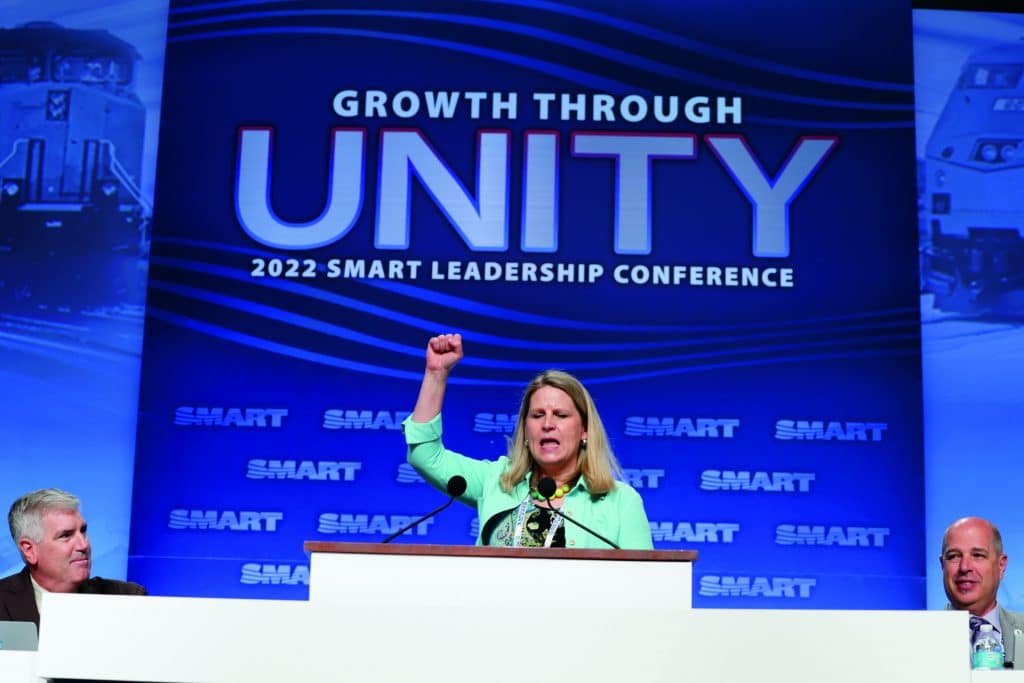
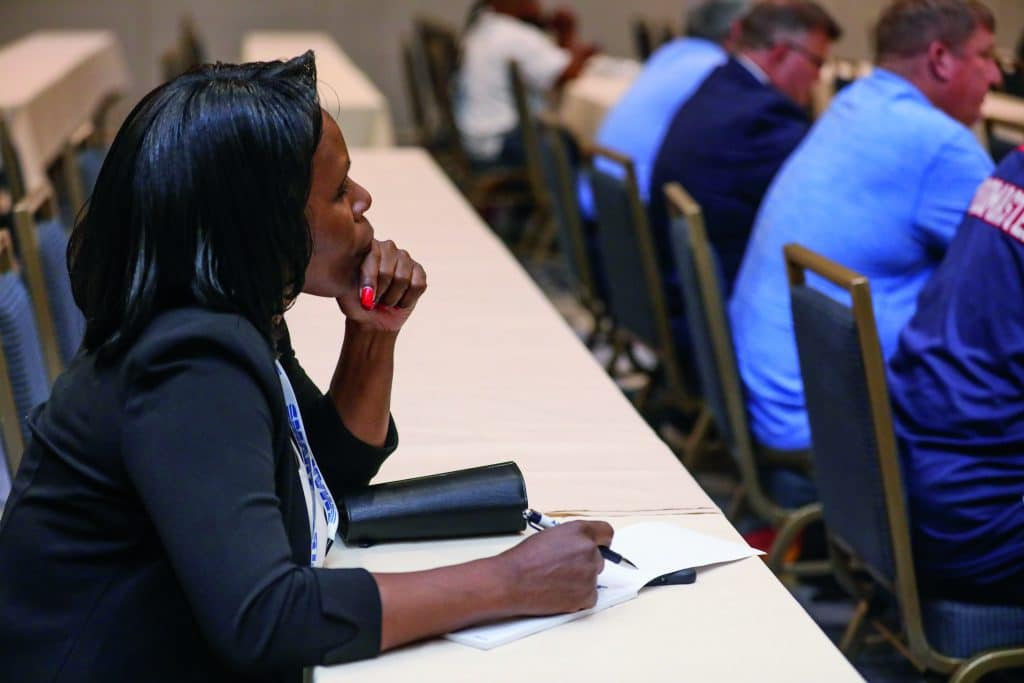
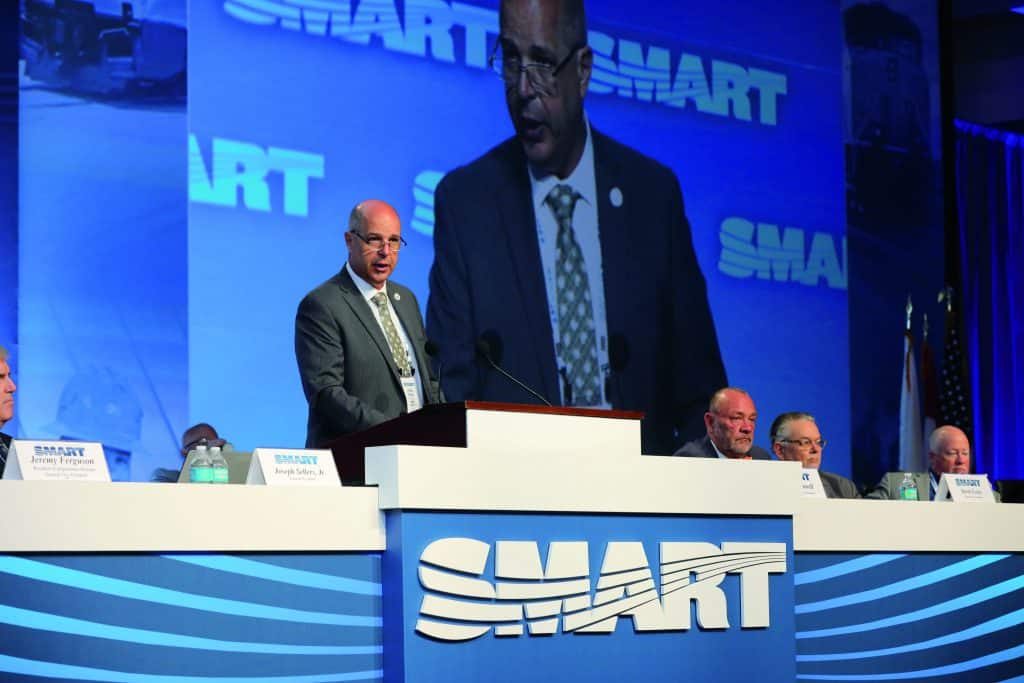
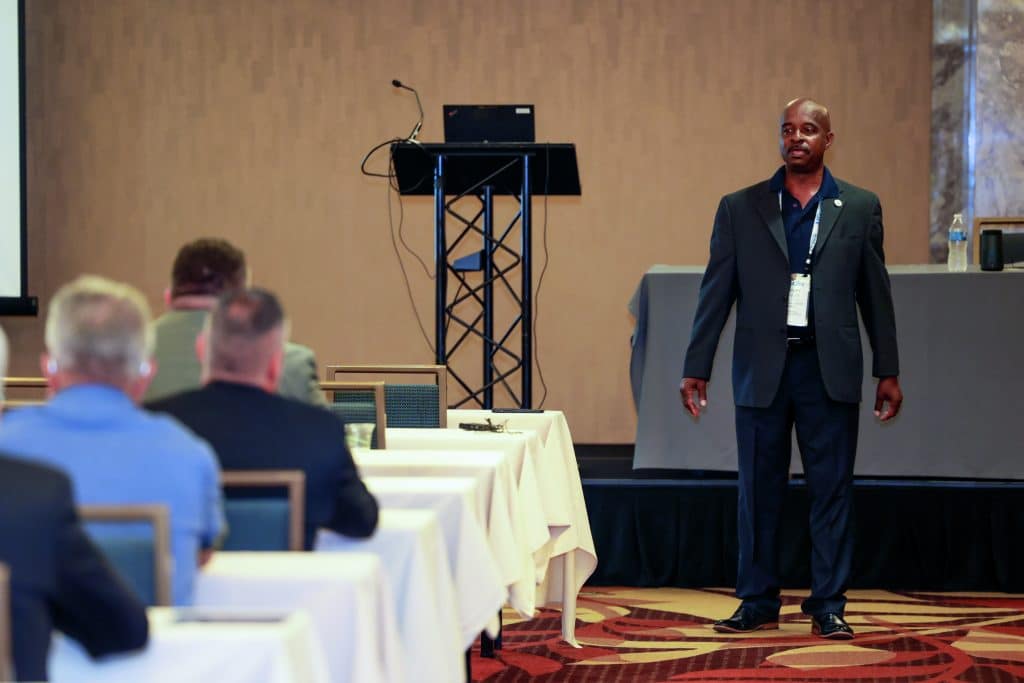
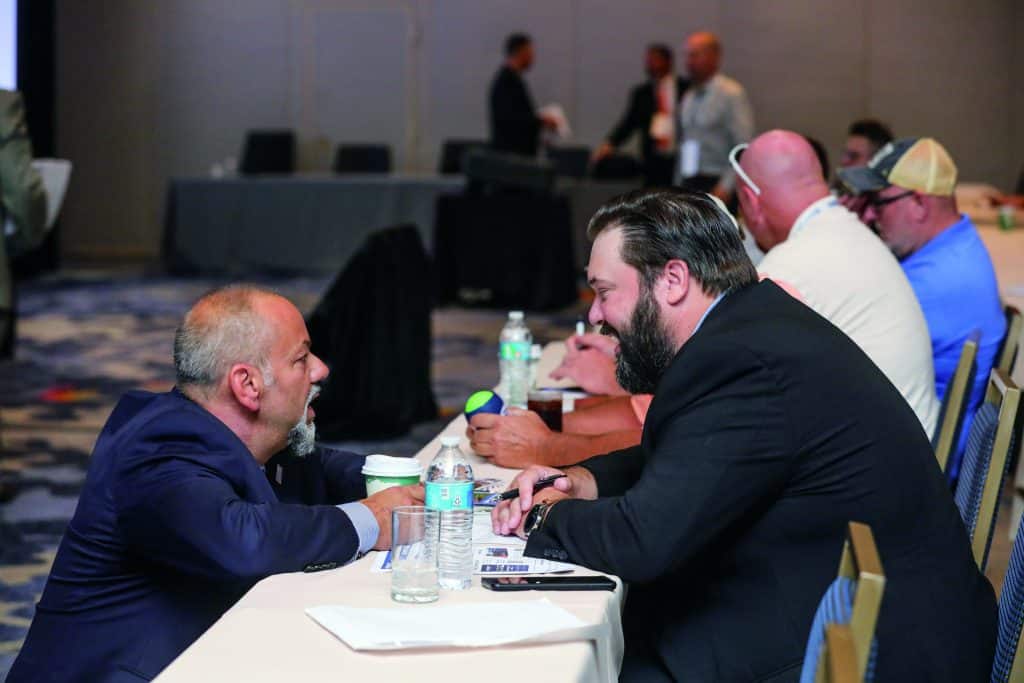
SMART General President Joseph Sellers opened the first-ever SMART Leadership Conference on Monday, August 8th, with local leaders from sheet metal and transportation gathering in San Francisco for three full days of hard work on behalf of SMART members across North America. The theme, “Growth Through Unity,” encompassed the focus of the gathering: In joint sessions, sheet metal and Transportation Division sessions, and breakouts, SMART leadership focused on how to secure the future of our union — together.
Leaders emphasize solidarity on day 1
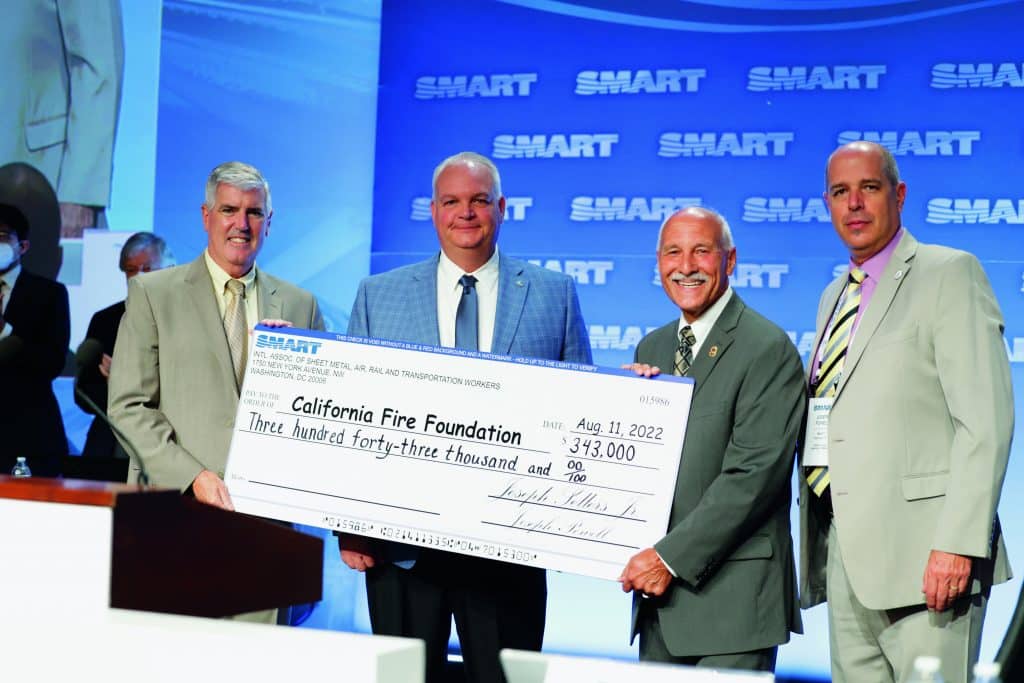
California Fire Foundation President Rick Martinez used his remarks to speak on the mission of the foundation — SMART’s chosen charity for the leadership conference — which provides emotional and financial support for the brave men and women (and their families) who put their lives on the line to fight disastrous fires. During the conference, SMART raised nearly $350,000 for the foundation.
In his opening remarks, General President Sellers summarized the last several years, noting that political developments across North America have created unprecedented opportunities for our union: huge investments in the transportation and sheet metal industries under the Bipartisan Infrastructure Law, pension protection in the American Rescue Plan and project labor agreements on federal projects above $35 million in the United States, plus the achievement of the Labour Mobility Tax Credit and added apprenticeship funding in Canada. He also noted the proposed rule for two-person freight rail crews and the importance of working across sheet metal and transportation to secure that victory for rail workers.
“We must be proactive and seize our opportunities to strengthen and grow our union,” Sellers said. “We must build our capacity and capitalize on union-friendly administrations in both the United States and Canada.”
That being said, Sellers pointed out, all those gains will be in danger if anti-labor politicians take back Congress. Elections in battleground states don’t only matter for members in those states — they will impact the future of SMART.
“Either we determine the future of our union, or our adversaries will do it for us,” he declared. “So let’s organize, mobilize, recruit and fight like hell to increase our density and our market share across industries.”
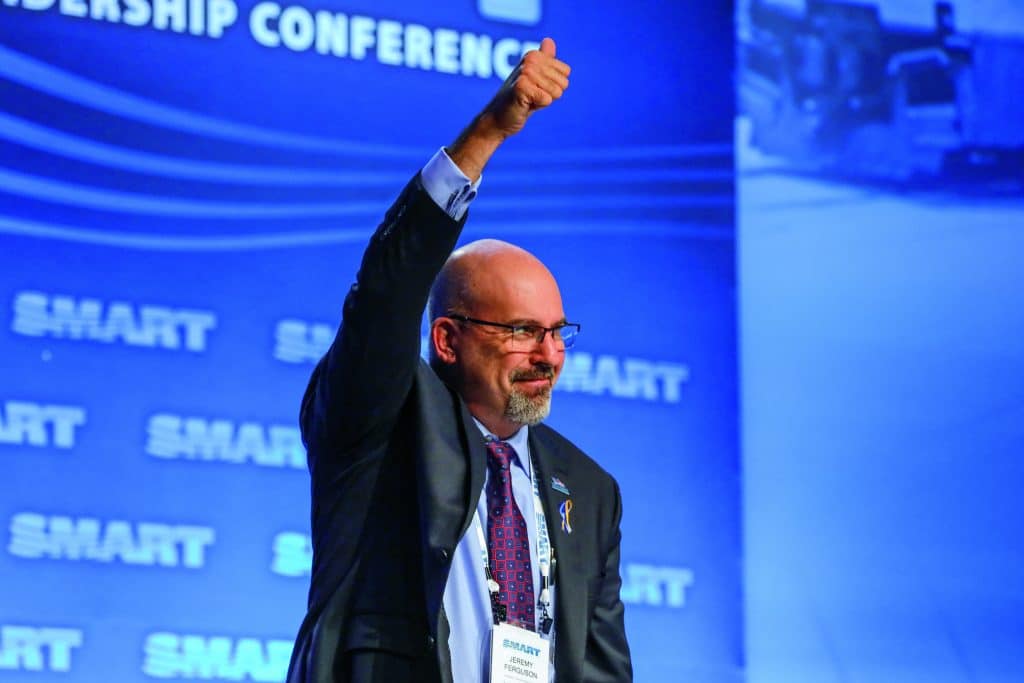
Jeremy Ferguson, president of the SMART Transportation Division, spoke on the furious fight to safeguard and expand working conditions for TD members against a corporate onslaught, particularly from Class 1 freight railroads.
“When things get tough, I know that the one thing we’re not afraid to do in the face of adversity is to show up and step up,” said Ferguson. “We’re not fearful of the challenges that we see ahead, after what we’ve been through.”
Through all the difficulties of the last several years, he continued, a bright spot has emerged: friendly figures in government and federal agencies. Thanks to relationships with Federal Railroad Administration (FRA) Administrator Amit Bose, Secretary of Transportation Pete Buttigieg and others, SMART members have a voice in the halls of power. And most importantly, Ferguson declared, the solidarity of SMART provides a road map to a better future for all members.
“The changes we made in 2020 that we were all a part of,” he said, “have opened the doors to lasting progress for our organization and hope, even as we fight through all that the carriers and their Wall Street oligarchs throw at us to grind us down, such as draconian attendance policies.”
To cap off Monday’s joint session, SMART welcomed San Francisco Mayor London Breed and United States Surface Transportation Board (STB) Chair Marty Oberman — both allies of workers and SMART. In his speech, Oberman discussed the STB’s efforts to investigate the decline of freight rail service in the U.S., specifically pointing to the reckless workforce slashing that has helped spur current freight rail disruptions: “It’s quite clear that the main force driving how the railroads are being managed these days are the pressures of stockholders.”
The work continues on day 2
After General President Sellers called the second day to order, AFL-CIO President Liz Shuler took the stand, calling on SMART locals to bring more workers into the fold and mobilize members to achieve more victories: “Growth Through Unity is exactly what we need in this moment.”
Organizing is more important than ever, she elaborated, as we emerge into a future with ever-advancing technology, a needed focus on clean energy and other changes to our traditional sectors. As industries change and governments around the world implement new policies to mitigate the effects of climate change, unions like SMART need to ensure workers have a seat at the table. That can only happen, Shuler explained, if we have allies in elected office. The American Rescue Plan, the Bipartisan Infrastructure Law, the CHIPS and Science Act, proposed two-person crew rules and the Inflation Reduction Act (IRA) are all vital actions that will put SMART members to work on an enormous number of projects in the future. Those opportunities likely evaporate if we return to an anti-worker Congress.
“To make our vision of the future a reality, we need to elect people who will have our back, who share our values,” Shuler said. She then gathered with members of the BE4ALL Committee, putting words into action to help SMART better represent all workers.
Shuler was followed by AFL-CIO Transportation Trades Department (TTD) President Greg Regan, who has worked closely with SMART TD leadership to help transportation workers. Like Shuler, Regan praised the unprecedented solidarity uniting railroad unions across TTD and vowed to fight tirelessly for the rights and protections workers deserve.
“There is a level of strength and solidarity in the freight rail labor movement right now that is unmatched,” said Regan. “We are going to win this fight; we are going to deliver on the contract rail workers have earned.”
Throughout the morning, the joint session highlighted SMART’s relationship with elected and federal officials. That peaked with a rousing speech from FRA Administrator Amit Bose, whose tenure has led to unprecedented access and a seat at the table for SMART. In his remarks, Bose touched on a variety of topics: the proposed federal rule requiring two-person crews on freight trains, funding to expand and modernize freight and passenger rail systems, and much more.
“As we forge ahead with new passenger and freight rail projects, the FRA understands the important role SMART members will play,” Bose said. “My staff and I will strive to continue to be available to you and listen to your concerns.”
Building our strength on day 3
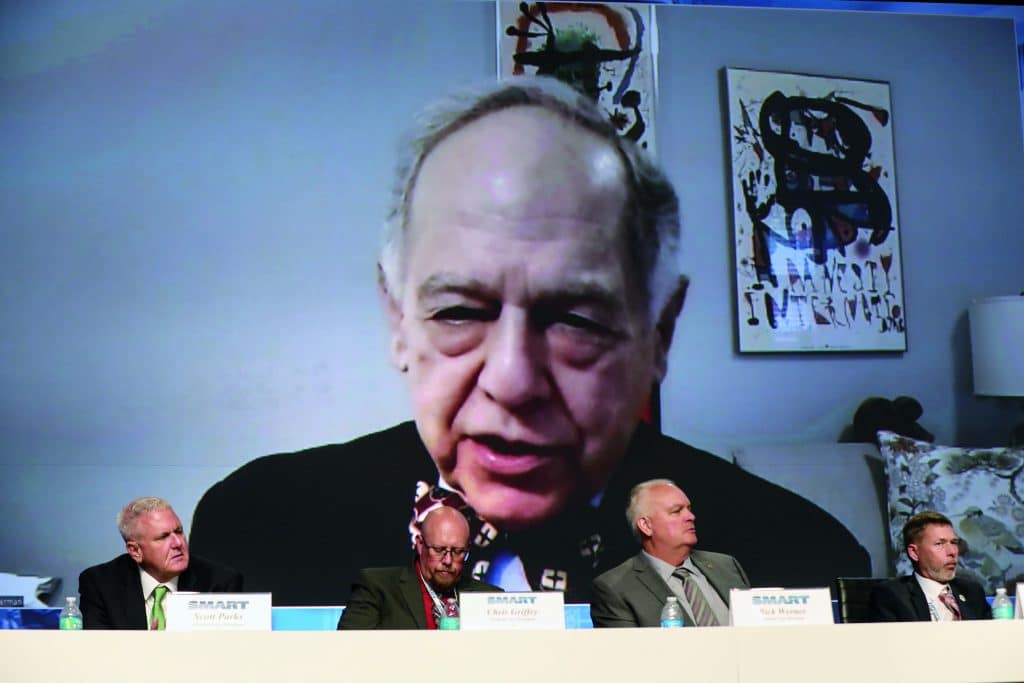
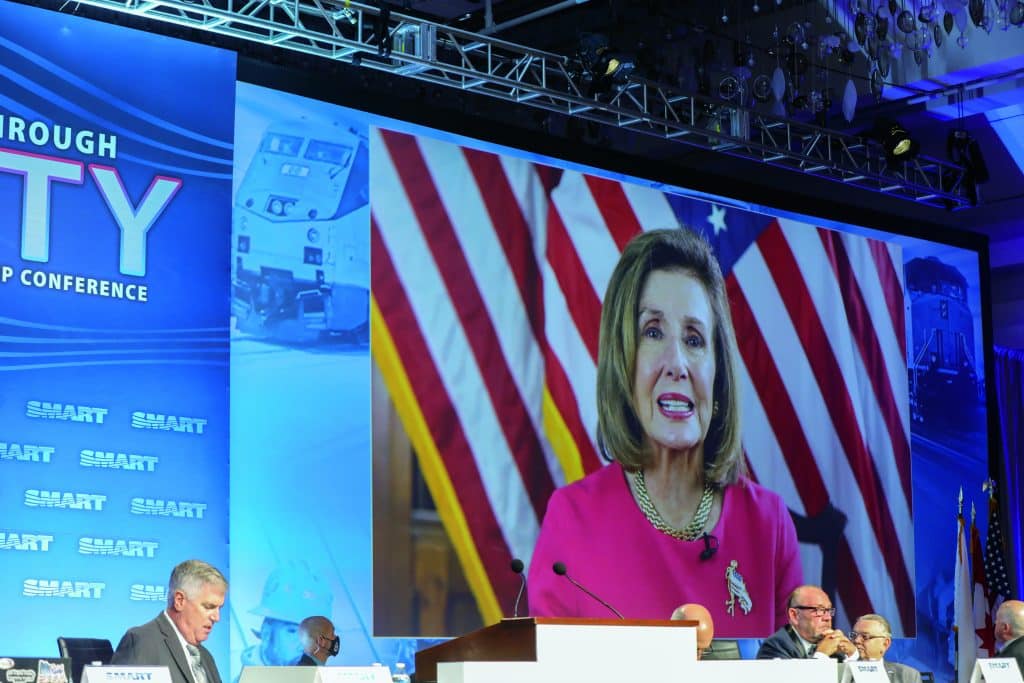
The conference’s final day’s focused on developing community solidarity and legislative power. After General Secretary-Treasurer Joseph Powell called the conference to order, U.S. Speaker of the House Nancy Pelosi joined the conference by video, outlining recent legislative accomplishments of House Democrats and the Biden administration before ending with a promise: “We will not relent until the Richard Trumka PRO Act is signed into law.”
Following Pelosi’s speech, SMART Director of Government Affairs Steve Dodd and Transportation Division National Legislative Director Greg Hynes provided an update on SMART’s political advocacy. After referencing SMART victories on legislation like the Bipartisan Infrastructure Law — which made specific investments in HVAC work, indoor air quality, transportation and more — Dodd and Hynes explained that such achievements are largely due to the level of access SMART has with the president, Congress and federal officials. As an example, Dodd pointed to historic pension relief included in the American Rescue Plan, which provided millions to SM Local 33 in Ohio (and to other unions as well). Hynes, meanwhile, focused on the difference the new president, Congress and federal appointees have made for TD members.
“We’re going for the [two-person crew] regulation and we’re going for the law, and we’re not backing down,” Hynes said to thunderous applause.
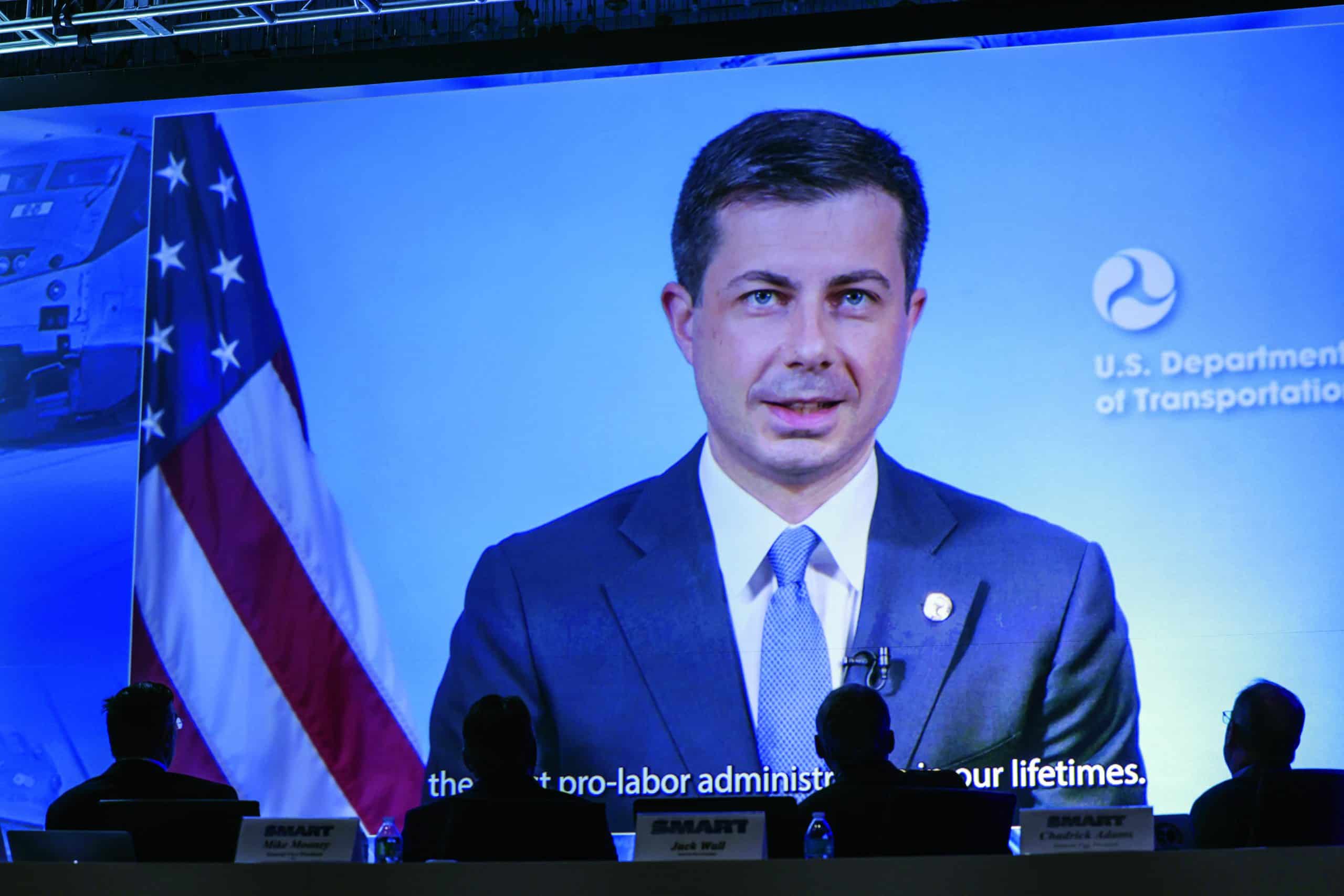
Secretary of Transportation Pete Buttigieg also delivered remarks by video. After summarizing how the American Rescue Plan and the Bipartisan Infrastructure Law are improving and modernizing U.S. transportation systems, Buttigieg acknowledged that “the most important part of a transportation system isn’t the physical infrastructure, it’s the people operating it every day.” He added: “We really are living through a new dawn in American transportation, and you all are at the center of it.”
Many speakers throughout the conference, including California Building and Construction Trades Council President Andrew Meredith, remarked on the importance of diversity and inclusion as we seek to grow our union, organize new sectors and lift workers into the middle class. Labor Secretary Marty Walsh emphasized many of those points in a video address, stating: “We need strong, diverse unions now more than ever. I know SMART is devoted to that.”
Like others, Walsh noted proworker Department of Labor initiatives, like strengthening Davis-Bacon protections and fighting against worker misclassification. He also observed that while three quarters of young workers are interested in forming a union, only 10% know how — a gap that must be closed for the betterment of all working people.
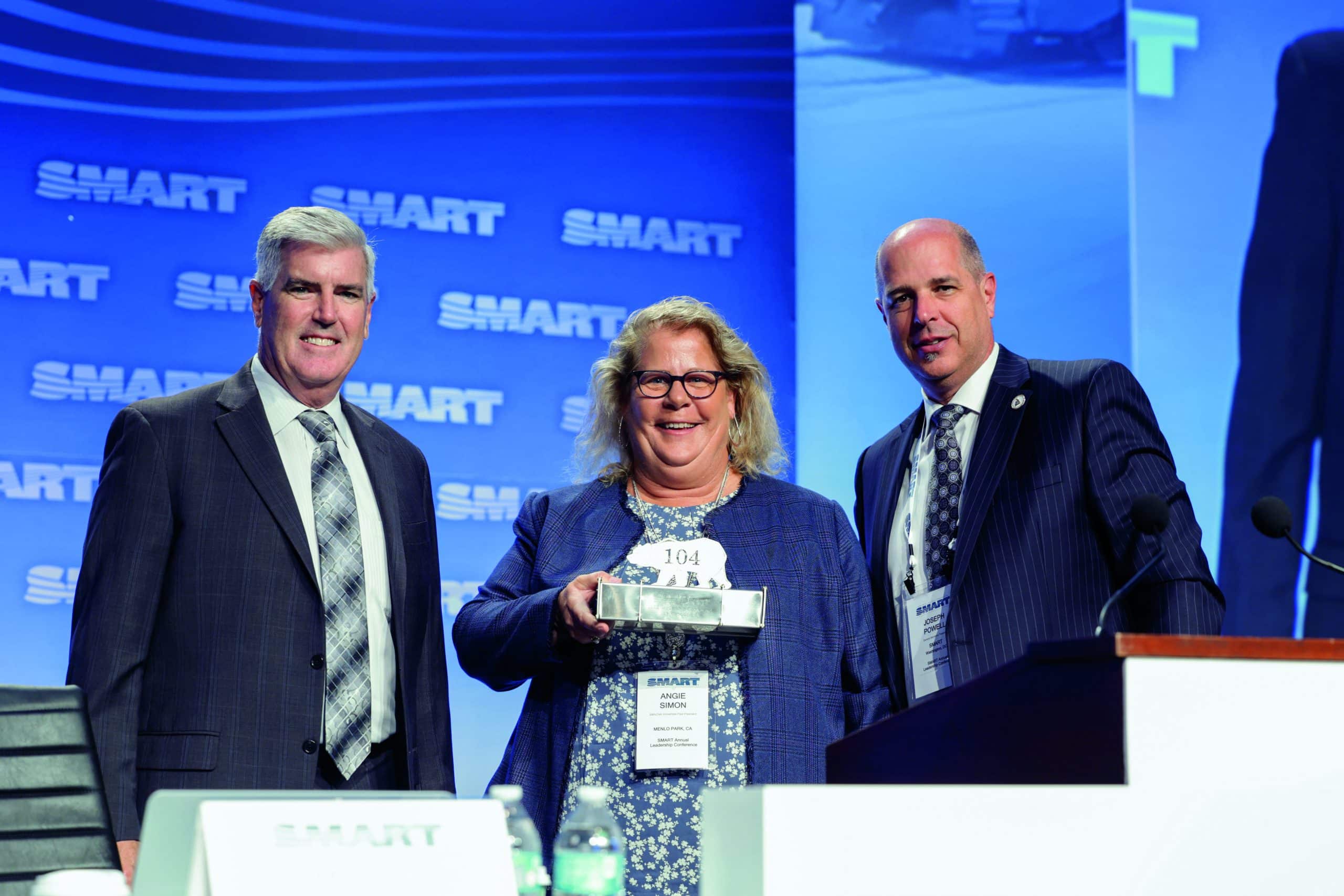
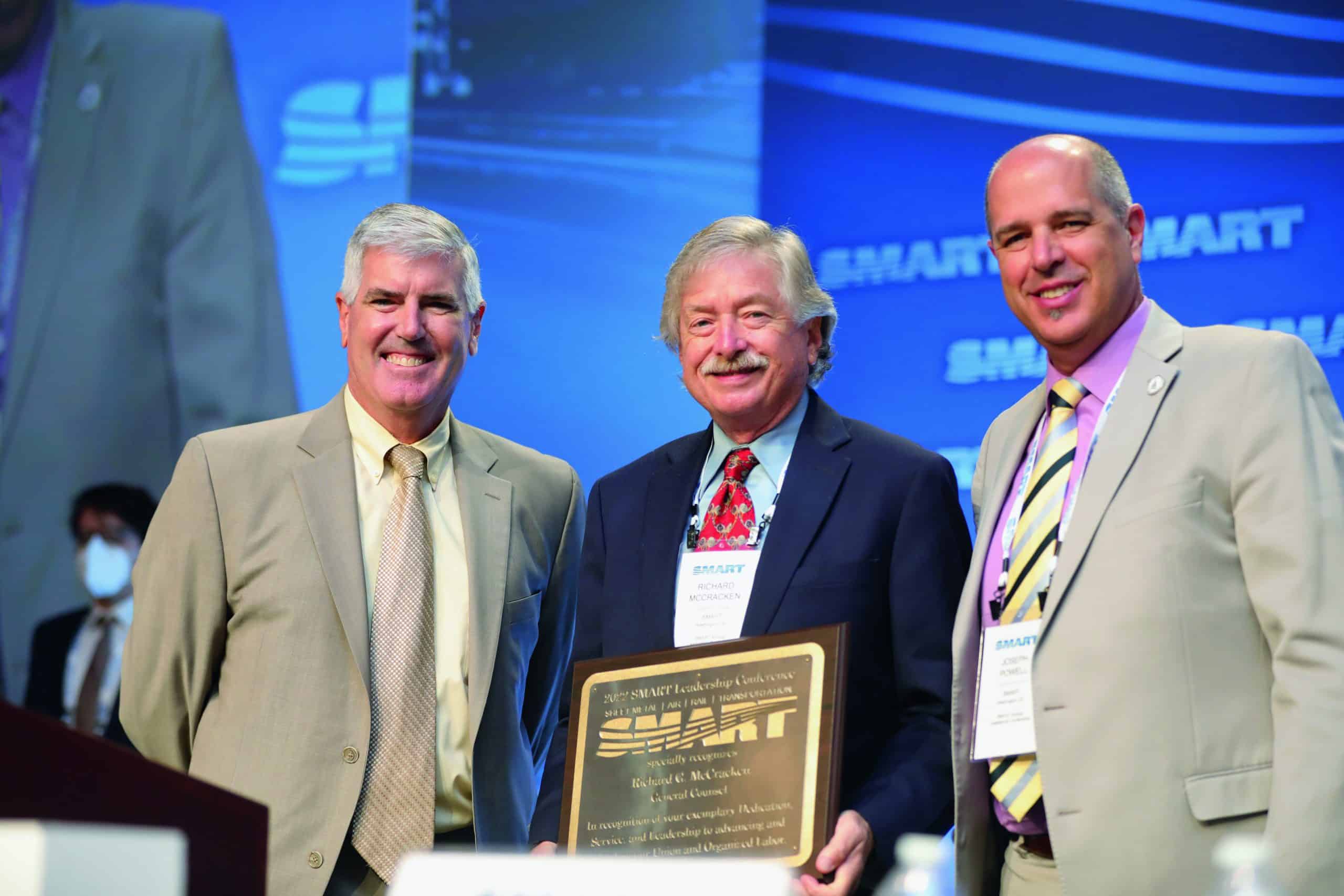
The conference culminated with a focus on the SMART Army — our union’s cross-industry, every-member effort to make North America aware that SMART workers are part of the fabric of our communities. General President Sellers presented the 2022 Joseph J. Nigro SMART Army Service Award to two members who have selflessly devoted themselves to their union and their communities: Local 18 (Wis.) retiree Kevin Turner and TD Local 610 (Baltimore) and SM Local 100 (Washington, D.C.-area) member Johnny Walker.
“The SMART Army brings us together in the community, it makes us a part of the community,” Turner said.
“The community knows who we are. We’re there,” Walker added. “The important thing about the SMART Army is you’re a part of something that’s a lot bigger than you.”
The White House released a back-to-school fact sheet ahead of the new school year, highlighting SMART, SMACNA and NEMI’s collaboration with the White House on improving ventilation in schools. This fact sheet was circulated to school districts across the country and notes that SMART, SMACNA and NEMI are the experts that schools should use for indoor air quality, HVAC, ventilation and energy efficiency improvements and upgrades.
In conjunction, NEMI launched a new website that can facilitate connecting buildings that want to make ventilation and energy efficiency improvements to skilled, trained and certified workers and contractors — SMART and SMACNA members. Ideally this will be a useful resource for schools and other buildings as they try to take advantage of federal funding available for these efforts. If a building owner fills out a form on the NEMI website and requests assistance, they will receive a response within 48 hours to help them identify steps they can take to improve ventilation in their buildings.
SMART hopes these resources will help building owners and/or state and local elected officials access billions of dollars in federal funding approved by the Biden administration to improve ventilation and energy efficiency of buildings.
This month, we would like to pay homage to those who served in the Armed Forces. General Committee 2 is committed to recognizing its veteran members and making sure they know that we appreciate them and their service to our country. As a show of respect, however modest, this issue’s report is dedicated to honoring a veteran member whose service has extended into the work he’s done for fellow veterans on the railroad.
For Brother Styka, helping his fellow veterans is something about which he feels deeply passionate, and he values being able to apply the lessons he learned from his experiences to help make things easier for others.
Brother Toby Styka, a member of SMART Local 256 who works on Metra Chicago, is proud of his military service and passionate about assisting those who share his background. Having served in the Army from 1987 to 1995, including deployment during Operations Desert Storm and Desert Shield, he understands the challenges servicemembers face when they return to civilian life, particularly around accessing benefits and support that will help them succeed. This is something Brother Styka himself encountered when he sought assistance for health issues that arose as a result of his service.
Realizing that many others might be confronting similar barriers, he started a veterans’ program at Metra for veterans to learn about the benefits they can receive and the programs available to them. For Brother Styka, helping his fellow veterans is something about which he feels deeply passionate, and he values being able to apply the lessons he learned from his experiences to help make things easier for others. Ultimately, Brother Styka is proud to support fellow veteran railroaders, and his program has been successful.
Beyond this important work, Brother Styka also enjoys hunting, taking trips on his motorcycle and travelling. He has been married to his wife, Tammy, for eight years, and he has two daughters, Kellie and Jenna, and two stepchildren, Morgan and Zach.
BE4ALL is a bold, multi-year effort to transform the sheet metal industry by ensuring our work environments are welcoming to all workers and that we achieve the highest standards of performance and excellence.
To make this vision a reality, BE4ALL has adopted several strategies. In the last issue of the Members’ Journal, we introduced the strategy of micro-affirmations. In this issue, we want to share the seven components of a courageous conversation.
A courageous conversation is an exchange between two people. Usually, the conversation is initiated in one of two situations: a) When we feel that we’ve been wronged by another person; and/or b) When we’ve done or said something (real or perceived) to wrong another person. The seven “A’s” are appropriate for disagreements or tensions around ideas, opinions, beliefs and personalities. They’re not necessarily appropriate in situations involving physical altercations, harassment or discrimination. In these situations, please consult your union representative.
Ultimately, courageous conversations are a tool for resolving interpersonal conflict and/or disagreements in the workplace. But, beyond this, they support us in being better human beings to one another. The following seven components can be practiced in sequence, or you can pick and choose which ones are more appropriate to your situation. They are:
1. ANCHOR
Initiating a courageous conversation is hard. This is especially the case if you feel the other person is wrong OR that you will lose something (i.e., the other person will see you as “weak” or “giving in”). Therefore, it’s important to prepare yourself — mentally and emotionally — before the conversation so that you have energy to draw on for what can be a long and uncomfortable process. Preparation may include listening to music, going for a walk/run, etc.
2. APPRECIATE
Share with the other person at least one thing you genuinely appreciate about them. It can be something they’ve said or done, or it can be some special quality, talent or gift they have.
3. ACKNOWLEDGE
Share with the person ways that you may have contributed to the problem or tension. If this isn’t relevant to your situation, you can skip this step.
4. ACKNOWLEDGE
Share with the person ways something they may have said or done impacted you. Share the feeling of the experience, NOT your evaluation of the experience or the person.
5. ASK
Whether you were the person wronged or you wronged someone else, ASK the other person a few probing questions as a way of approaching them from a place of understanding and curiosity.
6. AFFIRM
After the person shares, paraphrase or summarize what they shared by stating:
“What I think I hear you saying is …”
Affirming DOES NOT mean you agree with the person, it just means you are listening with the intent to understand.
7. AGREE
Both people agree on a new way to move forward (i.e., “let’s agree that, in the future, we’re going to ___________.”) OR ask the person for their ideas and support on how to move the relationship forward.