Washington, D.C.— On February 5, 2026, the U.S. Senate Health, Education, Labor, and Pensions (HELP) Committee underscored a critical message for SMART-TD members: Railroad Retirement remains a strong and valuable system, but chronic underfunding of the Railroad Retirement Board (RRB) itself is creating unacceptable service delays that directly harm railroaders and their families.

The Good: RRB Is Much Stronger Than Social Security

Committee Chairman Sen. Bill Cassidy (R-La.) emphasized the system’s long-term financial strength and sustainability, calling it a model for retirement security nationwide.

“The RRB’s trust fund is predicted to continue running smoothly and solvently for 75 years, which is the limit of our projections. It is the gold standard for sustainability.”

Lawmakers from both parties acknowledged that Railroad Retirement provides benefits that far exceed those available under Social Security, particularly for career railroaders.

During the hearing, Sen. Bernie Sanders (I-Vt.), the committee’s Ranking Member, remarked that, “Rail workers who have been on the job for 30 years and retire at the age of 60 receive more than $4,500 a month. That is the good news.”

For working SMART-TD members, this underscores that Railroad Retirement remains one of the strongest retirement systems in the country, rewarding long careers and supporting families in retirement.

The Bad: Chronic Underfunding and Lack of Service

While praising the benefit structure, Sen. Sanders delivered a blunt warning about the consequences of Congress failing to adequately fund the Railroad Retirement Board’s day-to-day office operations.

“The bad news, Mr. Chairman, is that the Railroad Retirement Board budget has been flat for several years. As a result of this insufficient funding, it takes an average of 470 days for the Railroad Retirement Board to determine if a worker is eligible to receive the assistance they need.”

And The Ugly: Real Life Emergencies Met With Long Delays

Those delays have serious consequences for active railroaders, particularly those dealing with injuries, illness, or sudden career interruptions.

Sanders also pointed to the erosion of in-person services, noting that rail workers are sometimes forced to wait up to two and a half hours on the phone to receive assistance. He added that many field offices in rail communities have been forced to shut down or substantially reduce their services.

Even when eligibility is eventually approved, workers are often left waiting far too long for relief.

“And even when it is determined that a worker is eligible to receive disability benefits, it can take 18 months or longer for them to receive those benefits. In my view, that is unacceptable.”

What This Means for SMART-TD Members Still Working

For active railroaders, the hearing confirmed several hard realities. Disability claims can take well over a year, leaving workers and their families in prolonged financial uncertainty. Field office closures and staffing shortages continue to limit access to knowledgeable, in-person assistance when it is needed most. These delays are not caused by the benefit system itself, but by years of flat funding for RRB administration despite growing workloads and increasing demands on the agency.

SMART-TD has consistently warned that underfunding RRB operations harms railroaders at their most vulnerable moments, and this hearing placed those concerns squarely on the congressional record.

What This Means for Retirees and Survivors

For retirees and survivors, the hearing offered both reassurance and caution. The Railroad Retirement system itself remains financially strong, with long-term solvency projections extending 75 years into the future. At the same time, service delays and reduced field office access can complicate survivor claims, benefit adjustments, and major life-event changes. Continued congressional attention is essential to ensure retirees can access the benefits they earned without unnecessary barriers.

Bottom Line for SMART-TD Railroaders

The Senate hearing made one thing unmistakably clear: Railroad Retirement works, and the trust fund is strong. However, the Railroad Retirement Board cannot properly serve railroaders without adequate staffing and funding. We all know that the RRB is self-funded out of our paychecks. The money is there and ready to fix the staffing and technology problems that prevent railroaders from accessing these important services. What the RRB and rail labor are asking is that Congress allow us permission to use these funds to fill the gaps.

SMART-TD will continue pressing Congress to fully fund RRB administrative operations, restore and strengthen field office access, and ensure no railroader or retiree is forced to wait months (or even years) for benefits they have already earned.

The birthday of civil rights pioneer Rosa Parks on Feb. 4 offers an opportunity to reflect on the lasting impact of her courage. As a union, we also owe it to ourselves to evaluate the role public transportation continues to play in shaping our communities.

Honoring Rosa Parks’ Legacy

This year, some bus and transit agencies across the country are commemorating the day in a powerful and symbolic way: by reserving a seat on every bus and passenger train with a sign honoring Parks’ legacy.

This simple gesture speaks volumes.

Public Transit: Where Courage Sparked a Movement

Rosa Parks’ refusal to give up her seat on a Montgomery city bus in 1955 was not just a personal act of defiance: it was a spark that helped ignite the modern civil rights movement. Her courage reminded the world that dignity and equality are not abstract ideas. They are embodied in everyday moments, often in everyday places.

Few places are as “everyday” or as essential as public transit.

Buses and trains are where working people connect to jobs, families, schools, and opportunities. They are where communities come together, and they have long served as the setting for some of our nation’s most important steps forward.

For SMART-TD bus and passenger rail members, this moment of remembrance carries special weight.

Transit Workers Build Communities

It’s the operators, conductors, onboard crews, mechanics, dispatchers, and frontline professionals who make the system run safely and smoothly. It’s our members, day in and day out, who make sure those seats, those buses, those trains, opportunity, and access are there for the public.

Honoring Rosa Parks is a reminder that public transportation is more than a service. It is a platform for dignity, equality, and opportunity.

So when a seat is reserved in Rosa Parks’ name, it’s about remembering the past as well as recognizing the continuing role transit plays in shaping a better future, and the vital role union workers play in that journey.

Because in public transportation, the road forward has always been about more than travel.

It’s been about progress.

And SMART-TD members are proud to be driving it.

What follows is an editorial from Chris Christianson in response to an Op-Ed by Dr. Erin Bendily in Louisiana. Christianson’s words ring as true in Chicago, Nebraska, Florida or California as they do in his home state of Louisiana.

Read Rail safety mandates don’t belong in America’s transportation bill ►

Chris Christianson, Louisiana Safety and Legislative Director

I’m a proud fourth-generation railroader who has spent more than 20 years working the rails for Union Pacific and serve as Louisiana’s Safety and Legislative Director for SMART-TD, the largest railroad union in the country.

Over the years, I’ve watched coworkers lose their limbs. I’ve attended funerals that never should have happened. I’ve seen what happens when safety becomes “at the corporation’s discretion” or “controlled by market factors.” AKA “optional.”

These buzzwords might keep people safe in the simulations run by PhDs in a think tank, but when cost-cutting outruns common sense and when people making safety decisions are far removed from the work, people get hurt or killed.

That’s why I read Erin Bendily’s recent op-ed with more than passing interest. I felt compelled to set the record straight.

In her piece, Dr. Erin Bendily argues that federal rail safety mandates, including provisions of the Railway Safety Act (RSA), are unnecessary, overly burdensome, and potentially harmful to Louisiana’s economy.

She presents her argument as a sober, fact-based analysis, citing regulatory costs, warning against “one-size-­fits-all” mandates, and suggesting that market forces, existing rules, and railroad discretion are sufficient to manage safety without additional federal intervention. It is an argument delivered with confidence, credentials, and the language of authority.

The problem? It just isn’t true.

As the Vice President of Policy and Strategy at the Pelican Institute, Dr. Bendily’s analysis rests on spreadsheets, economic models, and regulatory theory.

Mine rests on experience: not anecdotes, not hypotheticals, but decades of watching how railroads behave when safety is left to their discretion.

Here is the truth that never appears in think-tank white papers: rail safety regulations exist because railroads have repeatedly proven that they will not voluntarily choose safety over profit. Every major safety rule on the books today was written in response to blood on the ground, not academic concern.

I have ridden the rear rail car of a two-and-a-half-mile train downhill into a yard at night, in poor lighting, holding my radio as high as I could so the engineer might hear me when I gave instructions or yelled “stop.” I have walked rail beds for miles along adjacent creeks, balancing on uneven rock in the dark, just to reach a mechanical problem. I have worked jobs where a single missed detail could kill someone.

Those realities do not appear in cost-benefit analyses.

Dr. Bendily speaks authoritatively about safety outcomes without ever having to answer a radio call that comes too late. She speaks about efficiency without ever having to explain to a family why someone didn’t come home. She treats safety as a variable to be optimized rather than a baseline requirement for survival.

That is the central flaw in her argument: rail safety is not an abstract policy question. It is a lived condition.

The railroads have enormous financial resources. They employ armies of lawyers, lobbyists, and public relations firms to push back against every safety measure that might cost them money. Groups like the Pelican Institute and “experts” like Dr. Bendily are part of that ecosystem. They make a living providing intellectual cover fire for decisions that look good on earning statements and are catastrophic on the ground.

Let’s be clear: l ‘m not saying Dr. Bendily lacks intelligence or academic credentials. I’m saying she lacks proximity to this topic. When it comes to rail safety, proximity matters.

I’m offering it up that maybe she should not be considered any kind of authority on rail safety legislation in Louisiana. These safety regulations are supported by every craft in the industry, legislators on both sides of the aisle, and Presidents Biden and Trump.

SMART-TD, the union I represent, can (and does) argue publicly and privately about wages, attendance policies, sick time, and quality-of-life issues. Those are legitimate subjects for negotiation and debate. But when the question is whether rail workers survive their shift, the conversation changes.

At that point, it is no longer about ideology or regulatory philosophy, and it sure as hell isn’t time for a PhD at the Pelican Institute to be listened to.

Railroaders are not a line item. We are the people who walk the right-of-way, throw the switches, inspect the equipment, and manage massive, unforgiving machines in conditions most Americans never see.

So when lobbyists, law firms, or think-tank executives insist they know what level of safety is “enough,” they are speaking far outside their depth. They do not bear the consequences of being wrong. We do.

If Dr. Bendily and the Pelican Institute want to debate tax policy or regulatory structure, fine. But when they move into the realm of rail safety and argue against protections designed to keep people alive, they are no longer engaging in neutral analysis. They are choosing how much railroaders’ lives and trackside towns are worth compared to the rate of velocity on the freight we haul.

Rail workers are the experts on rail safety. Full stop. Not because we read about it, but because we live it. No amount of credentialed commentary can outweigh that fact.

This industry has learned repeatedly that safety regulations are written in response to tragedy. Ignoring that history doesn’t make it disappear. It guarantees it will repeat.

That is something we cannot, and will not, accept.

Please look at the RSA and all other rail safety legislation. Take the advice of these “experts” who have never operated a switch and who live in communities far from the tracks with a grain of salt.

As we approach the third anniversary of the Norfolk Southern derailment in Ohio, let’s consider our sources with more scrutiny than we once did. Let’s decide to listen to the guy with actual skin in the game, even if he isn’t wearing a fancy suit. It is time Louisiana and the rest of the country stand up and insist the Rail Safety Act gets the up or down vote on the floor of Congress that it deserves, and that we deserve.

Rail yards are for us to move freight, not playgrounds for management with surveillance tech.

October 8, 2025 — Washington, D.C.

Our union’s National Safety and Legislative Department makes it a priority to monitor everything the FRA and the FTA put out, but yesterday was a little different.

On October 6, SMART-TD got to send our “Don’t Tread on Me” message to the Federal Aviation Administration. (FAA)

Over the past few years, trainmasters have gotten tired of just lying in bushes and hiding in the back of MOW’s truck beds to spy on our rail members. They have gone to the next level and started flying drones around active rail yards like there wouldn’t be any ramifications.

SMART-TD took your concerns over this ridiculous hazard straight to the FAA, demanding a full prohibition on the use of drones by railroad managers, or anyone else, in active rail yards and along the mainline where trains are moving. The filing, under FAA Docket No. 2025-1908, comes as railroads increasingly use drones to hover over crews during “operations testing.”  We all know this is a practice that crosses every line of safety, respect, and common sense.

In no uncertain terms, SMART-TD told the FAA that these worksites are the crews’ domain. They’re the daily workplace of the men and women who move the nation’s freight, not a proving ground for corporate gadgets or a playground for amateur pilots.

“Our rail yards are not laboratories or surveillance zones. They’re our offices,” said Jared Cassity, SMART-TD National Safety and Legislative Director. “When a drone flies overhead, it’s not just a nuisance; it’s a distraction in one of the most dangerous work environments in America. And make no mistake: if something goes wrong, it won’t be the manager behind the joystick who gets hurt. It’ll be one of our members. There is nothing cute, cool, or futuristic about any of that.”

Beyond Member Safety: A Threat to National Security

While the physical risks of minimally-trained managers piloting drones around moving trains and heavy equipment are serious, SMART-TD said the larger danger is what happens whendrones become normalized in rail yards.

“Once drones are a common sight over critical infrastructure, we lose our ability to tell the difference between a company drone, a spy drone, or one armed with explosives,” Cassity warned. “Railroads carry hazardous and combustible materials every day. Treating drones like harmless gadgets in that setting is not only irresponsible — it’s a national security risk.”

The union’s filing cites the increasing use of drones in modern warfare and surveillance, warning that the FAA’s policy decisions today could unintentionally make rail facilities and all of us working in them more vulnerable to bad actors.

The Wrong People Giving the Wrong Orders

Don Roach, SMART-TD’s Deputy Director of the National Safety and Legislative Department, said the union is drawing a hard line to protect its members and the public.

“It’s not the trainmasters or company managers who should be deciding what’s safe in these environments — it’s the people who actually do the real work there,” Roach said. “We’re the ones with boots on the ballast. We understand the hazards, the noise, the moving machinery. A manager in the weeds with a drone doesn’t belong anywhere near our people.”

Roach added that the FAA must recognize who the true experts are when it comes to safety in active railroad operations.

“SMART-TD is the voice of real-world rail safety,” Roach continued. “If the FAA wants to know what happens when drones start zipping through switching operations or across mainline tracks, they don’t need to ask a corporate safety officer — they need to ask us.”

Undermining Safety Culture and Trust

The union also warned that surveillance by drones destroys the fragile trust that safety depends on. When rail workers are being filmed from above, they’re less likely to report on any safety issues they encounter or take initiative to correct hazards.

“Management wants to call this ‘monitoring,’ but workers see it for what it is — intimidation,” Cassity said. “They used to hide in the weeds to spy on crews. Now they’re just doing it from the sky.”

SMART-TD called for the FAA to:

  • Ban all drone operations in active rail environments.
  • Require specific FAA authorization for any exceptions.
  • Mandate worker notification before any drone activity.
  • Impose strict training, licensing, and security protocols for operators.
  • Conduct risk analyses on drone-related distractions and accidents.

“As a union, we don’t have many dealings with the FAA, but we wanted to let them know that safety concerns on the rail are no joke,” Roach said. “If the trainmasters won’t think through the recklessness of their actions, SMART-TD will.”

February 14, 2025: Celebration of Life Arrangements Announced

Arrangements for the celebration of life for Brother Steve Bryant (Local 1518, Indianapolis, IN) have been announced. All members of his union family are invited to attend.

The celebration will be held at St. Jude Catholic Church (5353 S McFarland Road. Indianapolis, IN) on March 9th, at 3:00 PM.

In honor of Steve, his family requests all attendees wear their favorite sports team’s jersey, a favorite concert shirt, or both!

BBQ will be served, which is what Steve was into. The family asks everyone to bring their favorite side dish or dessert and their favorite “Steve story.”

December 10, 2024:

It is with heavy hearts that SMART-TD announces the passing of Brother Steve Bryant, a beloved friend, co-worker, and union brother, who passed away on December 4, 2024. Steve, Local Chairperson of Local 1518, Indianapolis, IN, fought cancer with the same veracity he fought for his union brothers and sisters. Brother Bryant touched many lives throughout the union, and was known for his strength, compassion, and resilience by all who knew him.  

In lieu of flowers, the family requests donations to a charity of your choice that supports cancer research or addiction recovery, causes that were close to Steve’s heart. If you wish to help his wife Kristi with Steve’s medical bills and the cost of his final expenses, please consider contributing to the GoFundMe page set up in Brother Bryant’s honor.  

Donate To Brother Bryant’s GoFundMe Fundraiser

Donations of any amount are welcome and will be a fitting tribute to a man who gave so much of himself for the members of this union. SMART-TD asks our members to include their Local number along with their name, so that Kristi and the Bryant family can see the incredible impact Steve’s career had on the lives of members across the country. 

Steve always put others before himself. As the Local Chair and Secretary of Local 1518, he dedicated countless hours to serving his fellow union members. His unwavering commitment to his colleagues and the labor movement made a lasting impact, and his leadership was marked by tremendous success in helping others navigate complex issues at work. 

Outside of his union duties, Steve was a constant support to those around him, especially those struggling with addiction. He provided guidance and compassion to anyone who needed it, showing a deep understanding of the challenges faced by others. His ability to empathize and provide a helping hand made him a source of strength for many. 

Steve is survived by his wife, Kristi Bryant, their children and grandchildren. Steve took immense pride in serving his household, and he cherished every moment spent with his loved ones.  

Brother Bryant will be deeply missed by all who knew him. 

As those who worked with Brother Bryant know well, Steve loved going to concerts. His advice to all that would listen was, “Life is short. Buy the tickets!” It wasn’t just a catchphrase; it was the way Brother Bryant lived his life. He lived it to the fullest. He might not have been here for as long as any of us would have liked but make no mistake about it. Steve didn’t cheat himself out of living. That is a part of his legacy that we should all remember. We should all be a little more like Brother Bryant. Give of our time and talents to one another in the name of this brotherhood and always remember that life is indeed short. Buy The Tickets! 

In fall 2024, CSX Railroad announced plans to change how the carrier moves freight between Chicago and the East Coast; a plan that would have forced more than 120 SMART-TD members to choose between relocation from Cleveland to either Buffalo, N.Y., or Willard, Ohio — or be laid off.

SMART-TD officers and former Ohio Senator Sherrod Brown took action in response. And with the senator’s help, union railroad jobs stayed in Cleveland where they belong.

“[Senator Brown] said, ‘Hey look, your plan is very flawed and you’re definitely affecting Ohio workers in a negative way.’ And here we are [now], talking about creating more jobs for Ohioans,” said SMART-TD Ohio State Safety and Legislative Director Clyde Whitaker.

The fight for Cleveland railroaders started when CSX unveiled a plan to streamline its operations in Northern Ohio by reducing train stops and crew members at Collinwood Rail Yard. This streamlining predominantly depended on employees moving to Buffalo or Willard — 180 miles and 80 miles away from Cleveland, respectively.

“With the crews in Cleveland, there was a lot of panic and a lot of ‘what if,’” said Ryan Fries, SMART-TD Local 378 vice local chairperson. “‘Are we going to have to drive three and a half hours to work? Is my spouse going to have to change jobs?’”

“Their whole plan was contingent on us moving, because they needed the manpower to go with their plan,” added SMART-TD General Committee GO-049 Assistant General Chairperson Eric Kosinski.

According to CSX, this was a positive development — one that would actually create jobs, Fries said. But, he added, phase three of CSX’s plan was essentially a full shutdown of Collinwood Yard. After a conversation with CSX Superintendent Darin Hershiser, Whitaker agreed.

“In the 24 years I’ve been here, whenever I hear that word [streamlined], that tells me you’re shutting the entire place down and we’ll get a barebones operation. Which, coincidentally, was their plan.”

That’s when SMART-TD reached out to former Senator Brown, asking him to help broker a meeting between TD and CSX. Brown took action, issuing a public letter that called on CSX President and CEO Joseph Hinrichs “to meet with workers as soon as possible and reverse plans that would remove train stops and train crews from the Collinwood Rail Yard facility in Cleveland.”

“In the strongest possible terms, I urge you to reverse CSX’s strategy concerning Collinwood staffing,” Brown wrote. “CSX recorded more than $3.7 billion of profits last year. Instead of cutting positions at Collinwood, CSX should pursue safer and more reliable operations by investing in hiring in Cleveland and across your company’s rail network.”

The combined efforts of union labor and a pro-worker senator paid off: SMART-TD officers met with CSX and were able to devise a solution.

“We were actually able to implement a plan that created more jobs for the area,” Fries concluded.

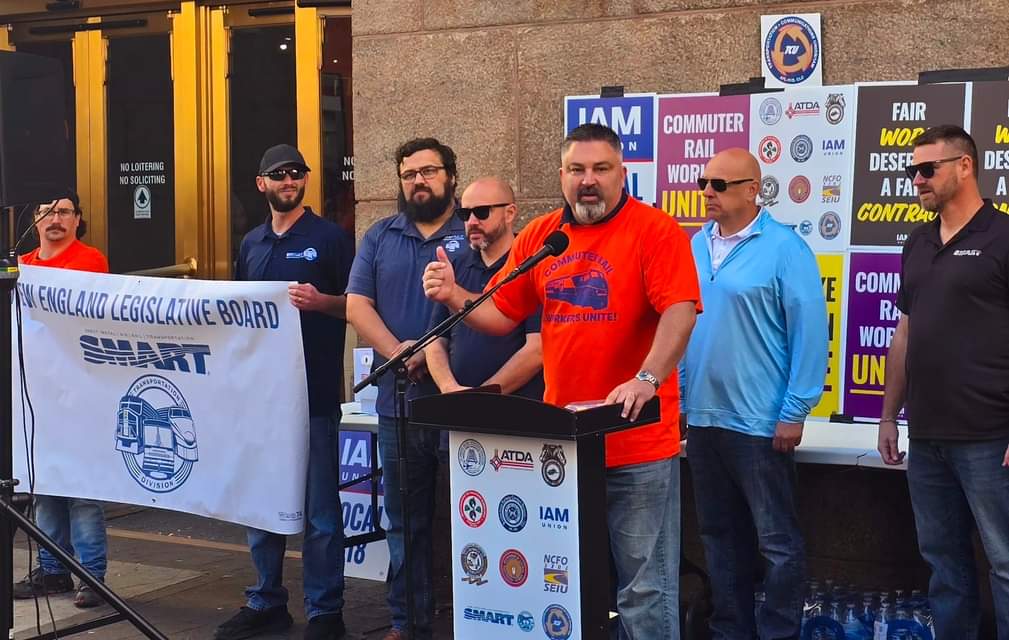
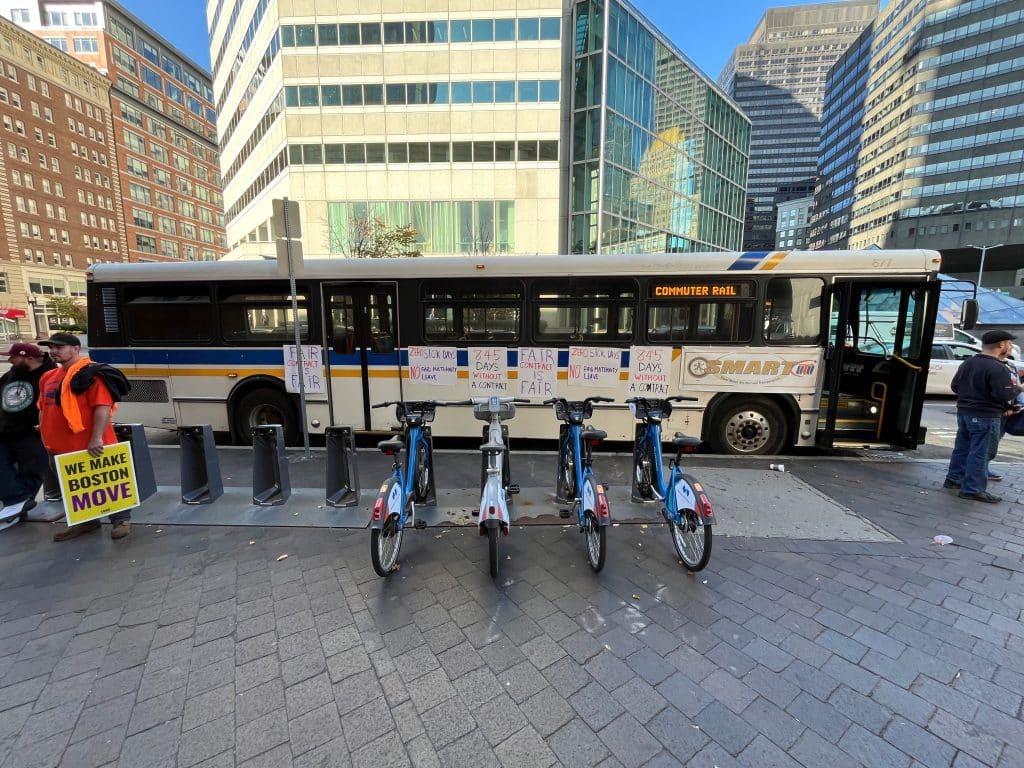
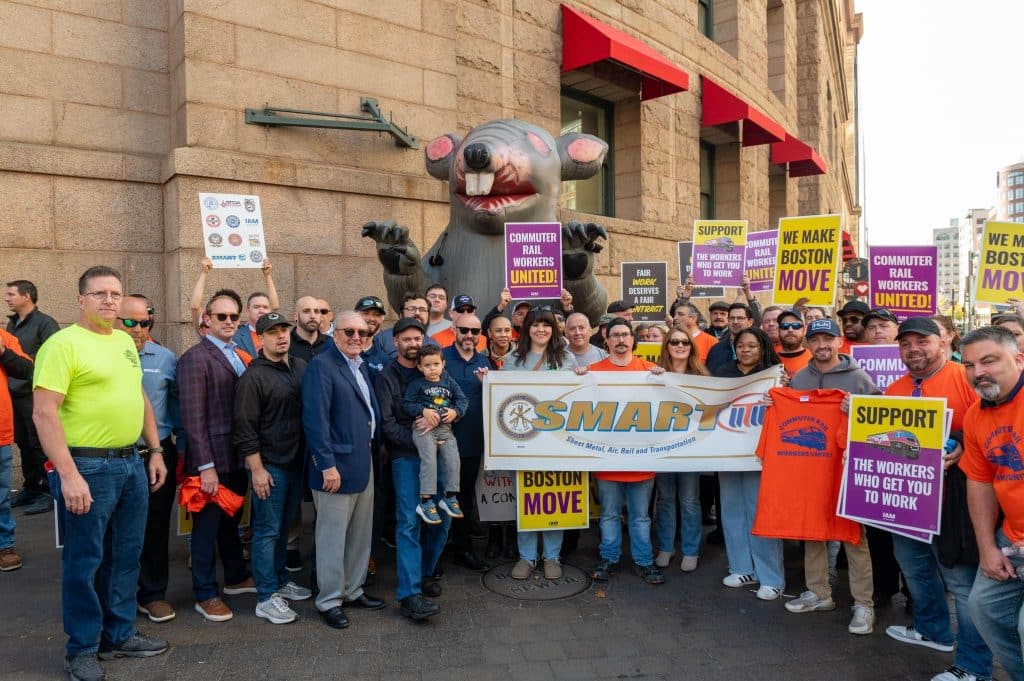
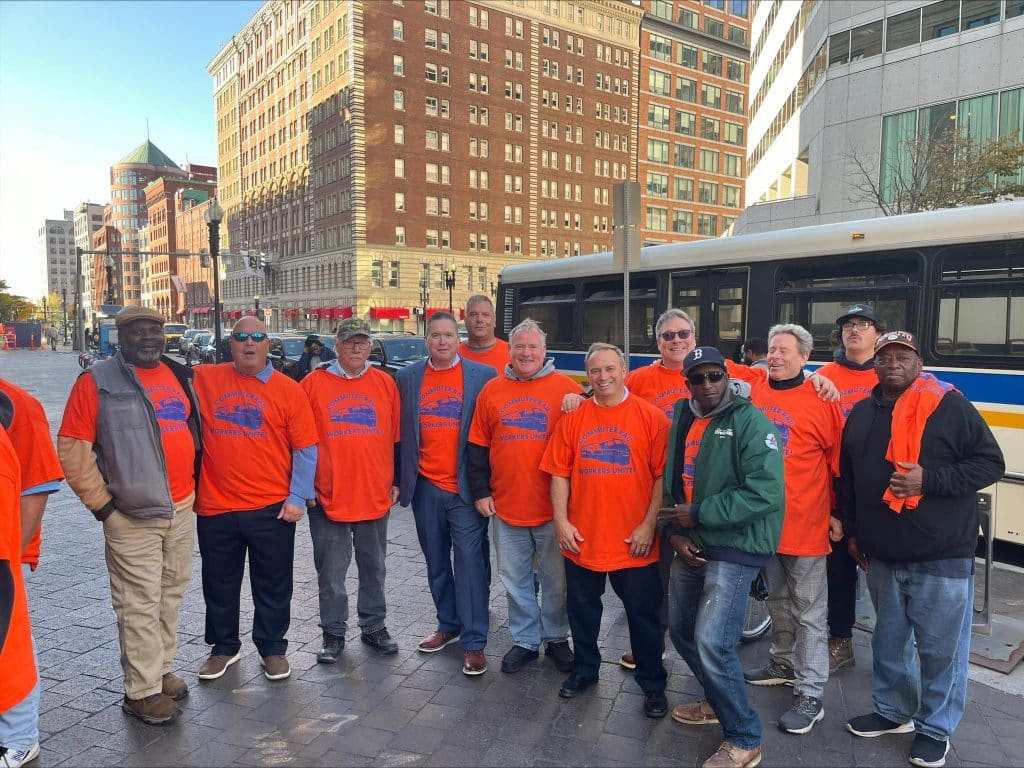
Hundreds of railroaders, along with friends, family and labor supporters, gathered at Boston’s historic South Station in October to rally for fair wages, sick leave, maternity days and other essential benefits.

The event was coordinated by a coalition of rail labor organizations, including SMART-TD, the AFL-CIO, IAM, ATDA, BRS, TCU and IBEW. Workers and allies confronted Keolis, the French-owned passenger rail operator of the Massachusetts Bay Transportation Authority, which has neglected negotiations since the previous contract expired July 1, 2022.

The rally featured passionate speeches from local Boston elected officials, four members of Congress and representatives from multiple rail unions.

SMART-TD was represented by Deputy National Safety and Legislative Director Jared Cassity, who emphasized the importance of solidarity among the unions.

“Today is our day. Now is the time to get the contract you all deserve!” Cassity declared. “It does not matter if you are an engineer. It does not matter if you are a conductor, if you’re a signalman, a dispatcher, a track worker; whatever the issues are, they are OUR issues. And the only way we fix them is when we stand together, and we fight together!”

Keolis has been accused of failing to bargain in good faith with SMART-TD and the other unions representing their workforce. As Congresswoman Ayanna Pressley pointed out in her speech, Keolis workers are paid 12% less, on average, than their counterparts on Amtrak to move the same passengers in Massachusetts.

Congressman Steve Lynch added that Keolis is contracted out by MBTA to run the commuter rail system in Boston, and the company’s contract is coming up for bid. He made it clear that if Keolis doesn’t come to the table and get serious about retaining the frontline workers who keep Boston trains running safely and on time, it will be replaced by a contractor that will.

More than 50 SMART-TD members attended the Oct. 23 rally, as well as brothers and sisters from SMART Local 17 and the Northeast Regional Council. The overwhelming message was clear: Workers will continue to fight for a fair agreement until they have a new contract.

Members of Local 17, including SMART NERC Regional Manager and General Vice President Robert Butler, showed their support at the rally.

“We showed Keolis that workers, riders, our congressional delegation and the whole Massachusetts labor movement is behind us in our fight for a fair contract,” said New England Safety & Legislative Director Dave Stevenson.  

Boston, MA (October 23, 2024) — Hundreds of railroaders, along with friends, family and labor supporters, gathered at Boston’s historic South Station to rally for fair wages, sick leave, maternity days and other essential benefits.  

The event was coordinated by a coalition of rail labor organizations, including SMART-TD, the AFL-CIO, IAM, ATDA, BRS, TCU, and IBEW. They confronted Keolis, the French-owned passenger rail operator of the Massachusetts Bay Transportation Authority, who have neglected negotiations since the previous contract expired July 1, 2022. 

The rally featured passionate speeches from local Boston elected officials, four members of Congress and representatives from multiple rail unions.  

Notably, SMART-TD was represented by Deputy National Safety and Legislative Director Jared Cassity, who emphasized the importance of solidarity among the unions. “Today is our day. Now is the time to get the contract you all deserve!” Cassity declared. “It does not matter if you are an engineer. It does not matter if you are a conductor, if you’re a signalman, a dispatcher, a track worker, whatever the issues are, they are OUR issues. And the only way we fix them is when we stand together, and we fight together!” 

Keolis, which operates under contract with MBTA, has been accused of failing to bargain in good faith with SMART-TD and the other unions representing their workforce. As Congresswoman Ayanna Pressley (D-MA 7) pointed out in her speech, Keolis workers are paid on average 12% less than their counterparts on Amtrak to move the same passengers in Massachusetts. 

“We showed Keolis that workers, riders, our congressional delegation and the whole Massachusetts labor movement is behind us in our fight for a fair contract,” said New England Safety & Legislative Director Dave Stevenson.  

The mood at the rally was one of determination and unity. The overwhelming message was clear: the workers will continue to fight for a fair agreement until they have a new contract. An additional message was sent by several of the speakers, most notably by Congressman Steve Lynch, (D-MA 8) who pointed out that Keolis is contracted out by MBTA to run the commuter rail system in Boston, and their contract is coming up for bid. He made it clear that if Keolis doesn’t come to the table and get serious about retaining their frontline workers who keep Boston trains running safely and on time, they will be replaced by a contractor that will.  

SMART-TD is proud to report that more than 50 of our men and women attended the Oct. 23 rally and would like to thank all our members including our brothers and sisters on the Sheet Metal side of our organization who attended and contributed their voices to a good cause.  

SMART News will continue to keep you informed as the fight against Keolis continues.  

For SMART-TD union bus operators, and railroaders nationwide, threats to Social Security loom large


In a recent Washington Post article, it was reported that the Committee for a Responsible Federal Budget, a nonpartisan group aimed at opposing the federal deficit, stated that “A new report projects that the Social Security Trust Fund might run out of money within six years under a Donald Trump presidency.” This alarming projection raises significant concerns for all members of our union (especially members of our bus department) as well as retirees nationwide, who rely on Social Security to support their retirement.

Rail members and retirees who benefit from a defined pension provided by the Railroad Retirement Board are quick to point out that our RRB pensions are completely separate from the Social Security system that the majority of Americans pay into. That is not as true as we would like to think. It is true that the RRB trust fund and the Social Security trust fund are two separate pots of money. Also, it is a fact that the RRB trust fund is in better shape than its counterpart at SS; however, Social Security is still the national standard, and when they change policies, RRB tends to follow suit. If and when SS runs out of money and begins reducing the percentage they are paying out, it is distinctly possible RRB will mirror that policy change as it relates to how they manage Tier I retirement payments. So when Social Security payments get reduced, railroaders could very well feel the squeeze right along with every other American retiree.  

If Social Security dries up in this country, it will not be a bus member issue or a rail member issue; it will be a SMART-TD issue.

Social Security’s solvency directly affects bus and transit operators and retirees nationwide. Most Americans depend on Social Security, which they have faithfully contributed to throughout their careers. They’ve paid their fair share into a system designed to provide them with financial stability throughout retirement. It is unacceptable that after a lifetime of labor, they may face an uncertain future due to reckless fiscal policies.

The Washington Post article highlights a stark reality: “Compared to prior presidential campaigns, I can’t think of anything that would be this order of magnitude in its detrimental effect on Social Security’s bottom line compared to the policies Trump has proposed,” Marc Goldwein, senior policy director for Committee for a Responsible Federal Budget, told the newspaper. These proposals, which include massive tax cuts for business owners and corporate bailouts, threaten to deplete the very retirements our members have diligently built.

As the report outlines, the potential consequences are severe: “All added up, the report forecasts that Social Security under Trump would hit the point where by law it must cut benefits in 2031 or 2032,” leading to a “reduction for all Social Security checks to a predicted cut of about 33 percent.”

For the workers and retirees dependent on Social Security, this translates to a significant and devastating reduction in the retirement income they expect and deserve after years of dedication and service to the public and to this union.

SMART-TD is not in the business of accepting agreements from transit agencies or railroad companies that give our members a 33% pay cut. It is unacceptable for our active members, and it is unacceptable to accept this for the nation’s retirees!

This situation represents a shocking abuse of the American worker, particularly for our SMART-TD brothers and sisters. The threat to Social Security is not just an economic issue. For SMART-TD, it is a moral one. Our members deserve what they have worked for, and it is our responsibility to stand against the policies of any employer, and in this case, any presidential candidate, that jeopardizes that security.

As we move forward as a union, we must remain vigilant in advocating for the protection and enhancement of Social Security. It is crucial that we amplify our voices and demand that the rights of all workers are upheld. The future of our retirement security is at stake, and together, we can fight to ensure that our hard-earned benefits are preserved for generations to come.

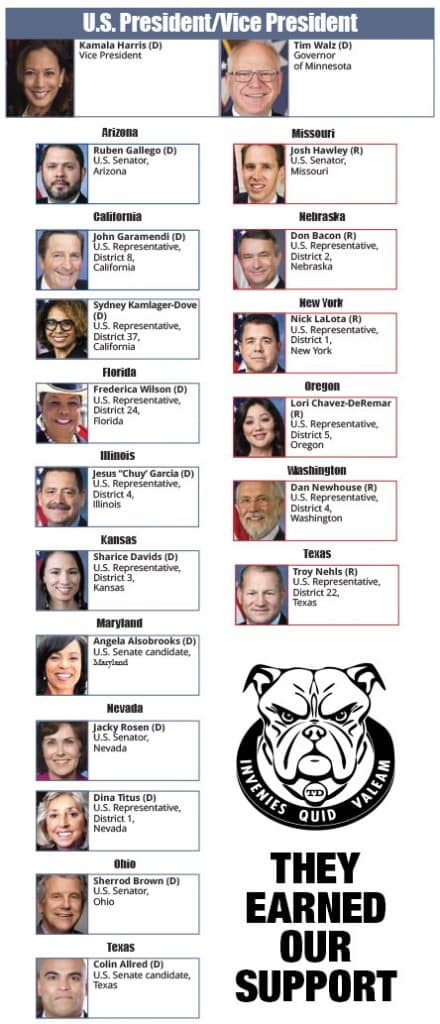
Prior to the Nov. 5, 2024, election, your union has endorsed the following candidates to represent workers’ interests in Washington, D.C.

These selections were made by SMART Transportation Division state legislative boards and national leadership with careful consideration as to the candidates’ track record regarding issues affecting your workplace. In short — who is with us and who is against us.

^ denotes an incumbent candidate

President/Vice President:
Kamala Harris/Tim Walz

Alabama

House of Representatives
Dist. 2: Shomari Figures (D)
Dist. 7: Terri A. Sewell (D)^

Alaska

House of Representatives
At Large: Mary Peltola (D)^

Arizona

U.S. Senate
Ruben Gallego

House of Representatives
Dist. 1: Amish Shah (D)
Dist. 3: Yassamin Ansari (D)
Dist. 4: Greg Stanton (D)^
Dist. 7: Raul Grijalva (D)^

Arkansas

House of Representatives
Dist. 2: Marcus Jones (D)
Dist. 3: Caitlin Draper (D)
Dist. 4: Risie Howard (D)

California

Senate
Adam Schiff (D)

House of Representatives
Dist. 2: Jared Huffman (D)^
Dist. 3: Jessica Morse (D)
Dist. 4: Mike Thompson (D)^
Dist. 5: Mike Barkley (D)
Dist. 6: Ami Bera (D)^
Dist. 7: Doris Matsui (D)^
Dist. 8: John Garamendi (D)^
Dist. 9: Josh Harder (D)^
Dist. 10: Mark DeSaulnier (D)^
Dist. 11: Nancy Pelosi (D)^
Dist. 12: Lateefah Simon (D)
Dist. 13: Adam Gray (D)
Dist. 14: Eric Swalwell (D)^
Dist. 15: Kevin Mullin (D)^
Dist. 16: Evan Low (D)
Dist. 17: Ro Khanna (D)^
Dist. 18: Zoe Lofgren (D)^
Dist. 19: Jimmy Panetta (D)^
Dist. 21: Jim Costa (D)^
Dist. 22: Rudy Salas (D)
Dist. 23: Derek Marshall (D)
Dist. 24: Salud Carbajal (D)^
Dist. 25: Raul Ruiz (D)^
Dist. 26: Julia Brownley (D)^
Dist. 27: George Whitesides (D)
Dist. 28: Judy Chu (D)^
Dist. 29: Luz Rivas (D)
Dist. 30: Laura Friedman (D)
Dist. 31: Gil Cisneros (D)
Dist. 32: Brad Sherman (D)^
Dist. 33: Pete Aguilar (D)^
Dist. 34: Jimmy Gomez (D)^
Dist. 35: Norma Torres (D)^
Dist. 36: Ted Lieu (D)^
Dist. 37: Sydney Kamlager-Dove (D)^
Dist. 38: Linda Sanchez (D)^
Dist. 39: Mark Takano (D)^
Dist. 40: Joe Kerr (D)
Dist. 41: Will Rollins (D)
Dist. 42: Robert Garcia (D)
Dist. 43: Maxine Waters (D)^
Dist. 44: Nanette Barragan (D)^
Dist. 45: Derek Tran (D)
Dist. 46: Lou Correa (D)^
Dist. 47: Dave Min (D)
Dist. 48: Stephen Houlahan (D)
Dist. 49: Mike Levin (D)^
Dist. 50: Scott Peters (D)^
Dist. 51: Sara Jacobs (D)^
Dist. 52: Juan Vargas (D)^

Colorado

House of Representatives
Dist. 1: Diana DeGette (D)^
Dist. 2: Joe Neguse (D)^
Dist. 3: Adam Frisch (D)
Dist. 6: Jason Crow (D)^
Dist. 7: Brittany Pettersen (D)^
Dist. 8: Yadira Caraveo (D)^

Connecticut

Senate
Chris Murphy (D)^

House of Representatives
Dist. 1: John Larson (D)^
Dist. 2: Joe Courtney (D)^
Dist. 3: Rosa DeLauro (D)^
Dist. 4: Jim Himes (D)^
Dist. 5: Jahana Hayes (D)^

Delaware

Senate
Lisa Blunt Rochester (D)

House of Representatives
At-Large: Sarah McBride (D)

Florida

Senate
Debbie Mucarsel-Powell (D)

House of Representatives
Dist. 9:
Darren Soto (D)^
Dist. 24: Frederica Wilson (D)^
Dist. 25: Debbie Wasserman Schultz (D)^
Dist. 26: Mario Diaz-Balart (R)^
Dist. 27: Maria E. Salazar (R)^

Georgia

House of Representatives
Dist. 2: Sanford Bishop (D)^
Dist. 4: Hank Johnson (D)^
Dist. 5: Nikema Williams (D)^
Dist. 6: Lucy McBath (D)^
Dist. 13: David Scott (D)^

Hawaii

Senate
Mazie Hirono (D)^

House of Representatives
Dist. 1: Ed Case (D)^
Dist. 2: Jill Naomi Tokuda (D)

Idaho

House of Representatives
Dist. 1: Kaylee Peterson (D)

Illinois

House of Representatives
Dist. 1: Jonathan Jackson (D)^
Dist. 2: Robin Kelly (D)^
Dist. 3: Delia C. Ramirez (D)^
Dist. 4: Jesus “Chuy” Garcia (D)^
Dist. 5: Mike Quigley (D)^
Dist. 6: Sean Casten (D)^
Dist. 7: Danny Davis (D)^
Dist. 8: Raja Krishnamoorthi (D)^
Dist. 9: Jan Schakowsky (D)^
Dist. 10: Brad Schneider (D)^
Dist. 11: Bill Foster (D)^
Dist. 13: Nikki Budzinski (D)^
Dist. 14: Lauren Underwood (D)^
Dist. 17: Eric Sorenson (D)^

Indiana

Governor
Mike Braun (R)

Senate
Valerie McCray (D)

House of Representatives
Dist. 1: Frank Mrvan (D)^
Dist. 4: Derrick Holder (D)
Dist. 5: Deborah Pickett (D)
Dist. 7: Andre Carson (D)^
Dist. 8: Erik Hurt (D)
Dist. 9: Timothy Peck (D)

Iowa

House of Representatives
Dist. 1:
Christina Bohannan (D)
Dist. 2: Sarah Corkery (D)
Dist. 3: Lanon Baccam (D)
Dist. 4: Ryan Melton (D)

Kansas

House of Representatives
Dist. 1:
Tracey Mann (R)^
Dist. 2: Nancy Boyda (D)
Dist. 3: Sharice Davids (D)^
Dist. 4: Esau Freeman (D)

Kentucky

House of Representatives
Dist. 3:
Morgan McGarvey (D)^

Louisiana

House of Representatives
Dist. 2: Troy Carter (D)^
Dist. 6: Cleo Fields (D)

Maine

Senate
Angus King (I)^

House of Representatives
Dist. 1:
Chellie Pingree (D)^
Dist. 2: Jared Golden (D)^

Maryland

Senate
Angela Alsobrooks (D)^

House of Representatives
Dist. 2:
Johnny Olszewski (D)
Dist. 3: Sarah Elfreth (D)
Dist. 4: Glenn Ivey (D)^
Dist. 5: Steny H. Hoyer (D)^
Dist. 6: April McClain Delaney (D)
Dist. 7: Kweisi Mfume (D)^
Dist. 8: Jamie Raskin (D)^

Massachusetts

Senate
Elizabeth Warren (D)^

House of Representatives
Dist. 1:
Richard Neal (D)^
Dist. 2: Jim McGovern (D)^
Dist. 3: Lori Trahan (D)^
Dist. 4: Jake Auchincloss (D)^
Dist. 5: Katherine Clark (D)^
Dist. 6: Seth Moulton (D)^
Dist. 7: Ayanna Pressley (D)^
Dist. 8: Stephen Lynch (D)^
Dist. 9: Bill Keating (D)^

Michigan

Senate
Elissa Slotkin (D)^

House of Representatives
Dist. 1:
Callie Barr (D)
Dist. 3: Hillary Scholten (D)^
Dist. 6: Debbie Dingell (D)^
Dist. 7: Curtis Hertel (D)
Dist. 8: Kristen McDonald Rivet (D)
Dist. 10: Carl Marlinga (D)
Dist. 11: Haley Stevens (D)^
Dist. 12: Rashida Tlaib (D)

Minnesota

Senate
Amy Klobuchar (D)^

House of Representatives
Dist. 1:
Rachel Bohman (D)
Dist. 2: Angie Craig (D)^
Dist. 3: Kelly Morrison (D)
Dist. 4: Betty McCollum (D)^
Dist. 5: Ilhan Omar (D)^
Dist. 8: Jen Schultz (D)

Mississippi

House of Representatives
Dist. 2:
Bennie Thompson (D)^

Missouri

Senate
Josh Hawley (R)^

House of Representatives
Dist. 1:
Welsey Bell (D)
Dist. 2: Roy Hartmann (D)
Dist. 3: Bethany Mann (D)
Dist. 4: Jeanette Cass (D)
Dist. 5: Emanuel Cleaver II (D)^
Dist. 7: Missi Hesketh (D)
Dist. 8: Jason Smith (R)^

Montana

Senate
John Tester (D)^

House of Representatives
Dist. 1:
Monica Tranel (D)
Dist. 2: John Driscoll (D)

Nebraska

Senate
Deb Fischer (R)^

House of Representatives
Dist. 1:
Mike Flood (R)^
Dist. 2: Don Bacon (R)^

Nevada

Senate
Jacky Rosen (D)^

House of Representatives
Dist. 1: Dina Titus (D)^
Dist. 3: Susie Lee (D)^
Dist. 4: Steven Horsford (D)^

New Hampshire

Governor
Joyce Craig (D)

House of Representatives
Dist. 1:
Chris Pappas (D)^
Dist. 2: Maggie Goodlander (D)

New Jersey

Senate
Andy Kim (D)^

House of Representatives
Dist. 1:
Donald Norcross (D)^
Dist. 3: Herb Conaway (D)
Dist. 4: Chris Smith (R)^
Dist. 5: Joshua Gottheimer (D)^
Dist. 6: Frank Pallone (D)^
Dist. 8: Rob Menendez (D)^
Dist. 9: Nellie Pou (D)
Dist. 10: LaMonica McIver (D)^
Dist. 11: “Mikie” Sherrill (D)^
Dist. 12: Bonnie Watson Coleman (D)^

New Mexico

Senate
Martin Heinrich (D)

House of Representatives
Dist. 1:
Melanie Stansbury (D)^
Dist. 2: Gabriel “Gabe” Vasquez (D)^
Dist. 3: Teresa Leger Fernandez (D)^

New York

Senate
Kristen Gillibrand (D)^

House of Representatives
Dist. 1:
Nick LaLota (R)^
Dist. 2: Andrew R. Garbarino (R)^
Dist. 3: Tom Suozzi (D)^
Dist. 4: Anthony D’Esposito (R)^
Dist. 5: Gregory Meeks (D)^
Dist. 6: Grace Meng (D)^
Dist. 7: Nydia Velasquez (D)^
Dist. 8: Hakeem Jefferies (D)^
Dist. 9: Yvette Clark (D)^
Dist. 10: Dan Goldman (D)^
Dist. 11: Andrea Morse (D)
Dist. 12: Jerrold Nadler (D)^
Dist. 13: Adriano Espaillat (D)^
Dist. 14: Alexandria Ocasio-Cortez (D)^
Dist. 15: Ritchie Torres (D)^
Dist. 16: George Latimer (D)
Dist. 17: Mike Lawler (R)^
Dist. 18: Pat Ryan (D)^
Dist. 19: Marc Molinaro (R)^
Dist. 20: Paul Tonko (D)^
Dist. 21: Paula Collins (D)
Dist. 22: John Mannion (D)
Dist. 23: Thomas Carle (D)
Dist. 24: David Wagenhauser (D)
Dist. 25: Joseph Morelle (D)^
Dist. 26: Tim Kennedy (D)^

North Carolina

House of Representatives
Dist. 1:
Don Davis (D)^
Dist. 2: Deborah Ross (D)^
Dist. 4: Valerie Foushee (D)^
Dist. 12: Alma Adams (D)

North Dakota

Governor
Merrill Piepkorn (D)

House of Representatives
At Large:
Trygve Hammer (D)

Ohio

Senate
Sherrod Brown (D)^

House of Representatives
Dist. 1:
Greg Landsman (D)^
Dist. 3: Joyce Beatty (D)^
Dist. 6: Michael Rulli (R) ^
Dist. 9: Marcy Kaptur (D)^
Dist. 10: Michael Turner (R)^
Dist. 11: Shontel Brown (D)^
Dist. 13: Emilia Sykes (D)^
Dist. 14: David Joyce (R)^
Dist. 15: Adam Miller (D)

Oklahoma

House of Representatives
Dist. 1:
Dennis Baker (D)
Dist. 3: Frank Lucas (R)^
Dist. 4: Tom Cole (R)^
Dist. 5: Madison Horn (D)

Oregon

House of Representatives
Dist. 1:
Suzanne Bonamici (D)^
Dist. 3: Maxine Dexter (D)
Dist. 4: Val Hoyle (D)^
Dist. 5: Lori Chavez-DeRemer (R)^
Dist. 6: Andrea Salinas (D)^

Pennsylvania

Senate
Bob Casey (D)^

House of Representatives
Dist. 1:
Brian Fitzpatrick (R)^
Dist. 2: Brendan Boyle (D)^
Dist. 3: Dwight Evans (D)^
Dist. 4: Madeline Dean (D)^
Dist. 5: Mary Gay Scanlon (D)^
Dist. 6: Christina Houlahan (D)^
Dist. 7: Susan Wild (D)^
Dist. 8: Matt Cartwright (D)^
Dist. 10: Janelle Stelson (D)
Dist. 13: John Joyce (R)^
Dist. 17: Chris Deluzio (D)

Rhode Island

Senate
Sheldon Whitehouse (D)^

House of Representatives
Dist. 1:
Gabe Amo (D)^
Dist. 2: Seth Magaziner (D)^

South Carolina

House of Representatives
Dist. 6:
Jim Clyburn (D)^

South Dakota

House of Representatives
At Large:
Sheryl Johnson (D)

Tennessee

Senate
Gloria Johnson (D)

House of Representatives
Dist. 7:
Megan Barry (D)
Dist. 9: Steve Cohen (D)^

Texas

Senate
Colin Allred (D)

House of Representatives
Dist. 1:
Nathaniel Moran (D)
Dist. 4: Simon Cardell (D)
Dist. 7: Lizzie Pannill Fletcher (D)^
Dist. 8: Laura Jones (D)
Dist. 9: Al Green (D)^
Dist. 14: Rhonda Hart (D)
Dist. 16: Veronica Escobar (D)^
Dist. 18: Sylvester Turner (D)
Dist. 20: Joaquin Castro (D)^
Dist. 21: Kristin Hook (D)
Dist. 22: Troy Nehls (R)^
Dist. 23: Tony Gonzales (R)^
Dist. 24: Sam Eppler (D)
Dist. 29: Sylvia Garcia (D)^
Dist. 30: Jasmine Crockett (D)
Dist. 33: Marc Veasey (D)^
Dist. 34: Vicente Gonzalez Jr. (D)^
Dist. 35: Greg Casar (D)^
Dist. 37: Lloyd Doggett (D)^

Utah

No endorsements

Vermont

Senate
Bernie Sanders (I)^

House of Representatives
At Large:
Becca Balint (D)^

Virginia

Senate
Tim Kaine (D)^

House of Representatives
Dist. 2:
Missy Smasal (D)
Dist. 3: Bobby Scott (D)^
Dist. 4: Jennifer McClellan (D)^
Dist. 7: Eugene Vindman (D)
Dist. 8: Don Beyer (D)^
Dist. 10: Suhas Subramanyam (D)
Dist. 11: Gerry Connolly (D)^

Washington

Governor
Bob Ferguson (D)

Senate
Maria Cantwell (D)^

House of Representatives
Dist. 1:
Suzan DelBene (D)^
Dist. 2: Rick Larsen (D)^
Dist. 3: Marie Gluesenkamp Perez (D)
Dist. 4: Dan Newhouse (R)^
Dist. 6: Emily Randall (D)
Dist. 7: Pramila Jayapal (D)^
Dist. 8: Kim Schrier (D)^
Dist. 9: Adam Smith (D)^
Dist. 10: Marilyn Strickland (D)^

West Virginia

No endorsements

Wisconsin

Senate
Tammy Baldwin (D)^

House of Representatives
Dist. 1:
Peter Barca (D)
Dist. 2: Mark Pocan (D)^
Dist. 3: Derrick Van Orden (R)^
Dist. 4: Gwen Moore (D)^
Dist. 5: Ben Steinhoff (D)
Dist. 6: John Zarbano (D)
Dist. 8: Kristin Lyerly (D)

Wyoming

Senate
Scott Morrow (D)

House of Representatives
At Large:
Kyle Cameron (D)

^denotes incumbent