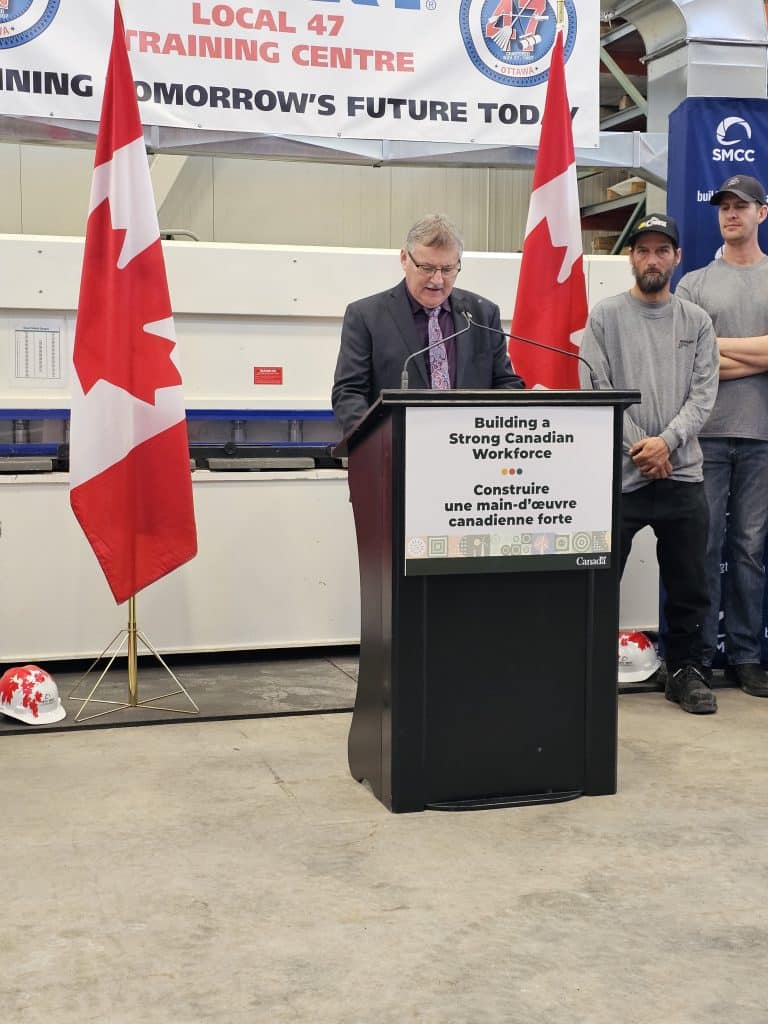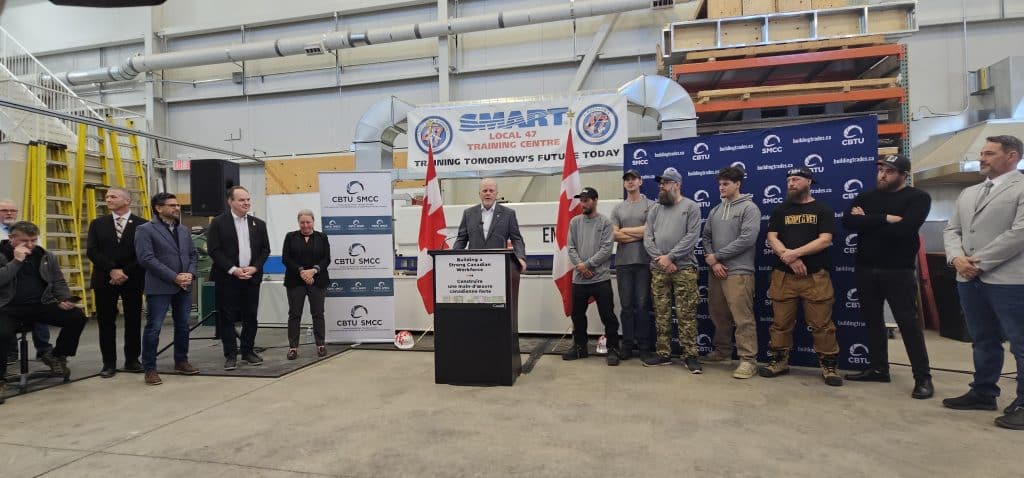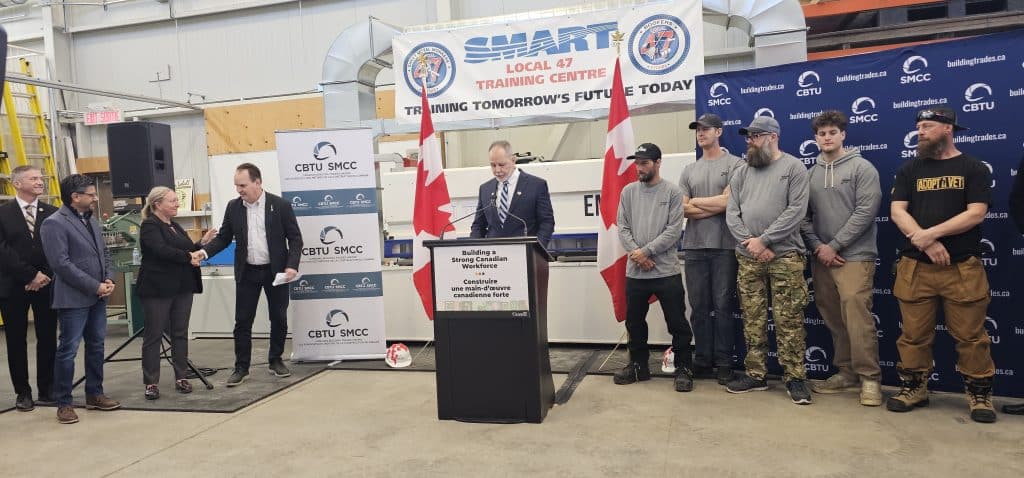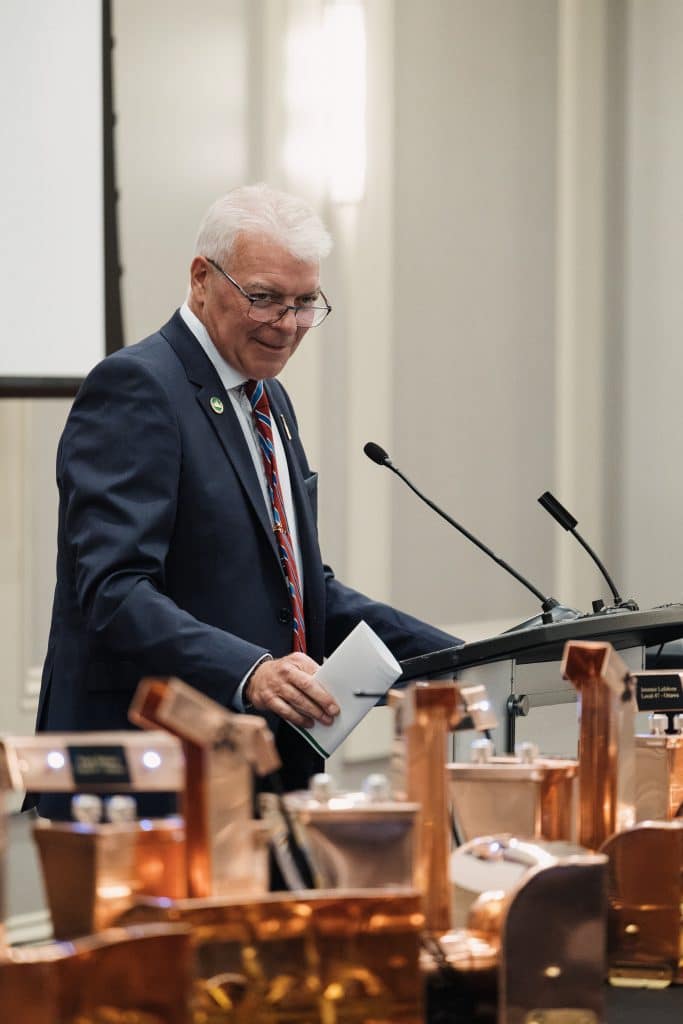
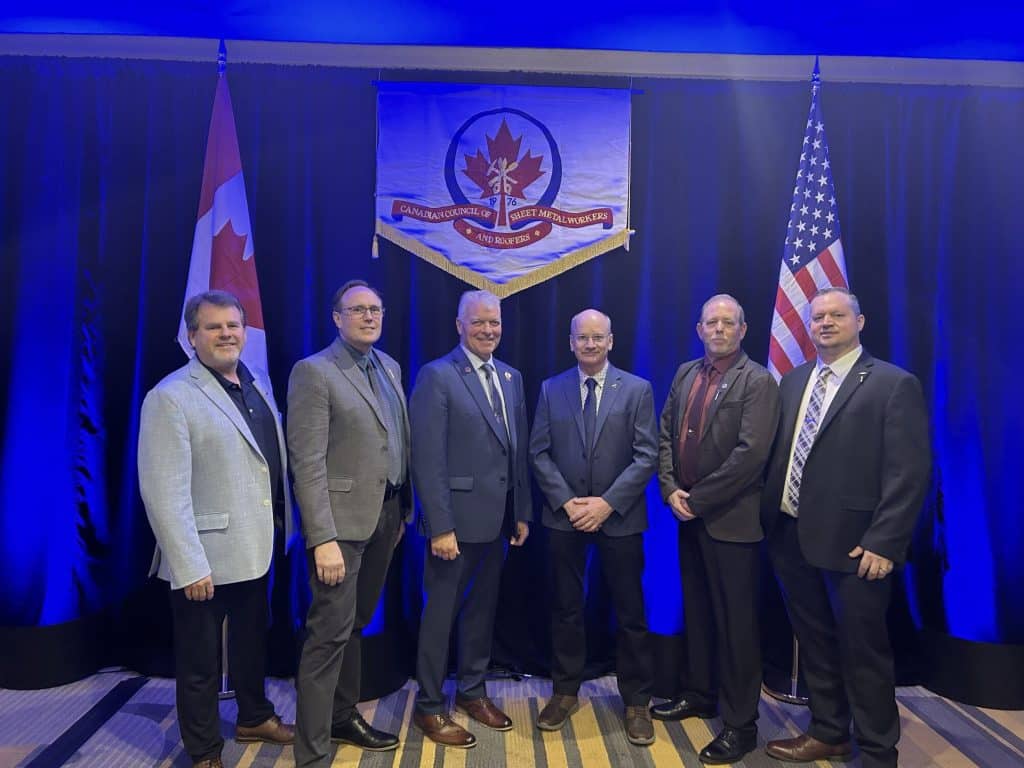
On March 18, 2025, Steven MacKinnon, minister of Jobs and Families in Canada, visited the SMART Local 47 (Ottawa, Ontario) training centre to announce $67 million in funding for unions to enhance training, aimed at ensuring skilled trades workers lead the transition to the clean economy of the future. The funding, awarded through the Union Training and Innovation Program (UTIP) Sustainable Jobs Stream, included a possible $8.9 million for SMART.
“We’re thrilled that the government has awarded this project to SMART,” said Jack Wall, SMART director of Canadian affairs. “This funding will go a long way to significantly improving the quality of the training our members receive and will help more than 2,000 of our members upgrade their skills, and build a new permanent resource for every apprentice and journey-worker in our trade.”
SMART Canada has been working for years to make sure Canada’s green future is built union. Since the Canadian government announced its ambitious goal to achieve net-zero carbon emissions by 2050, SMART has worked to promote strong labour standards in federal policy, secure funding for training programs such as Canada’s Building Trades Unions’ “Building It Green” initiative, promote the union sheet metal and roofing trades as pathways to good jobs, and more.
Partnering with CBTU and SkillPlan Canada to help secure financial assistance for new training is the next step in that process. Overall, the funding announced by MacKinnon in March will go to 10 union-led projects across Canada, training nearly 29,300 tradespeople with the skills they’ll need to build Canada’s new clean economy. The Local 47 training centre was one of the beneficiaries of that funding; CBTU and SMART also received funding to develop a national online training curriculum, empowering sheet metal workers nationwide to access always-available training to develop crucial skills for clean energy work.
“This is an exciting day for our organization,” Wall concluded. “This will be a team effort to help redevelop some of our curriculum and help train our members to be better prepared for green projects — and to pass those skills on to future generations.”
The International Association of Sheet Metal, Air, Rail and Transportation Workers (SMART) issued the following statement from General President Michael Coleman in response to announced tariffs impacting members across North America:
“For generations, the United States and Canada have benefited directly from the hard work of SMART members across North America. Union sheet metal workers and roofers in both nations have built strong, cooperative economies that support communities on either side of the border — working hand-in-hand to assure the mutual progress of American and Canadian families.
“For that reason, SMART strongly opposes the imposition of blanket tariffs that threaten jobs, raise costs and disrupt the long-standing economic partnership between the United States and Canada. These tariffs will harm SMART members, jeopardize industries that depend on our integrated supply chains and damage cross-border trade.
“We need trade policies that strengthen North American industries, protect union jobs and reinforce the shared success of the United States and Canada. What we are getting instead are policies that weaken the U.S.-Canada relationship, threatening the industries that put union members to work.
“Union workers across North America want the same things: good, family-sustaining jobs, stellar pay, a retirement with dignity. We will continue to work directly with our two governments to advocate for solutions that recognize the value of a strong, fair and balanced trading relationship between our two countries.
“Most importantly, we will not be divided. We are union brothers and sisters, regardless of what state, province or nation we call home. SMART members across North America will always stand together in solidarity, and we call on our federal governments to negotiate fair trade policies that put workers first.”
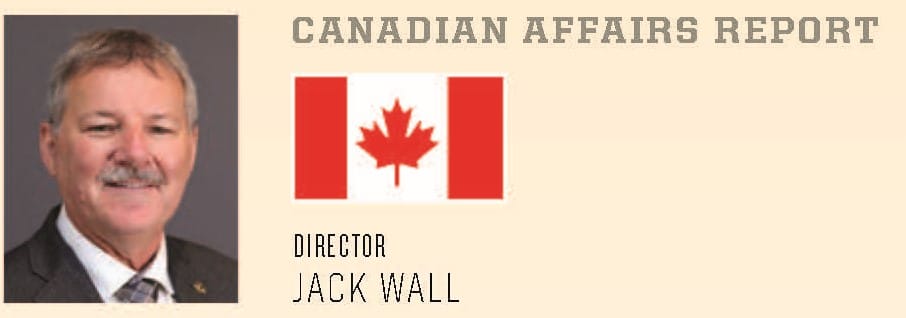
In November 2024, the SMART General Executive Council voted to appoint longtime SMART leader Jack Wall as the new director of Canadian Affairs, the latest step in a journey spent advocating for workers in provinces and territories across Canada.
“Brother Jack Wall has dedicated his life to advocating for the workers who make up our industry,” said SMART General President Michael Coleman. “With his four decades of knowledge in the sheet metal industry, we look forward to Jack’s leadership in Canada and wish him great success in his new role.”
Brother Wall began his career as a sheet metal worker with Local 56 (Cape Breton, Nova Scotia) 38 years ago. He began serving his fellow union members as recording secretary in 1990 and held that position through 2005, when he became business manager and financial secretary-treasurer. Over the next 19 years, he dramatically increased membership diversity at the young and growing local, demonstrating a commitment to the values of our union.
On October 1, 2021, Wall was elected to the SMART General Executive Council; after nearly three years serving on the GEC, he became an International representative in 2024, working in that capacity until his appointment as director of Canadian Affairs.
Throughout his career, Wall has sat on various boards and councils, including on the Nova Scotia Construction Sector Council and the executive board of the Canadian Council of Sheet Metal Workers and Roofers since 2008. He serves as the president of the Cape Breton Island Building and Construction Trades Council, has been a member on the Nova Scotia Apprenticeship Committee for the last 16 years, and has sat as a trustee to the Local Union & Council Pension Fund since 2018. He is a sitting member of the Nova Scotia Labour Board and has been listening to hearings since 2019. And in March 2024, he was appointed as the SMART delegate to the General Presidents’ Maintenance Committee for Canada & National Maintenance Council for Canada (GPMC/NMC).
As SMART’s new director of Canadian Affairs, Wall will work closely with International staff, local union officers and more to support our union’s efforts to organize and grow, from Vancouver to Toronto to St. John’s (and everywhere in between).
It’s an exciting time to be a sheet metal worker, a roofer and a trade unionist in Canada, and I’m honored to be given the opportunity to serve our members as the new director of Canadian Affairs,” Wall said. “To every single member of this great labour organization: I will work tirelessly to represent you to the best of my abilities.”
“We have apprentices from all over Ontario competing. They’re representing their locals and their contractors, and they’re doing a great job,” said Provincial Training Director Scott Wood on the day of the competition. “It’s a big trade, it’s a big industry, so we just like to really put it out there that we are looking for tradespeople, and we’re a really lucrative [trade] to be in.”
“They’re having a lot of fun, and it’s just a privilege to be here helping the apprentices move through their career,” added Local 47 Director of Training Stuart Simpson.
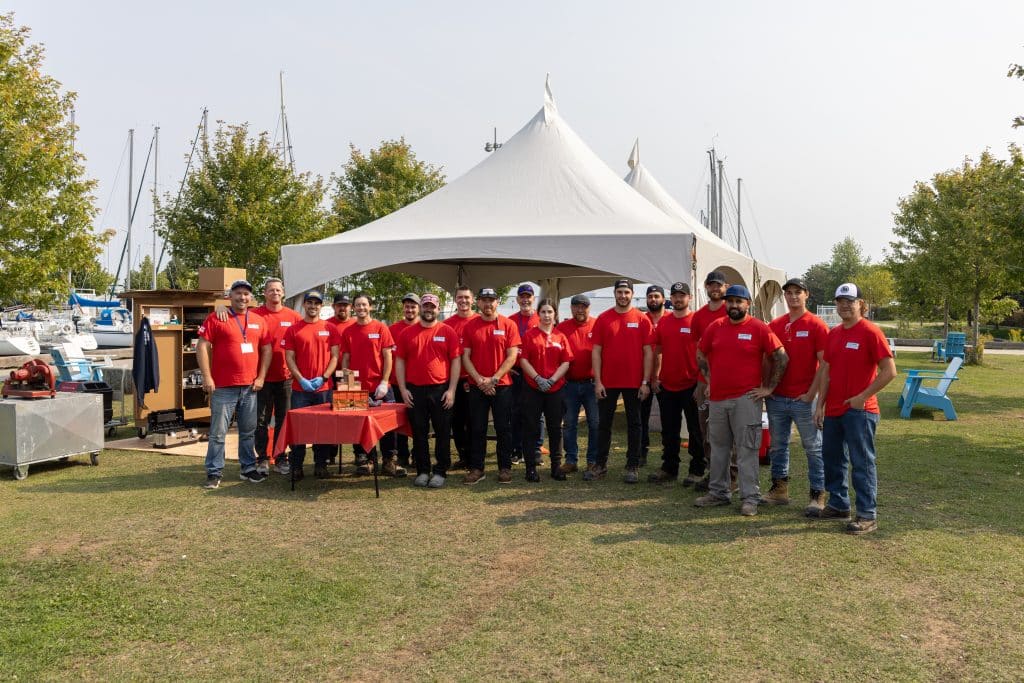
Fifteen apprentices underwent a theory test and a drafting test, but the marquee event was the shop component: building a model snowblower out of copper, complete with brass augers and a hand-made, one-inch Pittsburgh lock.
“[It’s] pretty difficult to do — working with copper is really, really hard, it’s very soft and scratches easily,” said Local 562 apprentice Sam Grant. “It’s pretty cool.”
Following the competition, apprentices gathered with local officers and fellow members for a dinner and awards presentation. Congratulations, all!
Locals represented: Local 30 (Toronto), Local 47 (Ottawa), Local 235 (Windsor), Local 269 (Kingston), Local 285 (Toronto), Local 397 (Thunder Bay), Local 473 (London), Local 537 (Hamilton) and Local 562 (Kitchener).
On June 4, 2024, an op-ed by Chris Paswisty, former director of Canadian Affairs at SMART, and Krista Wylie, co-founder of Fix Our Schools, was published in the Edmonton Journal. The article discussed the severe air quality issues in British Columbia, Alberta and Manitoba as a result of wildfires, particularly in schools, and is republished below.
As the world marks another Clean Air Day, it is incumbent on policymakers across Canada to ensure clean air, both inside and out, is a reality. Last year, on Clean Air Day, wildfires led Canada to record the worst air quality in the world. And already this spring, British Columbia, Alberta and Manitoba are witnessing some of the worst air quality levels on record.
Exacerbated by climate change effects, the increased prevalence of wildfires has resulted in prolonged periods of poor air quality across the country. This is causing a new public health crisis to emerge, and it is impacting our most vulnerable population, our children.
Wildfire smoke significantly deteriorates air quality, leading to increased respiratory illnesses, asthma and other health complications. Particulate matter in wildfire smoke can penetrate deep into the lungs, causing immediate and long-term health impacts, particularly in children whose respiratory systems are still developing.
Although many provinces, including Ontario, B.C. and Alberta, have made commendable investments in HEPA filters for schools since 2020, this must be part of a broader, more comprehensive strategy for schools across the country. This measure alone is insufficient to protect our children against harmful pollutants as many school buildings still rely on outdated ventilation infrastructure, open windows, or use fans that are circulating dirty, unfiltered air.
As Canada continues to grapple with the escalating frequency and intensity of wildfires, the current infrastructure is just not advanced enough for the challenges posed by today’s environmental conditions. Upgrading these systems to meet modern standards is a must — particularly as children spend an average of 120 hours a month in school.
In 2022–23, air quality monitoring was conducted in New Brunswick schools, and it was found that 83% of the schools accessed exceeded peak CO2 limits, among other pollutants. Continuous air quality monitoring is crucial to install the proper equipment.
To safeguard the health of our children, Canada must implement regulations to monitor, measure and report air quality levels in schools across the country. Once results are available, decisions can be made on additional funding for necessary infrastructure, such as air ventilation and filtration systems, to ensure children are not at risk while attending classes.
The last time the Ontario provincial government released school disrepair data was in June 2021. At that time, the school repair backlog stood at a whopping $16.8 billion. Fix Our Schools, a parent advocacy group in Ontario, estimates that this repair backlog has continued to grow year-over-year, with the figure likely being well over $17 billion by now.
Fix Our Schools points out that this total repair backlog number does not include much-needed improvements, such as equipment to monitor air quality, and other investments required to improve air quality in classrooms. The time to act is now.
As NDP MPP Chandra Pasma rightly emphasized when introducing the Air Quality for Our Children Act, strong air quality in schools has been shown to improve overall health, reduce the spread of airborne infections and boost children’s test scores.
Increasing wildfires across Canada serve as a stark reminder that new legislation and funding is required to ensure all children have access to a clean and safe learning environment for years to come.
On behalf of myself, the SMART General Executive Council and all your brothers and sisters across this union, I want to wish you a happy Thanksgiving.
Today is a day to gather with loved ones and enjoy precious time with family and friends. As the essential workers who build the HVAC systems, roofs and building envelopes that keep Canadian society moving, we know well just how valuable these precious moments are.
It’s also a day to take stock of the things for which we are grateful. Our union is full of people from a wide variety of backgrounds, with our own belief systems and practices, and we all have unique traditions that we celebrate. But today, no matter what you choose to do, I hope you can remember the things we have in common.
Union members nationwide know that days like today — and the ability to spend them with loved ones — are rights that were fought for, tooth and nail. It was our forebearers’ undying solidarity and resolve that won these and other privileges for today’s Canadians. Each of us should be proud to be part of a collective labour movement that has bettered the lives of working-class people across every province and territory; I hope you all wear the title of trade unionist proudly, today and every day.
Brothers and sisters, it is our solidarity with one another that keeps our union strong. And by working together, we will continue to improve the lives of workers across Canada.
Again, happy Thanksgiving. Enjoy the holiday, and please stay safe.
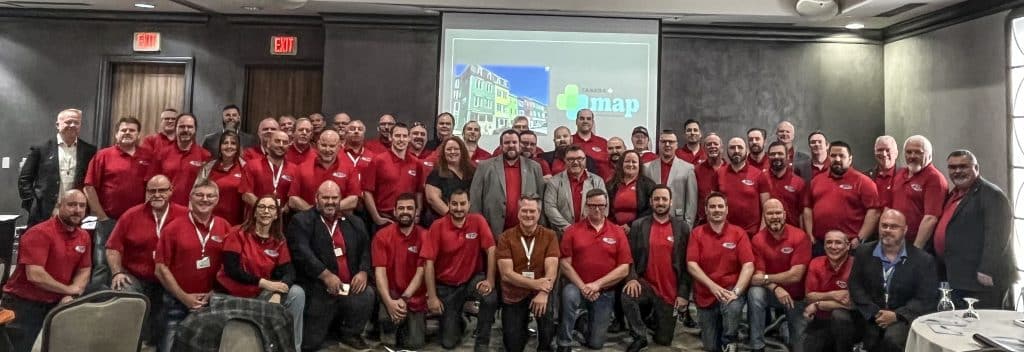
In March, Canadian staff gathered at the Hilton Toronto to participate in the SMART MAP (Members Assistance Program) training. The Canadian Pension and Benet Steering Committee worked with the Sheet Metal Occupational Health Institute Trust (SMOHIT) to organize the SMART MAP class for Canada, which was held on March 26–28, 2024. The class had a tremendous turnout, with over 50 participants including business managers, financial secretary-treasurers, business representatives, organizers, training instructors and office staff from across Canada.
The training focused on providing staff with tools and strategies to help support members who may be experiencing addiction and/or mental health concerns. The training was well received, and attendees emphasized a desire for more education and training. A big thank you to Chris Carlough, director of wellness and mental health support, and the team from SMOHIT for providing real-life experiences so we can better assist our members in their time of need.
Canadian Council of Sheet Metal Workers & Roofers Convention
In May, the Canadian Council met in Saint John, New Brunswick, and elections were held. Congratulations to President Jason Pedersen (Local 276, Victoria), Vice President George McDonald (Local 56, Nova Scotia), Recording Secretary-Treasurer Mark Hall (Ontario Conference), and Members at Large TJ King (Local 297, West), Gerald Murphy (Local 512, East) and Bob Gougeon (Local 285, Ontario) on your elections.
Retirement recognition was given to Brother Art White, who dedicated many years of service to the members, his local and the council. We wish him all the best in his retirement. Brother Lawrence Coulis was recognized for his contributions, as he will not be standing for reelection at Local 562 (Kitchener, Ontario).
The SMART Steering Committee presented a variety of initiatives, including SMART MAP Canada and peer-to-peer programming, HearCANADA, a hearing aid program, SMART index funds for Canadian local investments, Hamilton Lane SMART Air and Energy Fund and the SMART Canada Life Insurance Program.
Showcasing our skills
This year’s sheet metal apprentice competition showcased the talents of 12 apprentices who were tasked with duplicating the World’s Largest Axe! Built in 1991 and rising 49 feet above the glorious Saint John River, this landmark is a gleaming symbol of the industrious lives and legacies of Canada’s lumberjacks. Congratulations to first-place and Congeniality Award winner Kevin Berkmortel of Local 473 (London), second-place winner Jamie Weir of Local 30 (Toronto), third-place winner Jacob Wiebe of Local 235 (Windsor) and fourth-place winner Colin Nam of Local 280 (Victoria, B.C.).
The roofing competition demonstrated the skill and technique of nine apprentices who were tasked with the practical application of two roofing techniques: single and two-ply. Congratulations to first-place winner Elias Taylor from Local 276 (Victoria), second-place winner Matthew Rector, Local 409 (Halifax) and third-place and Congeniality Award winner Liam Power, Local 437 (Saint John, New Brunswick).
Staff announcements
Brother Jack Wall, former business manager/financial secretary-treasurer of Local 56 and eighth general vice president, has been appointed International representative for Atlantic Canada, replacing retired International Representative Leonard Day. Brother Wall started his new position on January 1, 2024.
On May 1, 2024, Brother Patrick Gordon was appointed to the position of International representative for business development in Canada. This position will be key in leading nationwide campaigns with coalitions of International and local union staff, along with key partners in the architectural, roofing, HVAC and building envelope sectors. Emphasis will be placed on organizing, educating and promoting our trades to the public, our members and buyers of construction.
Raising our profile
SMART Canada has been working with a government relations firm, which has been paramount in establishing and creating networking opportunities with various MPs, MPPs and ministers. We have appeared before the Ontario Finance Committee to make recommendations for provincial oversight of compulsory certification of licensed trades, investing in the Infrastructure Health & Safety Association (IHSA), consultations on jobsite working conditions and equitable access to Skills Development Fund Training Streams. Together, we have developed government relations priorities centered around consumer protection, skilled trades and long-term care facilities. We have authored consumer alerts, as well as stories on fraud prevention and air quality. As the wildfires continue to burn across our country, we will continue to raise the issue of indoor air quality.
Working families across North America continue to bear the brunt of the climate crisis, from extreme heat and natural disasters to poor air quality caused by wildfire smoke. The Canadian government is pursuing aspirational green economy goals in response — and SMART Canada is working to take advantage, organizing and recruiting to make sure the provinces’ sustainable future is union made.
“Transitioning Canada’s workforce to net-zero and ensuring our members receive the skills required to lead the change — without losing jobs — is critical to our economy,” said SMART Director of Canadian Affairs Chris Paswisty.
To that end, SMART Canada recently targeted potential recruits across the nation with a digital advertising campaign. Students and guidance counselors received a video introducing them to the skilled trades, with a link to SMART’s Canadian website providing information on how to get involved. The video proclaims: “This is OUR time, so think green, think clean, think SMART” — emphasizing that a new focus on green industries provides bountiful career opportunities.
“We see the worsening effects of climate change every year,” Paswisty added. “Taking action isn’t just about the future of our planet and the world we leave behind for the next generation. This is about providing for our members, both today and tomorrow.”
The Canadian government’s current goal is to achieve net-zero carbon emissions, as a society, by the year 2050. Doing so will require a massive, nationwide effort — one that will rely largely on SMART’s skilled sheet metal workers and roofers. SMART Canada’s new apprenticeship web page underlines that fact, making clear that our green energy future will create plenty of jobs.
“Our sheet metal workers fabricate and install proper ventilation and air filtering systems, ensuring the overall health and energy efficiency of schools, offices, hospitals, factories, nuclear plants and homes,” said Paswisty. “Our architectural and roofing members play a crucial role in the building envelope, again helping structures operate efficiently, and they install green roofing that helps reduce greenhouse gases and improve air quality. Canada needs our members to complete the green transition.”
Union workers are being helped by political action. The Government of Canada’s 2023 federal budget featured a far-reaching focus on Canada’s green economy, including broadened investment in private-sector-led infrastructure, strong responses to the U.S. Inflation Reduction Act and much more. Perhaps most importantly, the budget tied green tax incentives to one of the strongest definitions of prevailing wage Canada has ever seen — one that incorporates union compensation, benefits and pension contributions, helping create good-paying union jobs as Canada transitions to sustainable energy.
In addition, Canada’s Building Trades Unions (CBTU) are taking steps to make sure today’s workers aren’t left behind. Funded by Employment and Social Development Canada’s Union Training and Innovation Program (UTIP) — which SMART Canada and the CBTU lobbied for extensively — CBTU’s “Building It Green” national training program aims to integrate climate literacy into already existing construction trades education and training, helping apprentices, journeypersons, inspectors and training instructors take on the pressing concerns of climate change. SMART Local 280 (Vancouver, B.C.) President and Training Coordinator Jud Martell helped develop the trade-specific curriculum for SMART members.
There’s no questioning the fact that the climate crisis is, in fact, a crisis, Paswisty added. But meeting the challenge head-on provides a way forward, both for our communities and for SMART members.
“We are ready to grow and meet the demand by welcoming Canadians into the skilled trades, and we will collaborate with the government to continue driving Canadians towards a career in the trades,” he concluded.
Happy Canada Day from myself and the SMART General Executive Council. Wherever you are today, in cities and towns across the provinces and territories, I hope you can take the time to relax with friends and family.
Canada Day commemorates the day of Canada’s Confederation in 1867. And since that day — even before it — unionists in the labour movement have been bravely organizing, striving to lift the working and living conditions of all Canadians.
Union sheet metal workers and roofers have been an integral part of the nation’s progress throughout its history. And today, SMART Canada members have just as vital a role to play, whether building the green-energy economy of our sustainable future or helping bring new members into our trades.
The Government of Canada has set its sights on achieving a net-zero-emissions society by 2050. It’s an ambitious and important goal, and it’s one that you — sheet metal workers and roofers — are going to make happen. Whether installing green roofs that help reduce carbon emissions or improving the energy efficiency of building envelopes in schools, office buildings and new housing, our members will be critical to the Canada of tomorrow.
We are already seeing the benefits of a worker-first green transition, such as the NextStar EV battery plant project in southwestern Ontario. I’m proud to say that SMART Canada is seizing on these opportunities to lift more families into the better life that we provide: recruiting new members, organizing nonunion workers and spreading the word far and wide about careers in our trades. As I mentioned earlier, Canada’s rich history is intertwined with the story of the union movement. Our bright future will be as well, and it is incumbent on all of us to be organizers; to help our fellow workers achieve the freedom and dignity of a union career, and to welcome every single person — no matter who they are — into our union.
Lastly, as you celebrate Canada Day with loved ones, I hope you’ll join me in honouring the generations of Canadians who have given the ultimate sacrifice to protect our freedoms and democracy.
Happy Canada Day. Enjoy the holiday, and please stay safe!
SMART MAP Coordinator Chris Carlough speaks at the sheet metal Safety Champions Conference.
SMART MAP (Member Assistance Program) mental health sessions have been evolving since they began more than a decade ago to combat the high suicide and substance use disorder rates among construction workers. Participants in the class become SMART MAP mentors as they learn to be mental health first responders — peer counselors able to lend a listening ear and guide fellow SMART members to local resources.
The three-day sessions offer theoretical as well as practical knowledge and the basic skills necessary for crisis intervention. They also give participants information about substance abuse disorder and relapse, motivational interviewing, confidentiality and ethics, legal issues, marijuana, health insurance and treatment center options, suicide prevention, aftercare programs and how to change the culture of the union and help end the stigma of addiction and other mental health issues.
While Canadian brothers and sisters have been included in SMART MAP sessions in the past, due to the pandemic, a session hadn’t made its way north since 2018. With some help from Patricia Pike, a Canadian-American dual citizen and CEO and founder CanAm Interventions, the SMART MAP session held in Toronto on March 26-28 provided a tailored presentation.
“Since we’ve been doing education and training through SMART MAP the last 10 years or so, we’ve had Canadian members attend regular SMART MAP sessions,” said Chris Carlough, SMART MAP coordinator. “It’s not brand new, but the program we delivered this time was specifically designed for Canada.”
The key to a successful SMART MAP mental health session is a group of participants willing to share their experiences and engage with the speakers. The March class was full of such attendees, with a long waitlist emerging within 18 hours of registration opening. Due to the need, the Sheet Metal Occupational Health Institute Trust (SMOHIT) allowed 57 members to attend the course, nearly double the size of a normal session.
Typically, having more than 25-30 participants takes away from the course’s intimacy and engagement. Not this time, said Jeff Bradley, SMOHIT program director.
“It was like a bunch of buddies going out together and talking,” he said. “It was cool.”
“We’ve had sessions before when you’re trying to pull out words, experiences, thoughts out of the attendees, but Canada wasn’t like that,” added Carlough. “It was a raucous event for three days.”
SMART MAP mental health sessions are typically held for local leadership, and the SMART MAP team also presents a peer-to-peer session for rank-and-file members. In July, they will be back in Toronto to impart skills and mental health knowledge to members of Local 285.
“We are doing peer training throughout North America, and we will be present in Canada in 2024,” Carlough said.
The combination of mental health sessions for leadership and peer-to-peer trainings for rank-and-file members helps bring awareness of mental health and substance use disorder to the entire local, Carlough explained.
“In the mental health trainings, we’re talking to people in the room directly,” he noted. “But we’re also talking about the people who they’re going to go back and help in their local unions.”
The success of the session is measured by the knowledge and skills gained and how members use that knowledge to help one another. During the March Toronto session, members developed the confidence to talk about difficult subjects, see different perspectives on addiction, and understand the true definition of self care and useful statistics, according to post-event evaluations.
“We can put this gained knowledge to use immediately,” one member said.
Another added: “Everything covered during this session has been well worth it, and I want to thank the team for all the work you do and help that was given to me.”