
By: Austin Keating, originally published in SNIPS

As wave of workforce demand sweeps the United States, the need for highly skilled, certified HVAC testing, adjusting and balancing (TAB) techni­cians has reached a critical point. In response, Chicago’s SMART Local 73 has opened a newly certified TAB lab — one of just 11 nationwide — to meet the industry’s most rigorous and current standards, and to provide a lifeline for both local apprentices and experienced technicians.

The lab’s recent certification by the International Certification Board (ICB) — under the National Energy Management Institute (NEMI) — ensures that more candidates can now complete their hands-on perfor­mance exams in Chicago, rather than traveling out of state. It’s a significant boost for the pipeline of certified TAB professionals, a group in high demand as older technicians retire and the complexity of building systems continues to climb.

From hall of famers to the next generation

For Leo Thier, a JATC instructor at Local 73 and a veteran of nearly four decades in the trade, the new lab is both a point of pride and a natural next step in a storied local tradition.

“I started my apprenticeship in 1987, and I was lucky enough to have the best instructors ever for TAB — John Christie and Gene Kennedy. They’re literally TAB Hall of Famers,” Thier recalled. “Now, our school has absolutely everything a sheet metal worker could come across, from architectural welding to a fully equipped TAB lab that just got certified.”

The facility features a clean room, fire damper walls and an array of both modern and legacy equipment — so students learn to balance everything from cutting-edge digital controls to the pneumatic systems still found in older buildings.

“We want to show both ends of the spectrum,” Thier said. “We’re adding new stuff to keep it current, but we keep the old controllers too, because that stuff’s still out in the field.”

Setting a national standard — and sharing it

Cassandra Kline, director of certification for ICB, empha­sized the broader impact: “Certifying labs like the one at Local 73 is a critical part of our mission. It guarantees that candidates are tested in facilities that meet rigorous, consistent requirements nationwide.”

The ICB/TABB certification process is accredited to the ISO/IEC 17024 standard, and it has recently been updated to reflect industry and regulatory benchmarks. As part of the transition to updated standards, previ­ously certified labs are undergoing recertification, with Local 73 being one of the first to meet the new benchmarks.

The lab’s reach extends beyond its own members.

“We had some members from other locals — 265, 20 — who wanted to take the test but didn’t have a school available because theirs was being rebuilt,” Thier explained. “We offered to help those members out as well. As far as TAB, you can test at any certified TAB school.”

Training for megaprojects, data centers and the future

The surge in demand for TAB technicians is driven not just by retirements, but also by a boom in projects like battery plants, high-tech manufacturing and data centers.

“This is where our trade is going,” Thier said. “Fire/ smoke damper technician, indoor air quality, building envelope — all those classes are getting more popular every day. Indoor air quality, especially, is a huge future for sheet metal workers.”

Certification is rigorous: Candidates must pass a five-hour written exam and a practical test at an ICB-approved lab, with pathways for advanced super­visor roles. Local 73’s program includes night classes, hands-on labs and, as Thier notes, a commitment to ensuring “everybody that takes the class gets the chance to pass the written test and then take the practical.”

The human side of certification

Thier credits his own mentors with sparking a passion for sharing knowledge.

“I can’t say enough about the instructors I had,” he said. “I picked their brains for every bit of information I could get. I’m just happy to pass it along. That’s what all members should be doing — sharing this information. The more we know, the better off we are.”

The curriculum at Local 73 goes beyond balancing airflows.

“We teach about commissioning, controls, everything,” Thier said. “Owners are hiring third-party commis­sioning agents to check building performance before letting in occupants. It’s all about integrity, and balancing is a big part of that. Owners should be able to trust our reports — they know these are certified people.”

Building trust, building the trade

For both Kline and Thier, the stakes are more than tech­nical; they’re about credibility and opportunity.

“I’m passionate about this because it’s about fairness for the candidates and trust for the industry,” Kline said. “By choosing a certified TAB technician, building owners can be confident the job is done right and meets the highest industry standards.”

With a certified lab now open in Chicago and more facilities upgrading across the country, Thier hopes the next generation will be equipped to meet this moment.

“The best way to build a reliable pipeline is to invest in new talent and make sure the standards are rock solid,” he said.

The Department of Veterans Affairs (VA) added the Testing, Adjusting and Balancing Bureau (TABB) as a third certification body for certifying personnel and contractors who perform testing, adjusting and balancing (TAB) on heating, ventilation and air conditioning (HVAC); water balancing; and sound and vibration equipment testing. The addition was effective Nov. 1, 2021.

With endorsements and acceptance/ inclusion from the VA, the U.S. Army Corps of Engineers, the Sheet Metal and Air Conditioning Contractors’ National Association (SMACNA) and construction companies nationwide, TABB is the professional’s choice for the testing, adjusting and balancing of HVAC systems.

“Certification provides assurance to building owners that a particular contractor will meet a specified level of quality. The need for highly skilled technicians has increased with the complexity of HVAC systems.”

– From a 2020 white paper released the University of California, Davis, Western Cooling Efficiency Center (WCEC)

The decision was based, in part, on a white paper released in 2020 by the University of California, Davis, Western Cooling Efficiency Center (WCEC) — “Testing, Adjusting and Balancing HVAC Systems: An Overview of Certification Agencies” — which examined the benefits of using certified contractors and favorably positioned TABB as the first and only personnel-certifying body accredited by the American National Standards Institute (ANSI) in this field. The paper also stated TABB conforms to ISO/IEC 17024, an internationally recognized standard for personnel certification bodies.

TABB has developed certifications to serve as verification that technicians and supervisors have the knowledge and experience needed to complete the job tasks at hand. A well-balanced HVAC system isn’t just efficient; it’s also safer due to enhanced ventilation rates and overall indoor air quality.

“Certification provides assurance to building owners that a particular contractor will meet a specified level of quality,” the white paper explained. “The need for highly skilled technicians has increased with the complexity of HVAC systems.”

TABB is the first program to gain ANSI accreditation for certification in the testing, adjusting and balancing industry. Certification is a statement that the technician, supervisor and contractor demonstrate the highest level of professional expertise
Adriana Farren has always been into numbers. She earned a bachelor’s degree in human resources with a minor in finance and worked in the front office of the former Sheet Metal Workers Local 41 in Puerto Rico before moving to Pennsylvania in 2011.

This was the point where her life took a much different turn, and it all started with a job working in the office of Comprehensive Test and Balance in Dover, Pennsylvania.

After two years overseeing Farren working in the office, reading plans, going over forms and entering data, Todd Walter, owner of the company, approached her with a question: would you be interested in becoming an apprentice?

“I said, ‘yes.’ Then, he said, ‘You’ll have great benefits,’ and I said, ‘yes’ twice,” Farren recalled with a laugh. “By looking at the reports, I thought it would be a career I would be interested in.”

Walter saw Farren working on bids and learning the drawings, documentation and paperwork and offered up the change to a career instead of a job. A second-generation sheet metal worker, Walter also took the opportunity to guide Farren through the process and mentor her as others had mentored him.

The first lesson: integrity and honesty are important in testing, adjusting and balancing (TAB), he said.

“No matter what you do, they have to believe what you tell them. Adriana had good personal skills. She had the insight. She is very smart, and she was at the top of her class. She fit the bill,” Walter added. “It’s something my father said a long time ago — you can have a job or you can put your head into it and make it a career.”

The first two years of her apprenticeship at Sheet Metal Workers Local 19, Central Pennsylvania, Farren knew she wanted to do testing, adjusting and balancing. So, at night, she took air and water classes and was certified as a technician in 2015 while she was still an apprentice.

Since her graduation in 2017, Farren has continued to gain certifications. She said testing keeps the skills fresh in her mind. To date, she holds a welding certification in addition to duct leakage testing and high-efficiency particulate air (HEPA) testing.

“It’s a continuous learning process. I want to continue learning more about the balancing concept. I like to learn new things every day. I would like to expand my knowledge in different areas related to TAB,” she said. “Having a certification shows people you’re certified in that concept and you know what you’re doing. In order to be a TAB tech, you don’t have to have the certification, but if you do, it proves you know what you’re doing.”

Knowledge, in Farren’s case, was definitely powerful. Although she took English classes on her native island of Puerto Rico, it was her second language. Being the only female balancer at Comprehensive Test and Balance — something Walter would like to see change — has its challenges, but all the challenges she’s faced have been nothing she can’t handle, she said.

“Back when I was in college, I thought I wanted to look after the employees and watch over them from a human resources point of view,” Farren said. “Looking back, 12 years later, that would have been very boring for me. I would have had to be in an office with the same four walls. No offense to the people who do it, but I like the fact I’m always somewhere different and learning something new.”

Walter took a chance asking Farren if she would be interested in a career. Now, as a full-time balancer at Comprehensive Test and Balance, she sees how her love of numbers led her to the career she now has. An interest in math, problem solving and finance isn’t relegated to an office and four walls. Those interests also can lead outside to various Comprehensive Test and Balance locations, continuous learning and a skillset that can last a lifetime.

“If you think you can do it, give it a try,” Farren said. “You don’t lose anything by trying, not just in this career, but anything. Trust your gut feeling. If you think you can do it, you probably can.”

The Department of Veterans Affairs (VA) added the Testing, Adjusting and Balancing Bureau (TABB) as a third certification body for certifying personnel and contractors who perform testing, adjusting and balancing (TAB) on heating, ventilation and air conditioning (HVAC); water balancing; and sound and vibration equipment testing. The addition was effective Nov. 1.

With endorsements and acceptance/inclusion from the VA, the U.S. Army Corps of Engineers, the Sheet Metal and Air Conditioning Contractors’ National Association (SMACNA), and construction companies nationwide, TABB is the professional’s choice for the testing, adjusting and balancing of HVAC systems.

The decision was based, in part, on a white paper released in 2020 by the University of California, Davis Western Cooling Efficiency Center (WCEC), “Testing, Adjusting and Balancing HVAC Systems: An Overview of Certification Agencies,”  which examined the benefits of using certified contractors and favorably positioned TABB as the first and only personnel-certifying body accredited by the American National Standards Institute (ANSI) in this field. The paper also stated TABB conforms to ISO/IEC 17024, an internationally recognized standard for personnel certification bodies.

TABB has developed certifications to serve as verification that technicians and supervisors have the knowledge and experience needed to complete the job tasks at hand. A well-balanced HVAC system isn’t just efficient, it’s also safer due to enhanced ventilation rates and overall indoor air quality.

“Certification provides assurance to building owners that a particular contractor will meet a specified level of quality,” as stated in the white paper. “The need for highly skilled technicians has increased with the complexity of HVAC systems.”

In addition to the endorsement, TABB’s relationship with SMACNA ensures personnel will be trained and certified, as well as have access to technical publications and complete continuing education requirements to maintain expert status.

The Testing, Adjusting and Balancing Bureau (TABB) is the first program to gain ANSI accreditation for certification in the testing, adjusting and balancing industry. Certification is a statement that the technician, supervisor and contractor demonstrate the highest level of professional expertise.

Whether the general public realizes it or not, the heating, ventilation and air conditioning industry has been center stage during the COVID-19 pandemic. Testing, Adjusting and Balancing Bureau (TABB)-certified HVAC contractors in particular have been on the front lines, testing and balancing airow for healthcare facilities so they can treat COVID patients, while also providing for the general health needs of their communities.
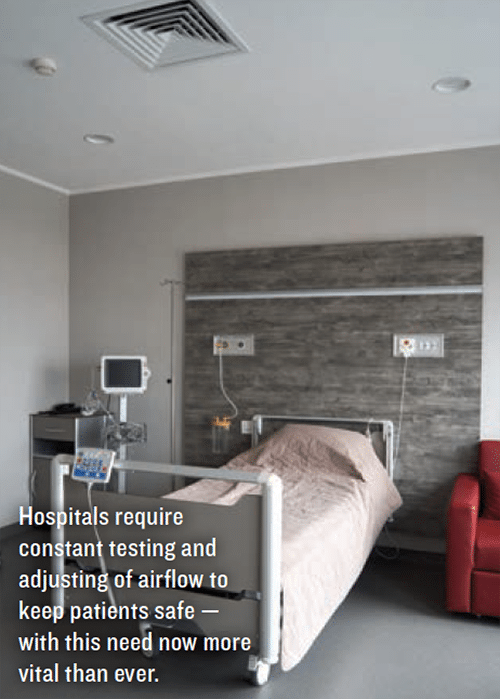
Hospitals require constant testing and adjusting of airow to keep patients safe, and their needs have grown exponentially during the pandemic.
Fisher Balancing, a New Jersey-based HVAC company and union signatory contractor helmed by President Matt Sano, has seen its business grow substantially. The company has worked with the healthcare industry for many years to provide testing and balancing, said Sano, but when the pandemic hit, technicians went into overdrive, turning regular patient rooms into COVID-19 isolation rooms.

Union-provided training guarantees Fisher employees have the skills and certifications necessary to provide the same TAB expertise the company has provided for 20 years.

Philadelphia-area testing, adjusting and balancing (TAB) technicians at Fisher Balancing sometimes worked 12- to 24-hour shifts converting entire hospital wings into isolation rooms at local hospitals. Within a few weeks of the initial outbreak of COVID-19, Fisher’s crew had helped convert more than 250 regular rooms to negative airflow rooms at the University of Pennsylvania’s Hospital and the Children’s Hospital of Philadelphia.
Not all balancing firms could provide the services that Fisher does. All members can earn certifications through training provided through a joint partnership between the International Association of Sheet Metal, Air, Rail and Transportation Workers (SMART) and the Sheet Metal and Air Conditioning Contractors’ National Association (SMACNA).
Union-provided training guarantees Fisher employees have the skills and certifications necessary to provide the same TAB expertise the company has provided for 20 years.
“The training our employees receive as SMART apprentices and journeymen is unparalleled,” Sano said. “The TABB certifications our employees hold also ensure that they have the knowledge and experience needed to do this kind of work.”
To convert individual rooms to isolation rooms, TAB professionals modify the airow, switch standard rooms to negative pressure rooms and verify the number of times the air changes in the room to ensure health and safety.

According to CDC guidelines, a single-patient airborne infection isolation room must have negative pressure relative to other parts of the facility. The negative pressure causes air to ow from the corridors to the isolation room, but air cannot escape to other parts of the facility when the door is closed and the ventilation system is operating properly. Air from the isolation room can be exhausted directly to the outdoors or passed through a special high efficiency air (HEPA) lter that removes most of the droplet nuclei before it is returned to general circulation.
Beyond healthcare facilities, Fisher Balancing has seen an uptick in work for casinos, malls, restaurants and other retail clients. Sano said he expects engineering to change going forward, as building owners will want to be prepared for these types of catastrophic events as well as respond to state mandates regarding airow rule changes in some facilities.
Hidden behind walls or tucked high up in ceilings, HVAC systems are often ignored by the public, but during these unprecedented times, ventilation has become critical to health and safety.