
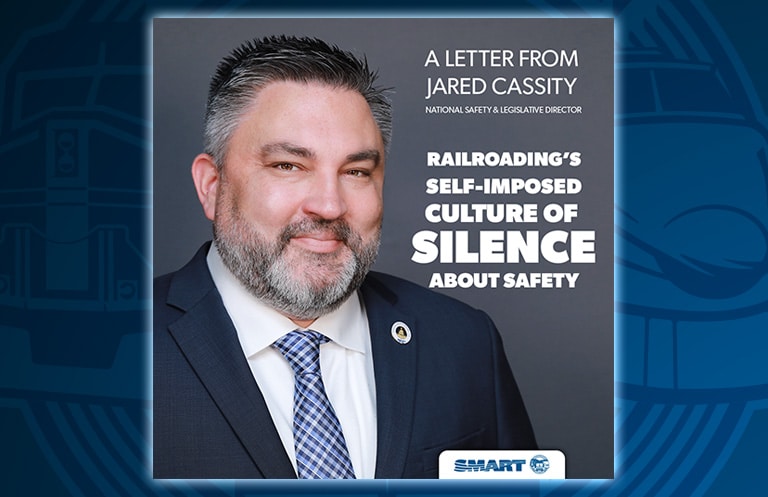
If there is a foundational principle that defines the only meaningful factor in transportation, it can be asked in this one simple question: Is it safe?
Whether referencing our country’s first significant mode of transportation – railroads – or the complexities of our modern-day air systems, the priority should always be safety. Unfortunately, profit margins, dividends, operating ratios, or whatever popular finance-related buzzword corporate America has created continue to seep in like a river of poison, tainting the well of common sense and decency by blinding those seeking to make money and allowing greed, rather than safety, to become their guiding light.
The irony is stark when it comes to how the agencies responsible for regulating those two modes of transportation prioritize their approach to safety, or, more specifically, safety programs. The Federal Aviation Administration (FAA) has long recognized that employee participation and input are paramount to achieving the safest course, while the Federal Railroad Administration (FRA) subscribes to or capitulates to the Class I rail carriers’ philosophy of discipline into compliance, where training and education are always secondary to harassment and intimidation[1].
As a conductor and locomotive engineer, I can speak firsthand to the omnipresent fear of the pressures placed on lower- and mid-level managers to meet or exceed their executives’ expected deliverables. That sentiment almost always translates into scare tactics that keep workers silent and the big bosses oblivious to reality. Victims of the protective bubbles they’ve created, the C-suite has made it illogical for any middle manager to ever be honest with them or give them negative feedback. Instead, they are incentivized to keep pushing while unaware of how the ramifications of their decisions affect the men and women in the shops or at the ballast level. Oblivious to reality, why would they not push for more with less, especially when their managers on the ground get ahead by placating their superiors and present false narratives that things are fine when nothing could be further from the truth?
The airline industry once fell into the same trap, but rather than stay on its own doomed path, it chose to break the cycle and push safety to the forefront.
Take the response to the 1974 TWA Flight 514 crash. The FAA recognized that its regulatory and enforcement role would deter unsafe-condition reporting. It began working with labor and the U.S. National Aeronautics and Space Administration (NASA) to establish the Aviation Safety Reporting System (ASRS). The result was a program that would offer immunity from discipline for voluntary, confidential reporting to uncover systemic and unidentified flaws and generate the data needed for analysis to identify root causes and for course correction. Today, the ASRS is attributed (by many) to having the most significant and fundamental impact on improving aviation operations and procedures and serves as the gold standard for transportation safety.
Following suit was the FRA. Recognizing the achievements of the FAA and staring down its own stagnation in accident and incident rates, the agency began developing a similar program around late 2002/early 2003. By 2007, a pilot program known as C3RS (Confidential Close Call Reporting System) was launched, marking the railroad industry’s first confidential safety reporting program.
Since then, it has been touted as the country’s premier rail safety program and has been adopted by more than 25 different railroads, including Amtrak. But despite such a successful record, the FRA has yet to compel America’s Class I railroads to do the same. This includes a brief period when two Class I railroads, Union Pacific and Canadian Pacific, agreed to participate early on before canceling shortly thereafter.
Their justification was that they were unable to discipline workers for the most common events, but it doesn’t stop there.
Discipline is not limited to employees involved in incidents: it also extends to employees who report injuries or general unsafe conditions. Not only does this affect the worker but it also has a chilling effect on coworkers who are afraid to do the same. This is exactly why the railroad industry has more improperly terminated workers than most any other job field.
The result is a culture of silence and an industry left in the dark when it comes to safety.
This was on full display during the catastrophic Norfolk Southern derailment in East Palestine, OH, on February 3, 2023, when long-standing safety complaints regarding inspection practices and the use of defect detectors went largely unaddressed. Since that day, the entirety of this nation’s Class I railroads committed to joining the C3RS, fully aware of what that commitment entailed, as two of them had once participated in the program, and more than 25 other railroads benefit from its use. True to form, the railroads soon retracted their commitment and demanded concessions from the FRA that would allow the continuance of heavy-handed discipline and the blind approach to accident and incident causation.
These demands carried over to the FRA’s Railroad Safety Advisory Committee (RSAC), which collaboratively took up the task of creating a regulation that would require all of the major railroads to participate in the program. Without fail, the carriers refused to give an inch when it came to discipline or the other core principles of the C3RS, and the effort collapsed.
The timing could not be worse, as the realities of the industry are once again starting to set in. Workers are desperate for change. They’re tired of the harassment and intimidation, and they’re tired of the railroads turning a blind eye to safety, not just for themselves but for the public, too. They want to see meaningful improvements while leading the carriers to overall success, and they know that C3RS is the model to get them there.
On the contrary, it is the railroads and the powerful influence they have over the FRA that is pulling these hopes and expectations down.
Regardless of past commitments, the FRA has abdicated its commitment to C3RS, aligned itself with the railroads, and is poised to present labor with a watered-down, take-it-or-leave-it safety program under the C3RS banner without the core principles that give C3RS its strength. The necessary protections for workers are mostly gone, and harassment, intimidation, and excessive discipline will be free to continue.
Will it give the FRA some data they didn’t otherwise have? Perhaps. Will it foster a safety culture that encourages communication and reporting? Absolutely not.
The FAA and the applicable airlines have a 50-year history that has allowed their program to evolve into a relationship built on trust and a shared commitment that no one should be punished for taking the safest course. Now, their safety record is the envy of the world.
Juxtaposed with them is the FRA and its Class I railroads, which are unwilling to relinquish their flawed approach to safety despite the obvious faults. It should come as no surprise that other countries are invited to joint safety functions so that the industry can learn from them, rather than from us.
The fact that the FRA has conceded its most successful program ever and allowed it to suffer the fate it fought so long to prevent is a detriment to the railroad industry and the communities it intersects. The unfortunate reality is that a faction of labor will one day cede to the new watered-down program out of desperation for change and improvement. Should it not provide the results that ASRS or the original C3RS program has, it is not on them. I encourage the FRA and the railroads to be less concerned about checking the box and more concerned with doing something meaningful to improve the unsafe trajectory and stagnation of America’s railroads.
[1] For example: https://www.propublica.org/article/railroad-safety-union-pacific-csx-bnsf-trains-freight
Related News
- Train Lengths Would Be Capped Under New Arizona Bill
- Senate Hearing Highlights the Good, the Bad, and The Ugly of RRB
- On-Duty Assault Leaves Amtrak Conductor Facing Financial Hardship
- Transit Equity Day: Remembering Rosa Parks
- Railroads Have Short Memories: East Palestine 3 Years Later
- SMART Local 1 signs new contractor to complete specialized workforce request
- RIDER Safety ACT Aims to Curb Transit Assaults Nationwide
- Rail Safety Is Too Important For Corporate Discretion
- Virginia 2-PC Law Could Become a Reality if We Act Now
- WATCH: Members Step Up to Take Care of Their Own