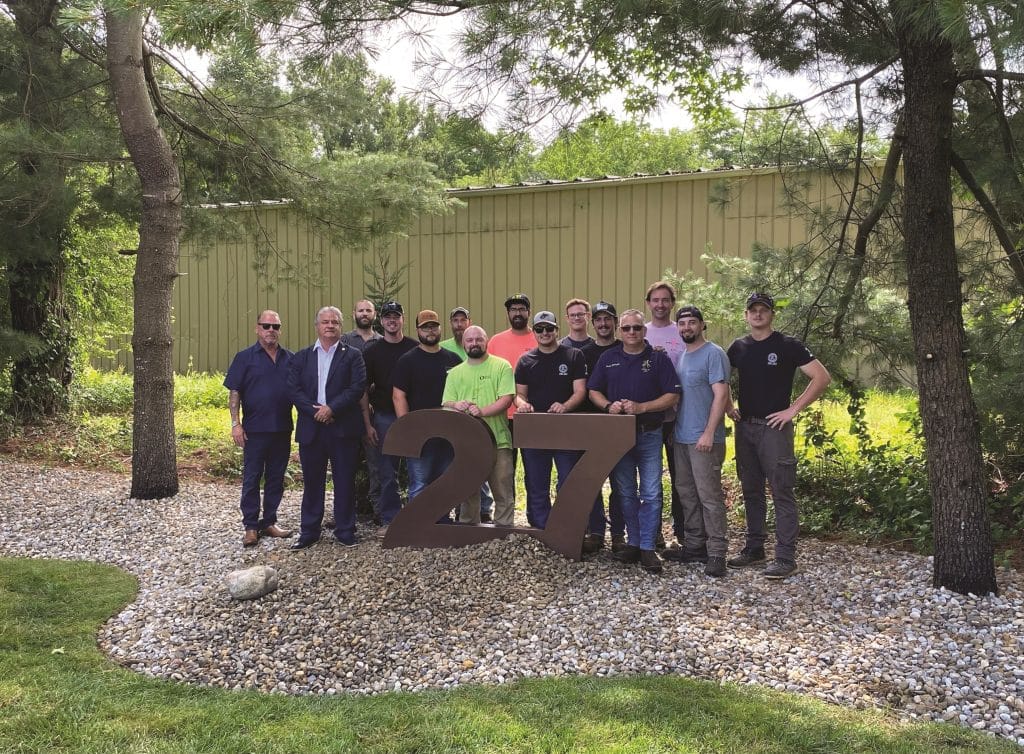
Fifth-year Local 27 (Southern New Jersey) apprentices forged their way into the local’s history with their group project this summer, creating a “27” sign that is now proudly displayed at the Local 27 union hall. The apprentices fabricated the sign out of 11 ga carbon steel, designing and forming the project using CAD, a plasma table and a press brake — all equipment that was provided through the International Training Institute (ITI) grant program.
Pictured, front row, left to right: Business Rep. Mike Kolbasowski, President/Business Manager Thomas De Bartolo, fifth-year apprentices Malcolm Hill, Clayton Jansa, Conner Kozar, Training Coordinator John Espinos Jr., Zach Szabo, Isaac Rolph. Back row: Peter Palumbo, Thomas Sommers III, Rob Rasmussen, Mike Melon, Dan Marino, Alex Sarti, Will Anderson.
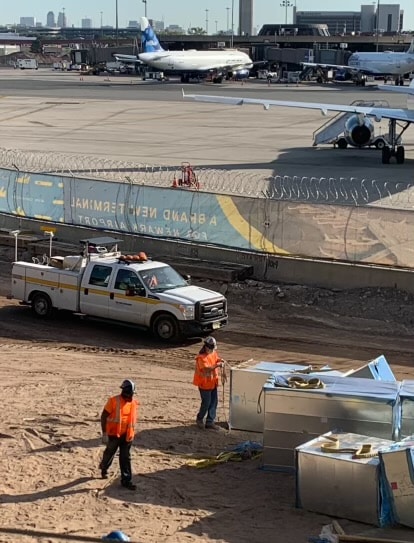
Local 25 sheet metal workers in northern New Jersey recently completed work on the brand-new Terminal A at Newark Liberty Airport. The huge project, funded by a $3 billion investment from the Port Authority of New Jersey/New York, included 33 airline gates and eight bridges, as well as restaurants, bars and retail.
“Local 25 covered all sheet metal and HVAC work in the terminal: restaurants, bars, stores, gates, airways to planes, exhausts and kitchen equipment to all bars and grills,” said Local 25 Organizer Gregory Conte. “Local 25 had over 90 members on the job at any given point in the project.”
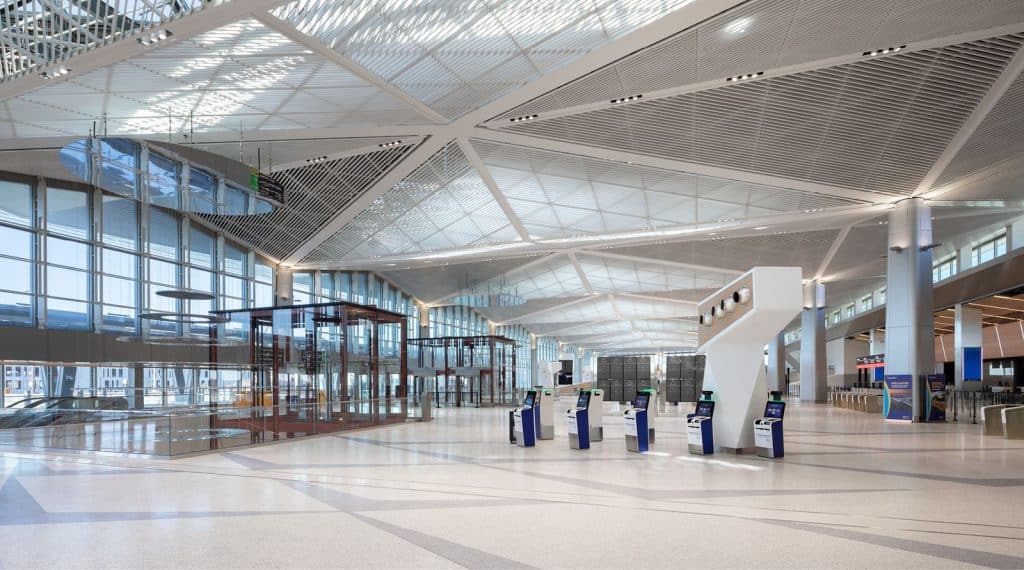
Newark Liberty Airport Terminal A, post-redevelopment
At more than one million square feet, the new Terminal A was the largest design and build project in New Jersey. The terminal was designed and built by Tutor Perini and Parson in a joint venture development; signatory contractors WDF and Halo Sheet Metal began work in September 2021 and finished the project – on time – on January 24, 2023.
“We are proud of everyone who worked on this massive new terminal,” said Local 25 President and Business Manager Joseph Demark, Jr. and area Business Agent/Financial Secretary-Treasurer Calvin Brooks. “Next up will be Terminal B and then C. Great job!”
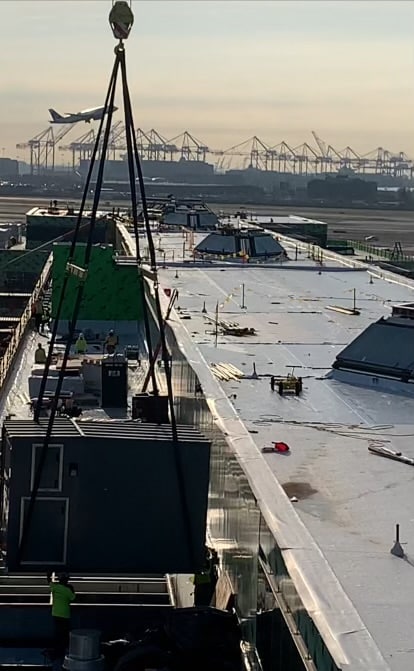
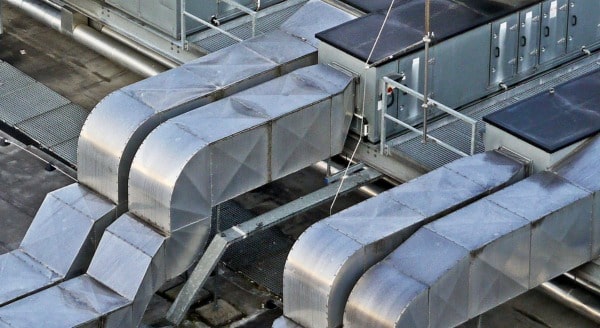
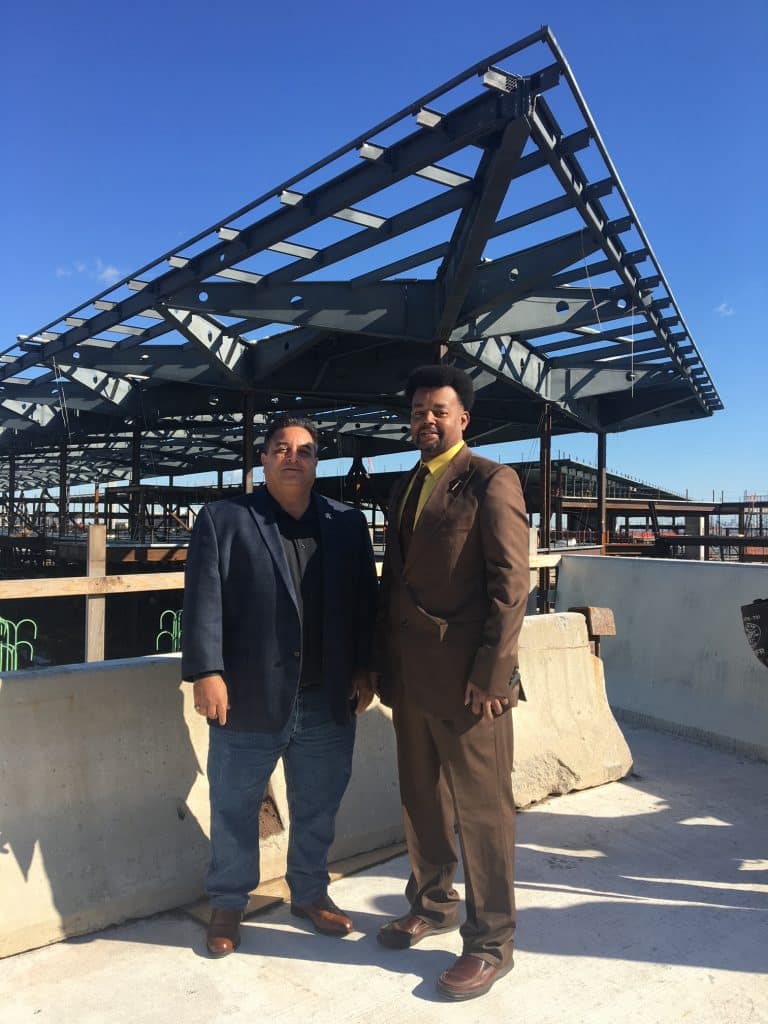
Members work on the Newark Liberty Airport Terminal A projectUnion ductwork at Newark Liberty AirportLocal 25 members on the jobOrganizer Gregory Conte (left) and Financial Secretary-Treasurer Calvin Brooks
In 2023, Local 19 worked with the National Energy Management Institute (NEMI) and pro-union politicians in New Jersey to help pass fire life safety legislation — helping keep citizens safe and creating more work for SMART members in the Garden State.
The process began in January, when then Assistant Business Manager Bryan Bush, Assistant Business Manager Luke Gordon and Political Director Todd Farally approached Assemblyman Anthony Verrelli and Senator Nilsa Cruz- Perez about running a bill that would ensure the state of New Jersey would follow the National Fire Protection Association Code (NFPA), along with the International Fire Code (IFC). Both mandate inspections of fire, smoke, combination fire/smoke dampers and smoke control systems, which include but are not limited to smoke evacuation systems and stairwell pressurization. In addition, any deficient dampers or smoke control systems would need to be repaired in a timely manner after inspection.
Early on, Local 19’s team consulted with Jeremy Zeedyk, the Northeast representative for NEMI. Zeedyk helped to get the ball rolling on crafting the legislation and ensuring that all the technical information, including the necessary certifications, were specified within the language of the bill. After several rough drafts, Local 19 had solid language and talking points to bring to Trenton.
Fire life safety is just one example of the job-creating lawmaking opportunities available to local unions. NEMI encourages all locals to reach out for assistance identifying and drafting legislation.
“By early March, companion bills were introduced in the Assembly and the state Senate, and both bills passed unanimously out of two committees in each chamber over the next couple months,” said Farally. “The Assembly fully passed their version in May, and the Senate moved to pass the legislation in mid- June. Oftentimes we see votes in government fall along stark political lines, but these bills left both the Assembly and Senate unanimously and were headed to Governor Murphy’s desk.”
That’s when the process hit a momentary hitch. After the bills had passed both chambers in Trenton, sponsors of the legislation began to receive questions and calls for concern from the New Jersey Department of Community Affairs (DCA) and the Fire Service, which falls within the DCA. Assemblyman Verrelli’s office reached out to Local 19, laying out the concerns and where they were coming from.
“At this point, we reengaged Jeremy Zeedyk to look over the concerns the Fire Service had and then proceeded to set up a meeting between Local 19, the DCA, the Fire Service, NEMI and Assemblyman Verrelli,” explained Farally. “We were able to hear and address many of their concerns, and Local 19 shared our concerns with some of the proposed changes from the DCA.”
After a few months of drafting and redrafting language, in mid- November all parties agreed to some changes within the bill that give the state some flexibility while still upholding important standards which must be enforced. At this point, the bill was labeled as conditionally vetoed, which meant the governor’s office had changed some elements of the bill and it would be sent back to both legislative chambers for a vote to concur with those amendments.
In early December of 2023, the New Jersey Senate and Assembly both unanimously concurred with the changes, and fire life safety is now the law statewide — showing how important it is for SMART to be involved in the political process, and the vital role pro-union legislators play.
“There are still some steps to go through at this point under the regulatory process before everything is implemented, but rest assured — Local 19 will be there every step of the way to ensure the regulations are applied correctly and fairly to all,” Farally concluded.
Fire life safety is just one example of the job-creating lawmaking opportunities available to local unions. NEMI encourages all locals to reach out for assistance identifying and drafting legislation.
Local 25 sheet metal workers in northern New Jersey recently completed work on the brand-new Terminal A at Newark Liberty Airport. The huge project, funded by a $3 billion investment from the Port Authority of New Jersey/New York, included 33 airline gates and eight bridges, as well as restaurants, bars and retail.
“Local 25 covered all sheet metal and HVAC work in the terminal: restaurants, bars, stores, gates, airways to planes, exhausts and kitchen equipment to all bars and grills,” said Local 25 Organizer Gregory Conte. “Local 25 had over 90 members on the job at any given point in the project.”
Newark Liberty Airport Terminal A, post-redevelopment
At more than one million square feet, the new Terminal A was the largest design and build project in New Jersey. The terminal was designed and built by Tutor Perini and Parson in a joint venture development; signatory contractors WDF and Halo Sheet Metal began work in September 2021 and finished the project – on time – on January 24, 2023.
“We are proud of everyone who worked on this massive new terminal,” said Local 25 President and Business Manager Joseph Demark, Jr. and area Business Agent/Financial Secretary-Treasurer Calvin Brooks. “Next up will be Terminal B and then C. Great job!”
Members work on the Newark Liberty Airport Terminal A projectUnion ductwork at Newark Liberty AirportLocal 25 members on the jobOrganizer Gregory Conte (left) and Financial Secretary-Treasurer Calvin Brooks
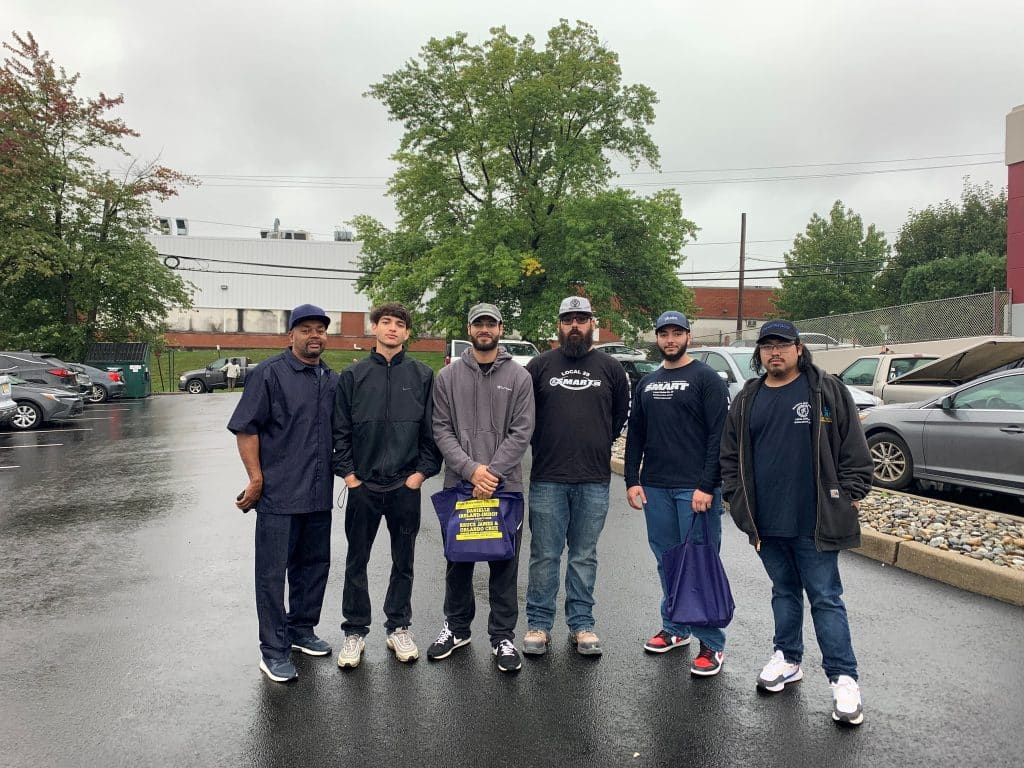
SMART members in New Jersey at a Passaic Central Labor Council labor walk.
This election cycle, SMART members across sheet metal and the Transportation Division flexed their muscles at the ballot box, helping elect union-friendly candidates across the United States. That includes SMART members who ran for office themselves, pledging to pursue policy that supports working families.
In New Jersey, the SMART New Jersey State Council endorsed a bipartisan group of pro-labor candidates that won big. Johnnie Whittington of Local 27 (southern New Jersey) won his election to the East Windsor Township Council, while Glen Kocsis — also from Local 27 — won re-election to the Neptune City Council: putting the voice of SMART workers in powerful positions to benefit their union brothers and sisters.
“So far this election cycle, 82% of our labor candidates have won their elections,” said Joseph Demark, Jr., president of the New Jersey State Council for Sheet Metal Workers, president and business manager of Local 25 (northern New Jersey) and executive board member of the New Jersey State AFL-CIO. “Together, we made the difference and won!”
In Kentucky, SMART members endorsed and helped re-elect Andy Beshear as governor. His victory is a big win for workers — during his first term, he made Kentucky the battery manufacturing capital of America, and he stood shoulder-to-shoulder with union members from the picket line to the governor’s office. Thanks in no small part to Beshear’s leadership, SMART members are seeing an extraordinary amount of work in the Bluegrass State — and our union is growing as a result.
Up and down the ballot, in races across the country, SMART members fueled a score of impressive victories. Warren Faust, SMART International representative and former business manager of Local 44 (northeastern Pennsylvania), won re-election to the Wilkes-Barre School Board. And in Virginia, workers marched to the ballot box to help pro-union candidates take the state House and Senate, putting advocates for working families in control of policymaking.
Ultimately, 2023 reiterated the importance of the union vote. Election Day reminds all legislators: When you stand with union members, union members stand with you.
“From door-knocking, to phone-banking, to peer-to-peer text messaging, we showed the power of our vote,” said SMART-TD Virginia State Legislative Director Ronnie Hobbs. “When we stand together as one, there is NOTHING that can stop us in our tracks.”
Note: This article was originally published by Eye On Sheet Metal, a resource for the unionized sheet metal industry.
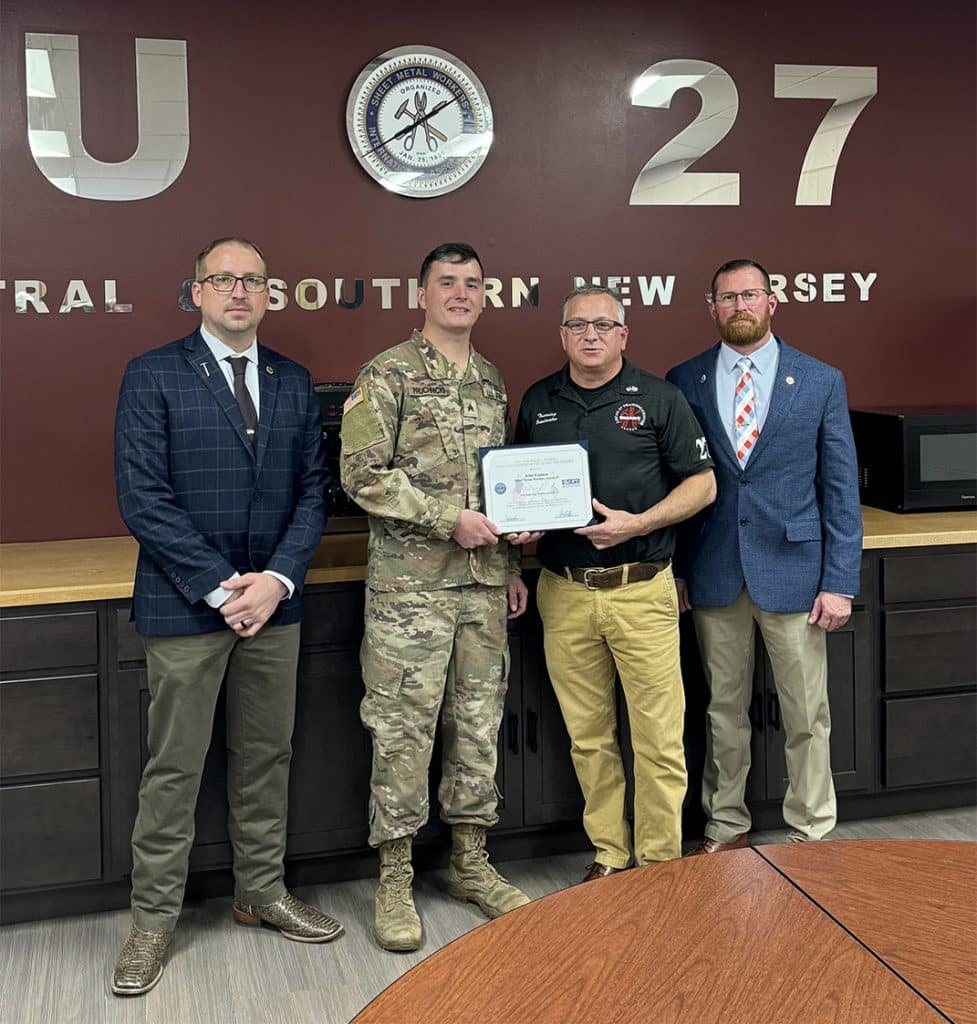
John Espinos (second from right) received the Patriot Award in November.
John Espinos has mentored many apprentices in his time as training coordinator at SMART Local 27 in central and southern New Jersey, but receiving a Patriot Award for going above and beyond in his support of a servicemember took him by surprise.
“I was not expecting this at all,” Espinos said. “It actually brought a tear to my eye.”
The award pin and certificate were presented to Espinos by Ronni Enzman, Monmouth County chairperson for the Employer Support of the Guard and Reserve (ESGR), at a small ceremony at the training center on November 27.
Sgt. Mike Pruchnicki, currently in the second year of his apprenticeship, is the servicemember who nominated Espinos. He recalled all the extra time Espinos took with him to help get his Veterans Affairs (VA) benefits in place and, later, to make his deployment as smooth as possible.
“John helped me a lot since I came to Local 27 … he supported me each time I went away on orders or training, and ensured I still would have work when I returned,” Pruchnicki said. “He has been very supportive through everything, and when I found out about the Patriot Award, I couldn’t think of anyone else more deserving than John.”
The Patriot Award is one in a series of Department of Defense awards granted by the ESGR, and it reflects efforts made to support servicemembers through a wide range of measures including flexible schedules, time off prior to and after deployment, caring for families and granting leaves of absence when needed. Servicemembers can nominate a supervisor they feel has made a substantial difference for them.
“This is yet another way to show the sheet metal industry is employing veterans, and veterans appreciate the support they are given,” said Josh Moore, International Training Institute field representative and SMART Heroes specialist. “This young man was worried about his apprenticeship, and he was glad John was there to support him. I think it’s great that the local is being recognized. They’re the ones that support the apprentices as they make their transition into journey work.”
Moore and Espinos believe this is the first time a training coordinator for a SMART local has received a Patriot Award. The ESGR awards program is progressive, with the Patriot Award serving as a first step toward further recognition. In order to qualify for consideration for higher honors, such as the Above and Beyond Award or the program’s highest recognition, the Secretary of Defense Employer Support Freedom Award, an employer must first have at least one supervisor recognized with a Patriot Award.
Espinos is no stranger to recognition as a mentor — or lapel pins of appreciation. He’s been involved in Boy Scouts of America as a scoutmaster for many years, and over time he accumulated quite a few mentor pins from Eagle Scouts who wished to honor those who had helped them on their journey. It got to the point, he said, that at Boy Scouts events he would jokingly walk lop-sided and say all the pins were weighing him down. Memories of those events came back to him as he received the Patriot Award.
“It reminded me of something my dad said before he passed,” recalled Espinos. “He told me, ‘You were a rough kid growing up, always in trouble, but I knew you were here to make an impact on other people’s lives.’”
The difference Espinos made for Pruchnicki was evident when Espinos received his award, but this is far from the first or last time a training coordinator will go to bat for an active-duty guard or reserve member. They step in to coordinate solutions when a contractor must lose a valued apprentice due to deployment, then make sure that servicemember’s job is safe and waiting for them when they return. Training coordinators at sheet metal locals also often help apprentices with VA matters and paperwork or online forms for the GI Bill, as well as making sure the apprentice gets hours covered to receive health care, pension and everything else that should be available to them.
Espinos said that there are quite a few hoops to jump through, but once you go through it the first time, it gets easier each time afterward. He also noted that apprentices at Local 27 are really in full-time classes for only around four weeks a year, each year of the five-year program.
“In that short amount of time, it felt good to make an impact on [Pruchnicki’s] life,” Espinos said.
Note: This article was originally published by Eye On Sheet Metal, a resource for the unionized sheet metal industry.
John Espinos (second from right) received the Patriot Award in November.
John Espinos has mentored many apprentices in his time as training coordinator at SMART Local 27 in central and southern New Jersey, but receiving a Patriot Award for going above and beyond in his support of a servicemember took him by surprise.
“I was not expecting this at all,” Espinos said. “It actually brought a tear to my eye.”
The award pin and certificate were presented to Espinos by Ronni Enzman, Monmouth County chairperson for the Employer Support of the Guard and Reserve (ESGR), at a small ceremony at the training center on November 27.
Sgt. Mike Pruchnicki, currently in the second year of his apprenticeship, is the servicemember who nominated Espinos. He recalled all the extra time Espinos took with him to help get his Veterans Affairs (VA) benefits in place and, later, to make his deployment as smooth as possible.
“John helped me a lot since I came to Local 27 … he supported me each time I went away on orders or training, and ensured I still would have work when I returned,” Pruchnicki said. “He has been very supportive through everything, and when I found out about the Patriot Award, I couldn’t think of anyone else more deserving than John.”
The Patriot Award is one in a series of Department of Defense awards granted by the ESGR, and it reflects efforts made to support servicemembers through a wide range of measures including flexible schedules, time off prior to and after deployment, caring for families and granting leaves of absence when needed. Servicemembers can nominate a supervisor they feel has made a substantial difference for them.
“This is yet another way to show the sheet metal industry is employing veterans, and veterans appreciate the support they are given,” said Josh Moore, International Training Institute field representative and SMART Heroes specialist. “This young man was worried about his apprenticeship, and he was glad John was there to support him. I think it’s great that the local is being recognized. They’re the ones that support the apprentices as they make their transition into journey work.”
Moore and Espinos believe this is the first time a training coordinator for a SMART local has received a Patriot Award. The ESGR awards program is progressive, with the Patriot Award serving as a first step toward further recognition. In order to qualify for consideration for higher honors, such as the Above and Beyond Award or the program’s highest recognition, the Secretary of Defense Employer Support Freedom Award, an employer must first have at least one supervisor recognized with a Patriot Award.
Espinos is no stranger to recognition as a mentor — or lapel pins of appreciation. He’s been involved in Boy Scouts of America as a scoutmaster for many years, and over time he accumulated quite a few mentor pins from Eagle Scouts who wished to honor those who had helped them on their journey. It got to the point, he said, that at Boy Scouts events he would jokingly walk lop-sided and say all the pins were weighing him down. Memories of those events came back to him as he received the Patriot Award.
“It reminded me of something my dad said before he passed,” recalled Espinos. “He told me, ‘You were a rough kid growing up, always in trouble, but I knew you were here to make an impact on other people’s lives.’”
The difference Espinos made for Pruchnicki was evident when Espinos received his award, but this is far from the first or last time a training coordinator will go to bat for an active-duty guard or reserve member. They step in to coordinate solutions when a contractor must lose a valued apprentice due to deployment, then make sure that servicemember’s job is safe and waiting for them when they return. Training coordinators at sheet metal locals also often help apprentices with VA matters and paperwork or online forms for the GI Bill, as well as making sure the apprentice gets hours covered to receive health care, pension and everything else that should be available to them.
Espinos said that there are quite a few hoops to jump through, but once you go through it the first time, it gets easier each time afterward. He also noted that apprentices at Local 27 are really in full-time classes for only around four weeks a year, each year of the five-year program.
“In that short amount of time, it felt good to make an impact on [Pruchnicki’s] life,” Espinos said.
This Sunday, New Jersey will be recognizing Railroad Workers Day for the second time. As Gov. Murphy said about railroaders last fall when he was signing the bill into law, “Their courage, as well as their role as the backbone of our state’s expanding transportation network, must not be overlooked. On October 15th — and every day — we honor the contributions of our workers not just as employees, but as New Jerseyans committed to promoting safety, efficiency, and economic activity in our local communities.”
SMART-TD New Jersey State Legislative Director Ron Sabol
New Jersey’s recognition of our members is a product of SMART-TD’s State Legislative Director Ron Sabol, N.J. State Sen. Patrick J. Diegnan (D), and N.J. Assemblyman Daniel Benson (D). Diegnan was the primary sponsor for the bill.
Both Sen. Diegnan and Assemblyman Benson serve on the Transportation Committee in the Legislature. In this role, both have been exposed to the realities of New Jersey’s rail crews. This insight led them to push for the creation of Railroad Workers Day.
SMART-TD is happy to celebrate Railroad Workers Day with our brothers and sisters. We hope that all of you stay safe out there on the ballast, and continue making our issues top of mind for the legislators in Trenton!
In a rare acknowledgment of the value railroaders bring to the table, New Jersey Gov. Phil Murphy (D) has named October 15 as “Railroad Workers Day”.
Gov. Murphy went on the record saying, “Through extreme weather events and a global pandemic, our state’s railroad workers have demonstrated extraordinary bravery despite significant obstacles. Their courage, as well as their role as the backbone of our state’s expanding transportation network, must not be overlooked. On October 15th – and every day – we honor the contributions of our workers not just as employees, but as New Jerseyans committed to promoting safety, efficiency, and economic activity in our local communities.”
By signing Senate Joint Resolution 86 (SJR 86), Gov. Murphy is giving a spotlight to rail labor in a moment when that light is desperately needed. As SMART-TD and other rail labor organizations engage in national rail labor negotiations with carriers who are willfully blind to the sacrifice and professionalism that our members embody, it is refreshing to hear that our answer to the call of duty has not gone unheard or unnoticed.
“Railroads continue to serve a crucial, and often overlooked, role in our society. Whether in transporting consumer goods or helping commuters get to and from work, we rely on rail services and railroad workers to keep our economy afloat,” said Assemblyman Daniel Benson (D), chair of the Assembly Transportation and Independent Authorities Committee. “By designating October 15th as New Jersey Railroad Workers Day, we carve out time to recognize the invaluable service railroad workers provide for the people of New Jersey.”
N.J. State Sen. Patrick J. Diegnan (D) was the primary sponsor of SJR 86 and cited rail labor’s persistence through COVID-19 as one of the reasons he felt it necessary to push this resolution through. In reference to our efforts, Diegnan said, “Without their contributions, the pandemic’s adverse impact on New Jersey and its residents would have been exacerbated. These workers put themselves and their families at risk for the benefit of the entire state. This recognition is a token of our appreciation for the dedication and sacrifices of all railroad workers. I am extremely proud to be a part of establishing the annual ‘New Jersey Railroad Workers Day.’”
For his part, SMART-TD New Jersey State Legislative Director (SLD) Ron Sabol said, “The men and women moving freight and passengers through the pandemic were not only essential workers, they should be viewed as heroic. Wherever there is a crisis going on, you have railroaders putting it on the line to fix it. Where there are wars, railroad infrastructure is always on the list of targets. Much is asked of our men and women, whether it means getting supplies to store shelves and nurses to their shifts during COVID or getting people out of the Ukraine to avoid civilian casualties. Railroad workers are getting it done everywhere you look. This consistent selflessness in times of chaos is why I thought it was important to get this bill done. These men and women deserve recognition and respect.”
SMART-TD would like to thank SLD Sabol, state Sen. Diegnan, Assembly Transportation Chairman Benson, Gov. Murphy and the state of New Jersey for putting in the work to get this bill through the legislative process. We look forward to celebrating Railroad Workers Day with you in your state for years to come.
On March 19, 2022, the SM Local 27 (Southern N.J.) SMART Army filled 42 contractor trash bags with litter during a trash cleanup spanning two miles of Silver Run Road in Millville, N.J. Local 27 Business Agent John Whittington and his son joined members Don Cooper, Ken Andeloro, Mike Mendez, John Davidson, Pete Polumbo, Malcolm Hill, John Manera, Jaden Sheppard, Dave Cooper, Mark Weatherby, Clarence Harris, Organizer Greg Goble and Business Agent Matt Johnson for the effort.