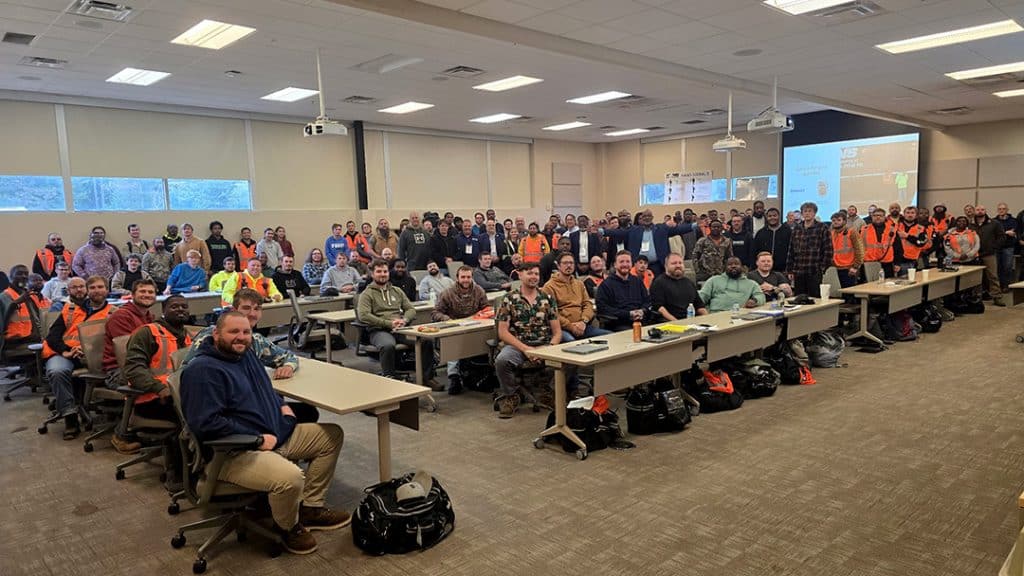
On Tuesday, October 28, SMART Transportation Division President Jeremy Ferguson, along with a delegation of national, general committee and local leaders, joined Norfolk Southern (NS) new hires at the company’s McDonough Training Center. The impromptu town hall brought together 97 fourth- and fifth-week trainees with the union that will have their backs every step of their careers. 

The event was made possible thanks to brothers Kelvin Hill and Greg Glenn. Both men are longtime NS employees and fixtures in the Atlanta area and Local 1245. Leading by example, Hill and Glenn go above and beyond to make sure new hires understand not just their job duties, but also the lifestyle, expectations that come with a railroad career and the support that’s a hallmark of their membership in SMART-TD. 

Brother Hill serves as a local chairperson and local safety and legislative representative, while Brother Glenn serves as a local chairperson and 2nd vice president of his General Committee. Together, the two have a long-standing agreement with Norfolk Southern to meet privately with every class of new trainees during their fifth week of instruction.  

Merger agreement creates stability for trainees 

When recent news of the proposed Union Pacific/Norfolk Southern merger sparked understandable anxiety among the trainees, Hill and Glenn saw an opportunity. With SMART-TD’s Regional Training Seminar (RTS) taking place nearby in Atlanta this week, they reached out to arrange a special visit. Their goal was simple: to get answers for our new brothers and sisters straight from the top. 

“Over the past few weeks, a lot of these men and women have been worried about what’s next for them,” Hill told SMART News. “Greg and I knew that if we could get our leadership in the room, (the people who are actually at the negotiating table), it could give these new brothers and sisters the clarity and confidence they deserve.” 

Their initiative quickly grew into a unionwide show of solidarity. Joining the session were President Jeremy Ferguson, Vice President Brent Leonard, NS General Chairpersons Tommy Gholson (GCA 898) and Nick Greficz (GCA 687), several vice general chairpersons, a few local chairpersons and other local officers who were in town for the RTS training. 

By the time the Q&A began the room was filled with experience, leadership and genuine care for the next generation of railroaders. 

“This went way beyond what I imagined,” Hill said. “These brothers and sisters haven’t even been to their home terminal yet. They haven’t been to a single local meeting and haven’t paid one dollar in union dues. And there they were, sitting in a private meeting with the president of the entire union, hearing directly from the leaders who can answer questions about the exact terminals they’ll be working in. It was absolutely next level.” 
Turning uncertainty into empowerment 

President Ferguson addressed the trainees directly, answering questions about SMART-TD’s historic “Jobs for Life” agreement, a deal he personally fought to secure with Union Pacific and Norfolk Southern. Should the merger go through, the agreement guarantees job security for union members from now until the day they choose to retire. 

“I’m proud that we’ve made real progress toward giving you something no generation before you has had. That’s true job security,” Ferguson told the group. “But with that gift comes responsibility. You’ve got a career ahead of you and right now, your focus should be on learning how to stay safe doing it. Learn the rules, build good work habits and keep your awareness sharp. We’ve helped make sure you’ve got jobs for life — now it’s up to you to make sure you’re not cutting that life short.” 

He also reminded the trainees that the work SMART-TD does nationally is possible because members stay active locally.

“When you get to your terminals, get involved in your local. Ask questions. Be informed. You’re part of something much bigger than just a job.  You’re part of a movement.” 

Assistant Director of Organizing Andy Goeckner also took the opportunity to congratulate the trainees on their progress and to welcome them into the SMART-TD family. 

“You don’t have jobs anymore,” Goeckner told them. “You all have careers. And in addition to that, you have a family in SMART-TD that’s here to make sure you never lose it. The future of this industry depends on people like you. And our job is to make sure that future is secure, safe and strong.” 

The event also received support from Jason Myers, who oversees the McDonough Training Center for Norfolk Southern. Myers helped Brothers Hill and Glenn make the meeting possible. 

As the meeting concluded, the sense of unity in the room was undeniable. What began as a simple idea by Brothers Hill and Glenn had evolved into a powerful moment of connection between SMART-TD’s leadership and its newest members.
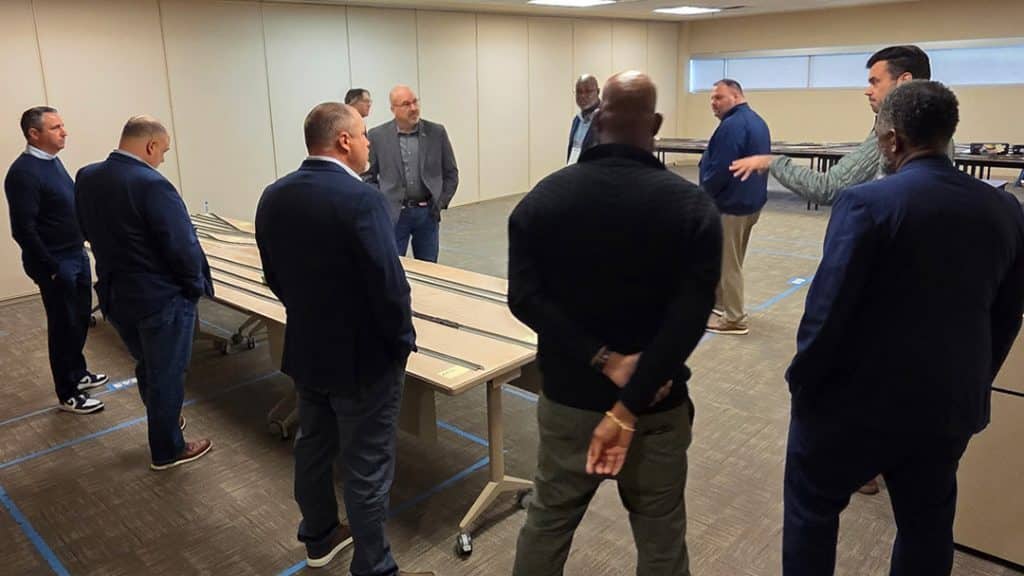
Welcome to the SMART-TD family 

“This is what unionism looks like,” Hill said. “From the president of the whole organization down to the newest trainee, everyone in that room was pulling in the same direction.” 

The men and women who attended that session are stepping into their railroad careers with a rare advantage. Thanks to the Jobs for Life agreement, their path is more stable than those who came before them. But as President Ferguson and the leadership team reminded them, stability doesn’t mean complacency. It means responsibility. 

It means learning the craft, working safely and honoring the generations who fought to make this progress possible. It means carrying the SMART-TD legacy forward, stronger than ever. 
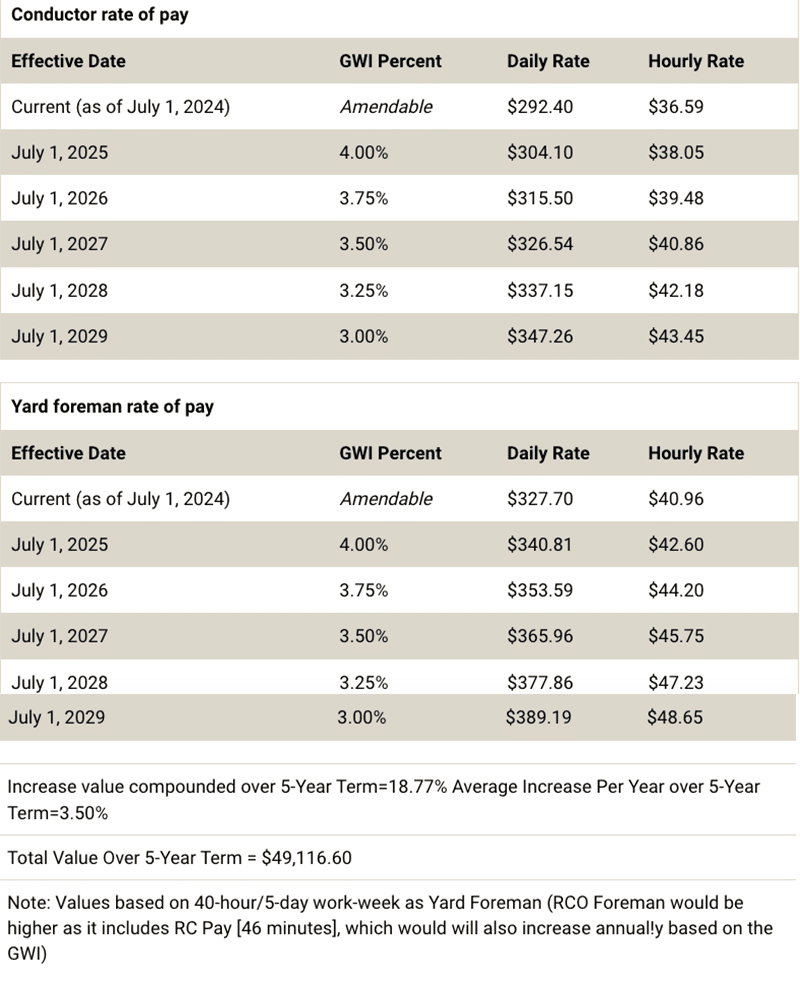
On October 30, the SMART Transportation Division announced that members on Burlington Northern Santa Fe (BNSF), Norfolk Southern (NS), Canadian National (CN) and several Class II and Class III railroads voted to ratify a new, five-year collective bargaining agreement that delivers substantial economic gains and key benefit improvements — without any concessions.

“SMART-TD railroaders work tirelessly, day in and day out, to keep this country moving, and they deserve to be rewarded with a contract that meets their demands,” said SMART General President Michael Coleman in response. “With substantial raises and improvements for medical, dental, vision and vacation benefits, President Jeremy Ferguson and his team made it clear that they heard those demands. The fact that almost 70% of voting members chose to approve this agreement speaks for itself. I want to congratulate Jeremy and his team on their work securing this agreement, and I want to thank every SMART-TD railroader for standing up for each other, making their voices heard and fighting for the contract they have earned.”

October 4, 2024: The SMART Transportation Division proudly congratulates SMART Railroad, Mechanical and Engineering Division (MD) members for their achievement in ratifying collective bargaining agreements (CBAs) with three major rail carriers: BNSF, CSXT and Norfolk Southern.  

The newly ratified agreements will provide SMART-MD members with healthcare stability and annual wage increases through December 31, 2029. The five-year agreements guarantee an average general wage increase of 3.5% per year and include improvements in paid vacation and health and welfare benefits, maintaining a consistent employee monthly cost-share contribution. 

John McCloskey, General Committee 2 directing general chairperson, remarked on the significance of these agreements, stating, “GWIs of 18.8% compounded are almost unheard of in the freight industry, especially on a voluntary basis without concessions. I appreciate BNSF, CSX and NS negotiating with SMART-MD in good faith.” 

SMART-TD President Jeremy Ferguson told SMART News, “This is a milestone that underscores the strength and determination of SMART members in securing fair labor agreements. Congratulations to our brothers and sisters in the Mechanical Division!” 

In a strong show of unity, members voted in favor of the CBAs, with results reflecting significant support: 69% for BNSF, 68% for CSXT, and 62% for Norfolk Southern. This outcome highlights the commitment of SMART-MD’s members to engage in the ratification process and ensure their voices are heard. 

SMART-MD Director Peter Kennedy expressed gratitude to the members who participated, stating, “Thank you to the members that took the time to educate themselves about their agreement, and that participated in the ratification process. We are glad to have resolved negotiations with these major freight railroads. The remaining rail carriers need to follow the pattern that has been established by BNSF, CSXT and NS.” 

SMART General President Michael Coleman also praised the outcome, noting, “The members have passed their verdict on the agreements with BNSF, CSX-T and NS, with more than 60% voting in favor for each carrier. I am grateful for the determination and advocacy of the SMART-MD negotiating team, and I appreciate the leadership at BNSF, CSX-T and NS for resolving the next round of national negotiations without dragging out the bargaining process for years.” 

As we celebrate this victory, the SMART Transportation Division reaffirms its dedication to supporting all SMART divisions in their pursuit of equitable labor agreements. These successful ratifications serve as a powerful reminder that together, we can achieve meaningful progress and secure a better future for all rail industry workers. 

The International Association of Sheet Metal, Air, Rail and Transportation (SMART) Railroad, Mechanical and Engineering Department (MD) members employed on BNSF, CSX-T and Norfolk Southern Railway have voted to ratify their respective collective bargaining agreements (CBAs). Members voted in favor of the CBAs by 69% (BNSF), 68% (CSX) and 62% (NS).

With these agreements ratified, SMART-MD members employed by BNSF, CSX-T and NS have secured healthcare stability and annual wage increases through December 31, 2029.  

The CBAs on each respective rail carrier are essentially identical, consisting of a five-year term that provides for annual general wage increases (GWI) that average out to 3.5% per year, improvements for paid vacation, as well as improvements to health and welfare benefits without changing the employee monthly cost-share contribution of 15% of the carriers’ monthly payment rate. The CBAs also resulted in the creation of new benefit design for employees that desire to have employee-only coverage under a high deductible health plan at a reduced employee monthly cost-share contribution. 

“GWIs of 18.8% compounded are almost unheard of in the freight industry, especially on a voluntary basis without concessions,” said General Committee 2 Directing General Chairperson John McCloskey. “I appreciate BNSF, CSX and NS negotiating with SMART-MD in good faith and allowing us the opportunity to engage with the members throughout the ratification process.” 

“Thank you to the members that took the time to educate themselves about their agreement, and that participated in the ratification process. We are glad to have resolved negotiations with these major freight railroads. The remaining rail carriers need to follow the pattern that has been established by BNSF, CSX-T and NS,” added SMART-MD Director Peter Kennedy.

“The members have passed their verdict on the agreements with BNSF, CSX-T and NS, with more than 60% voting in favor for each carrier,” said SMART General President Michael Coleman. “I am grateful for the determination and advocacy of the SMART-MD negotiating team, and I appreciate the leadership at BNSF, CSX-T and NS for resolving the next round of national negotiations without dragging out the bargaining process for years. I am glad these railroads recognized that our members deserve to be compensated fairly with wage increases coming to them in real time, rather than years after the fact.” 

Brothers and Sisters,

I would like to take a moment to address the tentative agreements on certain properties, including CSXT, NS, and BNSF, which are currently out for ratification or will be shortly, which for most will be in lieu of the traditional “national agreement.” Undoubtedly, this scenario is a bit unusual to those of us who have been around for a decade or more, and it is even more unconventional to us as international officers who are usually engaged in national negotiations every three to five years. We are definitely in some uncharted waters here, because we have never seen a tentative agreement come to fruition before our Section 6 notices were even served, or the existing agreement’s moratorium has opened to require negotiations under the Railway Labor Act (RLA).

In the last round of negotiations, we were met with some of the most-contentious circumstances imaginable, due to all the carriers being hell bent on achieving crew consist changes to remove conductors from our through freight trains. Throughout that round of bargaining, not a single rail labor union was able to gain any meaningful traction, as the carriers made it very clear they were not negotiating with anyone until SMART-TD conceded to eliminating a significant portion of the conductor craft. Of course, we never agreed and instead made our case to Presidential Emergency Board 250, which reaffirmed that all crew consist issues were to be handled at the “local level” (i.e., the General Committee of Adjustment level). PEB 250 also gave us the largest pay increase in modern history, along with some very complex work rule changes to include rest days, and the reinstatement of the 15 percent monthly health & welfare contribution requirement.

With the above in mind, and given some of the inquiries we have received at both the national and general committee levels, I am publishing this informational notice for members who may still be curious about certain aspects of these tentative agreements. We hope you will find the following questions and answers helpful and informative.

“Why didn’t we get more than 17.5% general wage increase? It’s not as much as 22%!”

First and foremost, the proposed general wage increases work out to be within $2.00 per day compared to what we received under PEB 250. You heard that correctly, less than $2.00 per day difference. Even though 17.5% is objectively less than 22%, we are compounding upon a higher dollar value today than we were under PEB 250. By July 1, 2029, the base foreman rate of pay will increase by $61.40 per day and the base conductor rate of pay will increase by $55.28 per day. Under the record 22% of PEB 250, our foremen experienced a $63.36 per day increase, and our conductors experienced a $56.53 per day increase. I would also like to add that this proposal is the largest general wage increase negotiated voluntarily without third party intervention, without healthcare cost increases, and without work rule changes!

What are we giving up?

NOTHING! There are no work rule changes or healthcare cost increases included in this proposal.

What about our crew consist agreement(s) that mandate conductors on all trains?

Since there are no work rule changes affecting crew consist, these agreements (if ratified) will secure another five-year period where no changes can even be proposed under Section 6 of the RLA. This is huge! Yes, we have obtained a two-person crew regulation from the Federal Railroad Administration, but we are still very concerned about the possibility of future anti-labor and anti-regulation focused administrations undermining our progress. We are equally concerned with what the Supreme Court has done with their recent Chevron decision, which could also compromise our regulation. Ratifying these agreements now will protect and guarantee the future of our conductors, while providing another 5 years for us to focus on passing a rail safety bill through Congress, which would make two-person crews the literal law of the land.

What else is in this for me?

If you have fewer than 25 years of service, you will be getting your next week(s) of vacation entitlement two years sooner. You will see much needed and commonly requested increases to your dental, orthodontic, and vision benefits, and voluntary male sterilization (vasectomies) will be covered by your medical insurance. Additionally, if you are single, you will have the option to choose a health & welfare plan with a lower monthly contribution requirement of 10%, compared to the 15% we are all currently paying. This voluntary option is worth approximately $100 per month for those who qualify and decide to opt in. For those who opt completely out of coverage, the payment made to you will double, from $100 to $200 per month.   

Why are General Chairmen signatory to this agreement and not the SMART-TD International officers?

Leading up to this tentative agreement, there were some informal discussions at the “national” level between some of the involved rail labor unions and the National Carriers Conference Committee (NCCC), which is the umbrella organization that represents approximately 40 railroads who are party to national bargaining.

Disappointingly, but not surprisingly, those discussions were not productive. However, one particular railroad CEO, Joe Hinrichs from CSX, took the bull by the horns and said he would make a deal for most of what had been discussed but rejected by the NCCC. As a result, these agreements now have to be done “on the property” at the individual General Committee level. Interestingly, NS and BNSF management also agreed to the same deals shortly after the CSX. Why? It’s a proposal that should bring labor peace instead of the high-profile confrontations all their shareholders witnessed just a few years ago. Simple as that. No hidden agendas, no waiting for 2+ years, no backpay hanging in the balance, and no nonsense.

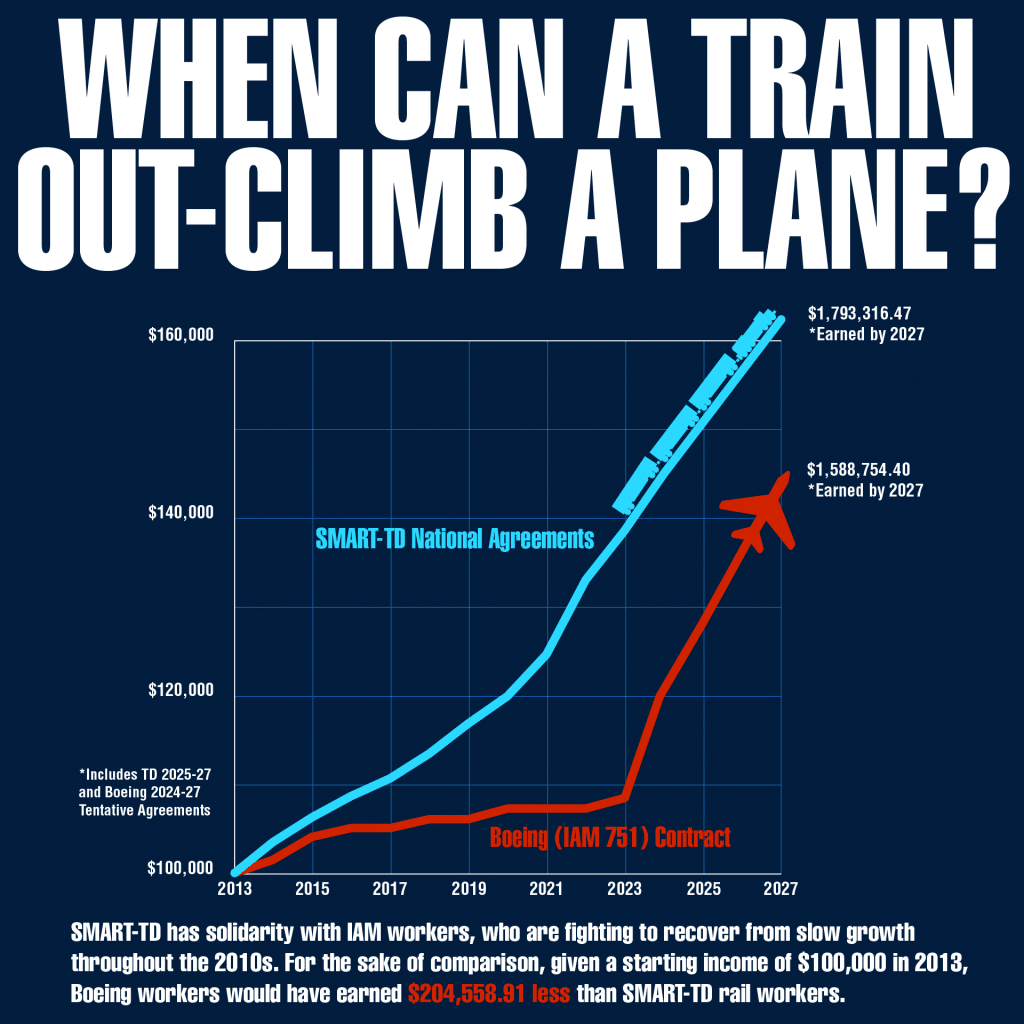
Boeing looks like they are getting a 30% pay increase and we should too!

We can certainly all agree that we should always get the highest general wage increases possible, and that is absolutely what we fight for. Fortunately for us, our situation is not comparable to Boeing employees being represented by the IAM. Going back to at least 2014, those Boeing employees have received sub-standard wage increases that have consistently fallen short of our agreements. If they ratify their proposed wage increases, it will essentially bring them up to speed with where SMART-TD members are today. And that is before we factor in the 17.5% general wage increases that have been proposed to you right now. Further, the Boeing proposal does not include back pay, so those employees will never recoup what they have lost during negotiations, which weakens the dollar value of what they are getting compared to what we have enjoyed during that time. Another major nuance when comparing the two is that Boeing employees lost their pension if they had fewer than 20 years of service, which is valued at approximately $5 per hour. By comparison, our pension fund is secured and doing very well at the RRB.  Just like the John Deere, UPS, and UAW scenarios we have observed over the past few years, Boeing simply does not compare to us. We cannot fixate on the percentages of another union’s general wage increases without considering their agreements as a whole. Doing so would be a disservice to our members and a failure in our duties to obtain the best possible wages, rules, and healthcare improvements. Nonetheless, social media, anti-labor news outlets, and bad-faith actors who want us to fail continue to attempt to mislead our members with half-truths and misleading statistics.

These tentative agreements are simple and straightforward, and provide substantial wage increases without making concessions in other areas, and without making us fight for 2-3 years just to get what we deserve. Like every agreement in every unionized setting, this may not address or resolve every single issue that is important to every single member, but I am proud to say that this agreement provides significant improvements on many of the key issues that our members tell us about. Of course, we could have demanded everything and refused to meet on middle ground, which would have inevitably led to the same old drawn-out battle and years of delays, likely followed by a binding decision made by outsiders who do not completely understand our industry. We saw that play out in PEB 250, and our members have made it abundantly clear that they do not want a repeat of that situation.  We firmly believe that this is a straightforward, no B.S. agreement that delivers another round of damn good wage increases and healthcare improvements, without sacrificing other important areas such as our work rules, crew consist, and benefits.

If you still have questions, I highly encourage you to contact your General Chairperson or this office prior to casting your vote. We are more than willing and able to dispel any rumor or misinformation that is circulating on social media, in the crew room or on anti-union so-called “news” outlets. To find contact information for your General Committee office, the simplest way is to download the SMART Union app on your phone or tablet, or visit our website at www.smart-union.org to register and sign in to the Member Portal. From there, you can find a convenient directory with all the contact information for your elected representatives.

I hope this provides a better understanding of what is on the table — and perhaps most importantly what we don’t have on the table — for you to decide on. When all things are considered, we are confident that a “yes” vote is the right decision for our involved members, and we highly recommend that you do so.

In solidarity,

Jeremy R. Ferguson

WASHINGTON, D.C. — Five railroads recently requested a special waiver to run their trains free from the oversight of the mandated safety technology Positive Train Control (PTC). The Federal Railroad Administration (FRA) denied their request in part due to union objections.

Greg Hynes, SMART-TD’s national legislative director, explains that “our opposition was grounded in a commitment to protect our members and the public from the risks associated with operating trains without PTC.”

Class I carriers BNSF and Norfolk Southern, and passenger carriers South Florida Regional Transportation Authority, Caltrain, and the New Mexico Rail Runner Express requested the waivers. Railroads often request waivers to critical regulation that protect the communities through which they operate, but that can impact their operating expenses. In this case, the expense of keeping critical safety technology in good working order. Deferring that maintenance is one way they can cut costs.

Waivers such as this one is one strategy the railroads employ to undermine the regulations they perceive as burdensome; despite the positive impacts the rules have on public and worker safety. Freight carriers often prioritize production over safety, as they were trying to increase the speed of trains without the vital safety overlay of PTC.

“The FRA’s denial of this waiver request is a victory for rail safety and underscores the importance of adhering to established safety protocols,” Hynes said.

Jared Cassity, SMART-TD’s Alternate Legislative Director, added, “SMART-TD will continue to be a vigilant watchdog in the FRA’s public comment process. We are dedicated to ensuring that safety regulations are not compromised and that our members work in environments where safety is not negotiable.”

SMART-TD, alongside the Brotherhood of Railway Signalmen (BRS), the AFL-CIO’s Transportation Trades Department (TTD), and the Brotherhood of Locomotive Engineers (BLE), opposed the request.

SMART-TD closely monitors the FRA’s public comment process as part of the union’s unwavering commitment to rail safety. Our members are the most at risk, which is why we continuously advocate for regulations that prioritize the well-being of rail workers, the safety of rail operations, and the communities in which we operate.

The railroads’ waiver was under review through FRA Docket Numbers FRA-2010-0039, FRA-2010-0045, FRA-2010-0051, FRA-2010-0056, and FRA-2010-0060.

SMART-TD is the Transportation Division of the Sheet Metal, Air, Rail and Transportation Workers union. The union is the largest rail union in the United States and represents several operating crafts.

FRA’s denial letter to railroads

SMART-TD comment

The SMART Transportation Division began a new era in rail safety and worker protection by working with Norfolk Southern to accept and act on anonymous safety reports.

How It Works

The one-year pilot program, called the Confidential Close Call Reporting System (C3RS), is similar to one that airline personnel use to hold their airlines accountable. Rail workers will share safety concerns through a secure website. NASA, acting as an independent party, will organize, anonymize and share the reports with the Federal Railroad Administration (FRA). Under FRA guidance, improvements will be made by a joint committee including SMART-TD and other rail labor representatives, as well as Norfolk Southern management.

A Long Time Coming

C3RS first came to the rail industry in 2007, when SMART-TD predecessor United Transportation Union (UTU) and Union Pacific (UP) participated in an early version, running until 2013. They piloted the system in Bailey Yard, North Platte, Nebraska, the largest rail yard in the world. The program was highly successful: It increased safety and reduced critical incidents and rule violations. The program also greatly decreased employee discipline. Other Class III and passenger rail carriers began to benefit from the system around the same time.

The program requires voluntary agreement among the rail carrier, labor and the federal government. Despite its success, UP refused to renew the program, effectively killing it. SMART-TD has engaged in an ongoing effort to reintroduce the program at all Class I carriers.

We Have Only Begun to Fight

After our 17-year effort, Norfolk Southern (NS) decided to take the lead on rail safety, and this C3RS agreement shows that CEO Alan Shaw is serious in his commitment to making NS the safest railroad by partnering with rail labor. SMART-TD President Jeremy Ferguson and General Chairpersons Tommy Gholson, James Ball, David Phillips, Dan Weir and Joe Borders began making real progress with NS executives in 2023, resulting in a signed agreement on February 15, 2024.

“For years we’ve watched the successes of the several shortlines that have practiced under C3RS, and because of that, for years, we’ve long been advocates,” said Gholson, who was instrumental in negotiating the pilot program.

Gholson also praised the efforts of the four other general chairpersons for their roles in constructing the C3RS framework. Alternate National Legislative Director Jared Cassity provided leadership by being a facilitator in the process and coordinating with the FRA.

SMART-TD: Out in Front

In a speech soon after the agreement’s signing, Ferguson said: “Rail labor has been out in front since the beginning. We have always advocated for the right to have a protected avenue to report safety concerns and injuries without fear of harassment, intimidation or retribution.

“For far too long, this nation’s rail carriers have been complacent with their approach to safety. Obviously, this is something that can’t be reversed overnight, but we are hopeful that the corrective process can begin with a program like C3RS.

“There is no higher priority for SMART-TD or the workers we represent than safety, not just for their own welfare but also for the communities in which they operate.”

“This is a good day for the men and women on the ballast line of Norfolk Southern! The attempt by the hedge fund known as Ancora to take over one of this country’s largest railroads could have been catastrophic to our nation’s economy and to the quality of life for thousands of SMART-TD members.

Surface Transportation Board Chairman Martin Oberman and Department of Transportation Secretary Pete Buttigieg supported NS’s management team because they recognized the threat the Ancora plan posed to rail workers’ safety and quality of life. These leaders’ support for current leadership’s course was not just an endorsement of the recent changes at NS. It was also a rebuke of the destructiveness of Precision Scheduled Railroading.

With two notable exceptions, rail labor leaders saw this scenario for what it was. The majority of us remained in support of the new course set by Alan Shaw and his board. Those others allowed themselves to be taken in by an empty promise.  Thankfully, today all railroaders can be assured that the progress they have witnessed in their quality of life, and the security they and their families count on from their paychecks are no longer at dire risk. Wall Street’s attempt to go back to the Hunter Harrison playbook has failed.

As the president of the largest union on Norfolk Southern’s properties and the largest in the U.S. rail industry, I look forward to continuing SMART-TD’s work with Alan and his team to improve the lives of our rail workforce and to continue to blaze a trail for all Class I railroads to follow.”

Jeremy Ferguson, President, SMART-TD

INDEPENDENCE, Ohio (May 9, 2024) — SMART Transportation Division President Jeremy Ferguson issued the following statement on the results of the Norfolk Southern proxy vote:

“This morning, a rare thing happened with the NS vote. Corporate raiders failed to take the reins of an essential player in the rail industry and veer this nation’s economy back into the bad old days of Precision Scheduled Railroading.

“Ancora’s attempt to railroad the railroad and ‘tear Norfolk Southern down to the studs’ has officially failed. A balanced approach, with particular emphasis on rail safety, will continue there.

“SMART-TD looks forward to continuing the progress we have made with CEO Alan Shaw and his team. They have been establishing a resilient approach to railroading and an improved workplace culture. NS has decided to place the safety of our members and the communities they run through at the forefront, and we are excited to see that this will continue!”

David Philips, SMART-TD General Chairperson for General Committee 680 stated:

“Committee 680 is pleased to hear the outcome of today’s NS proxy vote and plans to continue the progress we have made for our members. Now that the leadership at NS is stable, it strengthens our future negotiations and paves the way to good outcomes for our members.”

###

If you’re interested in speaking more about Norfolk Southern and the impact of today’s shareholder vote, we’d be happy to connect you with:

SMART Transportation Division President Jeremy Ferguson

President Jeremy Ferguson, a member of Local 313 in Grand Rapids, Mich., was elected president of SMART’s Transportation Division in 2019.

President Ferguson, an Army veteran, started railroading in 1994 as a conductor on CSX at Grand Rapids, Mich., and was promoted to engineer in 1995. Ferguson headed the recent national rail negotiations for the Union with the nation’s rail carriers.

SMART Transportation Division Alternate Vice President Thomas Gholson

Thomas “Tommy” Gholson, of Local 573 in Danville, Ky., has worked for Norfolk Southern since 1998, first as a brakeman, then as a conductor and as an engineer.

Gholson has served as general chairperson for GO 898 since 2018 and became a SMART-TD alternate vice president in October 2019. He also serves as vice chairperson of the Association of General Chairpersons, District 1.

In conjunction with multiple union officers, Brother Gholson assisted in the negotiation of the national railroad contract talks that opened in 2019. He also served on the Work-Rest Subcommittee and was a driving force behind the work that led to NS joining the Confidential Close Call Reporting System (C3RS).

SMART Transportation Division began a new era in rail safety and worker protection by working with Norfolk Southern to accept and act on anonymous safety reports.

How it Works

The one-year pilot program, called the Close Call Reporting System (C3RS), is similar to one airline personnel use to hold their airlines accountable. Rail workers will share safety concerns through a secure website. NASA, acting as an independent party, will organize, anonymize and share the reports with the FRA. Under FRA guidance, improvements will be made by a joint committee including SMART-TD representatives, other rail labor and Norfolk Southern management.

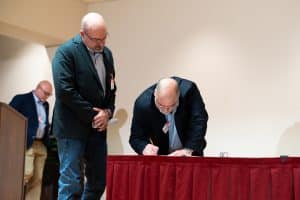
As SMART Transportation Division President Jeremy R. Ferguson observes at left, General Chairperson Thomas Gholson signs the memorandum of understanding establishing the C3RS pilot program with Norfolk Southern.

A Long Time Coming

C3RS first came to the rail industry in 2007 when SMART-TD predecessor UTU and Union Pacific participated in an early version, running until 2013. They piloted the system in Bailey Yard, North Platte, Nebraska, the largest rail yard in the world. The program was highly successful; it increased safety, reduced critical incidents and rule violations. The program also greatly reduced employee discipline. Other Class III and passenger rail carriers began to benefit from the system around the same time.

The program requires voluntary agreement among the rail carrier, labor and the federal government. Despite the program’s success, UP refused to renew the program, effectively killing it. SMART-TD has engaged in an ongoing effort to reintroduce the program at all Class I carriers.

We Have Only Begun to Fight

After our 17-year effort, Norfolk Southern has decided to take the lead on rail safety and this C3RS agreement shows that CEO Alan Shaw is serious in his commitment to making NS the safest railroad by partnering with rail labor. SMART-TD President Ferguson, and General Chairpersons Tommy Gholson, James Ball, David Phillips, Dan Weir and Joe Borders began making real progress with NS executives in 2023, resulting in a signed agreement on February 15, 2024.

“For years we’ve watched the successes of the several short lines that have practiced under C3RS and because of that, for years, we’ve long been advocates,” said Gholson, who was instrumental in negotiating the pilot program.

Gholson also praised the efforts of the four other general chairpersons for their roles in constructing the C3RS framework. Alt. National Legislative Director Jared Cassity provided leadership by being a facilitator in the process and coordinating with the FRA.

SMART-TD: Out in Front

In a speech soon after the agreement’s signing, SMART-TD President Jeremy Ferguson said: “Rail labor has been out in front since the beginning. We have always advocated for the right to have a protected avenue to report safety concerns and injuries without fear of harassment, intimidation, or retribution.

“For far too long, this nation’s rail carriers have been complacent with their approach to safety. Obviously, this is something that can’t be reversed overnight, but we are hopeful that the corrective process can begin with a program like C3RS.

“There is no higher priority for SMART TD or the workers we represent than safety, not just for their own welfare but also for the communities in which they operate.”